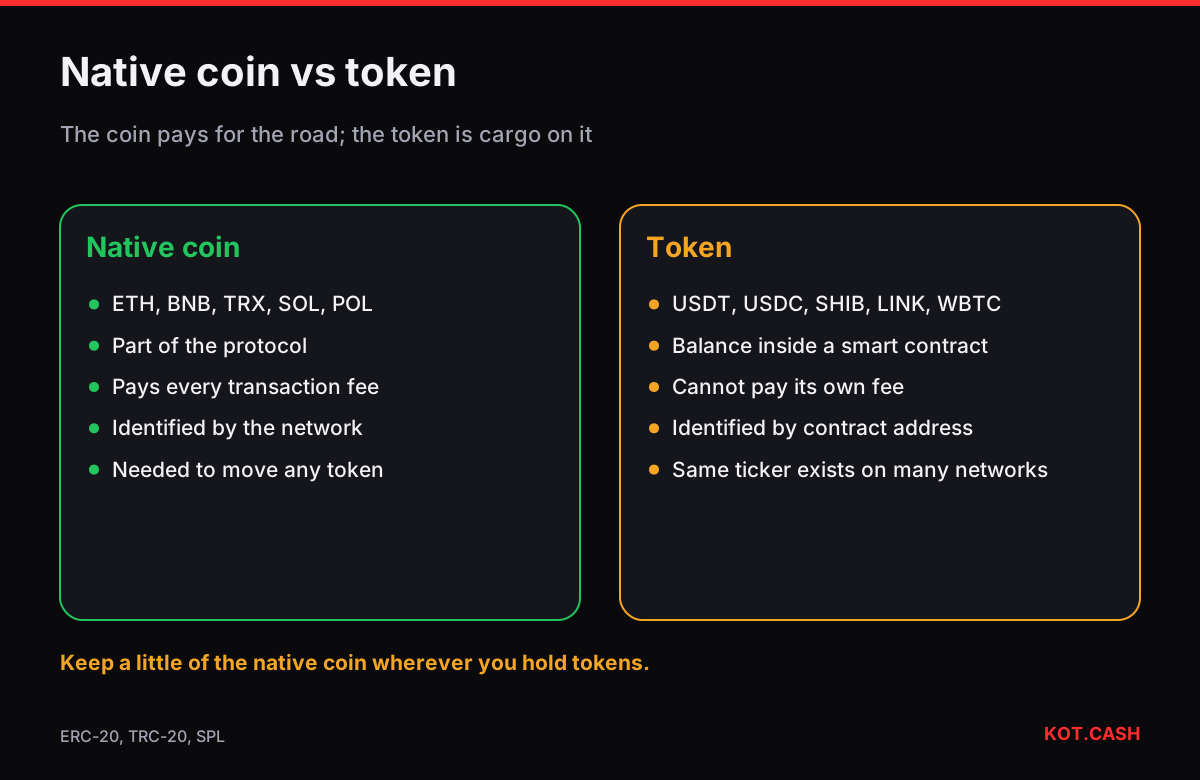
A native coin is the built-in currency of a blockchain — ETH on Ethereum, BNB on BNB Smart Chain, TRX on TRON, SOL on Solana — and it is what pays the network’s fees. A token is a balance recorded inside a smart contract running on that blockchain — USDT, USDC, SHIB, LINK. The practical consequence: to move a token you need some of the network’s native coin for the fee. A wallet full of USDT on Ethereum but with zero ETH cannot send anything.
How they differ under the hood
Native coins are part of the protocol: the balance of an address is kept by the blockchain itself, and a transfer is the most basic transaction type. Tokens are programs: an ERC-20, BEP-20, TRC-20 or SPL token contract keeps a table of “address → amount” and exposes functions such as transfer. When you “send USDT”, your wallet actually sends a transaction to the USDT contract asking it to update that table. The transaction itself, like any transaction, pays a fee in the native coin.
| Native coin | Token | |
|---|---|---|
| Examples | ETH, BNB, TRX, SOL, POL | USDT, USDC, SHIB, LINK, WBTC |
| Where the balance lives | In the blockchain state of your address | In the token contract’s table |
| Pays fees | Yes | No — needs the native coin |
| Identified by | The network itself | Its contract address |
| Explorer shows | Normal transfers | “Token transfers” tab |
Same ticker, different tokens
A ticker is just a label. USDT exists on many networks as separate tokens issued by Tether: on Ethereum its contract is 0xdAC17F958D2ee523a2206206994597C13D831ec7, on TRON it is TR7NHqjeKQxGTCi8q8ZY4pL8otSzgjLj6t. Our liquidity provider lists USDT on 17 networks, from TRON and Ethereum to Solana, Arbitrum and TON. They are not interchangeable: sending USDT on BNB Smart Chain to a deposit that expects USDT on Ethereum does not arrive where it is expected, even though the 0x addresses look the same. See sent crypto to the wrong network.
Anyone can also create a token called “USDT”. Fake tokens with the right name and logo are used in address poisoning and fake airdrops. The only reliable identifier is the contract address, which you can compare with the issuer’s official list.
Decimals and raw amounts
Token contracts store whole numbers and define how many decimals to display. USDT and USDC use 6 decimals on most networks, so a raw value of 1500000 is 1.5 USDT; most other ERC-20 tokens use 18, like ETH itself (1 ETH = 10¹⁸ wei). When an explorer or a transaction decoder shows a raw amount, the token decimals converter turns it into a readable number.
Keeping gas for your tokens
- Ethereum: keep a little ETH; a token transfer uses roughly 45,000–65,000 gas. The gas fee calculator converts that into ETH and dollars.
- TRON: a USDT transfer consumes energy; without staked energy the network burns TRX — the USDT TRC20 fee calculator estimates how much.
- BNB Smart Chain: keep some BNB; fees are low but not zero.
- Solana: keep a little SOL for fees and for creating token accounts the first time you receive a new token.
Wrapped and bridged tokens
Some tokens represent another network’s native coin: WBTC on Ethereum is a token backed by bitcoin, WETH is ETH wrapped into an ERC-20 for use in DeFi, “BTCB” on BNB Smart Chain is a bridged bitcoin. They behave like tokens — contract, gas in the native coin — and carry the extra risk of the custodian or bridge that backs them. A swap from WBTC to native BTC is a real conversion between networks, not a relabelling.
Common mix-ups
- Sending tokens to the token’s contract address instead of a person’s address — they are usually stuck. See sent tokens to a contract address.
- Expecting a token to appear automatically in a wallet; sometimes you need to add the contract address to see it.
- Selling a fake token that shares a ticker with a real one.
- Withdrawing all the native coin and leaving tokens that can no longer be moved.
FAQ
Why do I need ETH to send USDT?
USDT on Ethereum is a token. Moving it is a transaction, and transactions on Ethereum pay fees only in ETH.
Is BNB a coin or a token?
On BNB Smart Chain BNB is the native coin that pays fees. Tokens on that chain are BEP-20.
How do I know a token is the real one?
Compare its contract address with the issuer’s official list or a trusted explorer label. The name and logo prove nothing.
Are USDT on TRON and USDT on Ethereum the same?
Both are issued by Tether and worth the same, but they are separate tokens on separate networks and are not interchangeable without a swap or bridge.
What are token decimals?
The number of decimal places the contract uses. USDT has 6, most ERC-20 tokens 18. Raw on-chain values must be divided by 10 to that power.