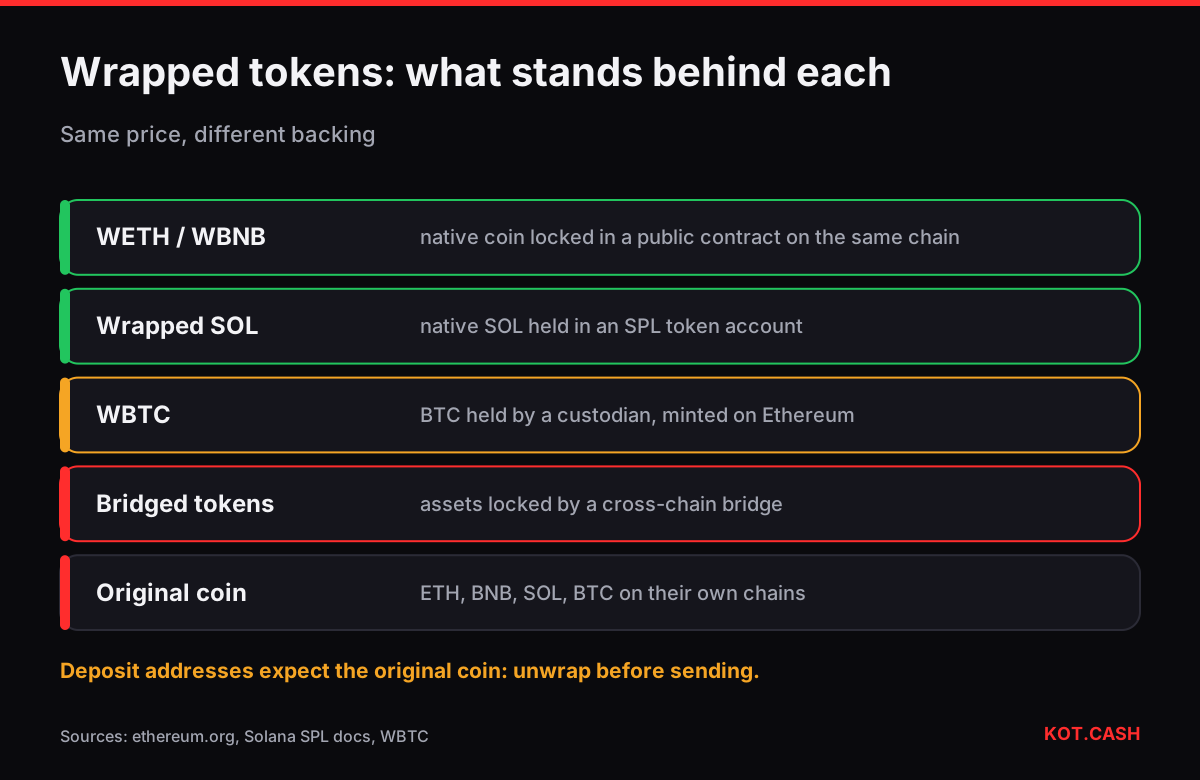
A wrapped token is a token that stands for another asset one to one and follows a token standard such as ERC-20 or SPL. WETH is ETH wrapped as an ERC-20 token; WBNB is the same for BNB; wrapped SOL is native SOL held in a token account; WBTC is a token on Ethereum backed by bitcoin held by a custodian. The point is compatibility: smart contracts that expect a standard token can work with them. The catch is that a wrapped token is not the original coin, and the way it is backed decides its risk.
Two kinds of wrapping
| Token | Represents | Backed by | Risk |
|---|---|---|---|
| WETH | ETH on Ethereum | ETH locked in a public contract | contract risk only |
| WBNB | BNB on BNB Smart Chain | BNB locked in a contract | contract risk only |
| Wrapped SOL | SOL as an SPL token | native SOL in a token account | minimal; unwrap by closing the account |
| WBTC | BTC on Ethereum | BTC held by a custodian | custodian and its processes |
| Bridged tokens | an asset from another chain | assets locked in a bridge | bridge security |
The first group is same-chain wrapping. You send ETH to the WETH contract and it mints the same amount of WETH; you can redeem at any time by calling withdraw, and the contract holds exactly the ETH needed. There is no company in the middle. The second group crosses chains. Bitcoin cannot be held by an Ethereum contract, so WBTC relies on a custodian holding BTC and minting tokens against it, with merchants who handle minting and redemption. Bridged tokens rely on a bridge contract or validator set, covered in what a cross-chain bridge is.
Why wrapped tokens exist
- Uniform interface. Native ETH predates the ERC-20 standard and does not have the same functions. DEXs and lending protocols handle WETH like any other token.
- Bitcoin in DeFi. WBTC and similar tokens let BTC holders use Ethereum applications without selling.
- Accounting on Solana. SPL token programs treat wrapped SOL like other tokens, which simplifies swaps.
Wrapping in a wallet, step by step
- In a wallet or DEX interface, choose wrap and enter the amount of ETH (or BNB).
- Confirm the transaction; it costs gas like any contract call, roughly 45,000 gas for WETH.
- WETH appears as a token. Add the token contract to the wallet if it does not show automatically, using the address from an official source.
- To unwrap, choose unwrap or withdraw; the contract burns WETH and returns ETH to you.
Common mistakes
The wrapped token and the original share a price but are not interchangeable at a deposit address. Sending WETH to an address that expects native ETH, for example an exchange or a swap deposit set up for ETH, means the funds arrive as a token the receiver may not credit. On KOT.CASH, an ETH deposit expects native ETH: unwrap WETH in your wallet first. The same applies to WBNB on BNB Smart Chain; the BNB to BTC guide notes this for BNB.
WBTC is listed by the liquidity provider as a separate asset on Ethereum and Mantle, not as bitcoin. A WBTC to BTC swap is a real exchange between two assets, not an unwrapping. Treat token decimals carefully too: WBTC has 8 decimals like bitcoin, WETH has 18; the token decimals converter turns raw on-chain amounts into readable ones.
Risk in one sentence each
- WETH, WBNB: as safe as a simple, widely audited contract that has run for years.
- WBTC and other custodial wrappers: depend on the custodian keeping the backing in full and processing redemptions; check who holds the keys and how they publish proof of reserves.
- Bridged versions: depend on the bridge. Several of the largest crypto hacks were bridge failures, after which the bridged tokens lost their backing.
Tax note
Some tax authorities treat wrapping as a disposal because you receive a different asset. The Australian ATO is one; others treat same-chain wrapping as neutral. If you wrap often, check the rule in your country; the swap taxation comparison has a section on it.
FAQ
What is WETH?
ETH wrapped as an ERC-20 token by a public contract, redeemable 1:1 for ETH at any time.
Is WBTC the same as Bitcoin?
No. It is an Ethereum token backed by BTC held by a custodian. Its value tracks BTC but it depends on that custodian.
Can I send WETH to an ETH deposit address?
Not safely. A deposit that expects native ETH may not credit WETH. Unwrap first.
Does wrapping cost a fee?
Only network gas for the contract call. The wrap ratio is 1:1.
How do I unwrap wrapped SOL?
Close the wrapped SOL token account in your wallet; the SOL returns to your main balance.