A cross-chain bridge is a system that lets value move from one blockchain to another. Blockchains cannot read each other's state directly, so a bridge needs a way to prove on chain B that something happened on chain A, and then release or create the matching asset. Bridges do this in three main ways: lock the asset on the source chain and mint a representation on the destination, burn a native token on one chain and mint it on another, or pay you out from a pool of assets already on the destination. Each design puts the risk in a different place.
Three designs compared
| Design | What happens | Example | Where the risk sits |
|---|---|---|---|
| Lock and mint | asset locked on chain A, wrapped token minted on chain B | many early token bridges | the vault holding locked assets |
| Burn and mint | issuer burns on A and mints natively on B | Circle CCTP for USDC | the issuer's attestation service |
| Liquidity network | you deposit on A, a pool pays you on B | fast bridges, swap services | pool solvency and the relayer |
| Canonical rollup bridge | deposits and withdrawals through the L2's own contracts | Arbitrum, Optimism, Base | rollup contracts; 7-day exit on optimistic rollups |
Lock and mint, step by step
- You send ETH to the bridge contract on Ethereum; it locks the coins.
- The bridge's validators, oracle or light client observe the deposit and agree it happened.
- A contract on the destination chain mints the same amount of a wrapped token to your address.
- Going back, you burn the wrapped token; the bridge confirms the burn and unlocks ETH on Ethereum.
The wrapped token is only as good as the locked collateral. If an attacker drains the vault or forges a message to mint without a deposit, the wrapped tokens on the other side lose their backing. That is the pattern behind the largest bridge losses: the Ronin bridge (around $600 million in 2022, compromised validator keys), Wormhole (around $320 million in 2022, a signature verification bug) and Nomad (around $190 million in 2022, a faulty upgrade that let anyone forge messages).
Burn and mint: native on every chain
When the token issuer runs the bridge, it can burn tokens on the source chain and mint the native version on the destination. Circle's Cross-Chain Transfer Protocol does this for USDC: the result is native USDC, not a wrapped copy. That avoids a pool of locked collateral, but you rely on the issuer's attestation. It is also why native USDC and older bridged USDC.e are different tokens on some chains; see native USDC vs bridged USDC.e.
Rollup bridges and withdrawal delays
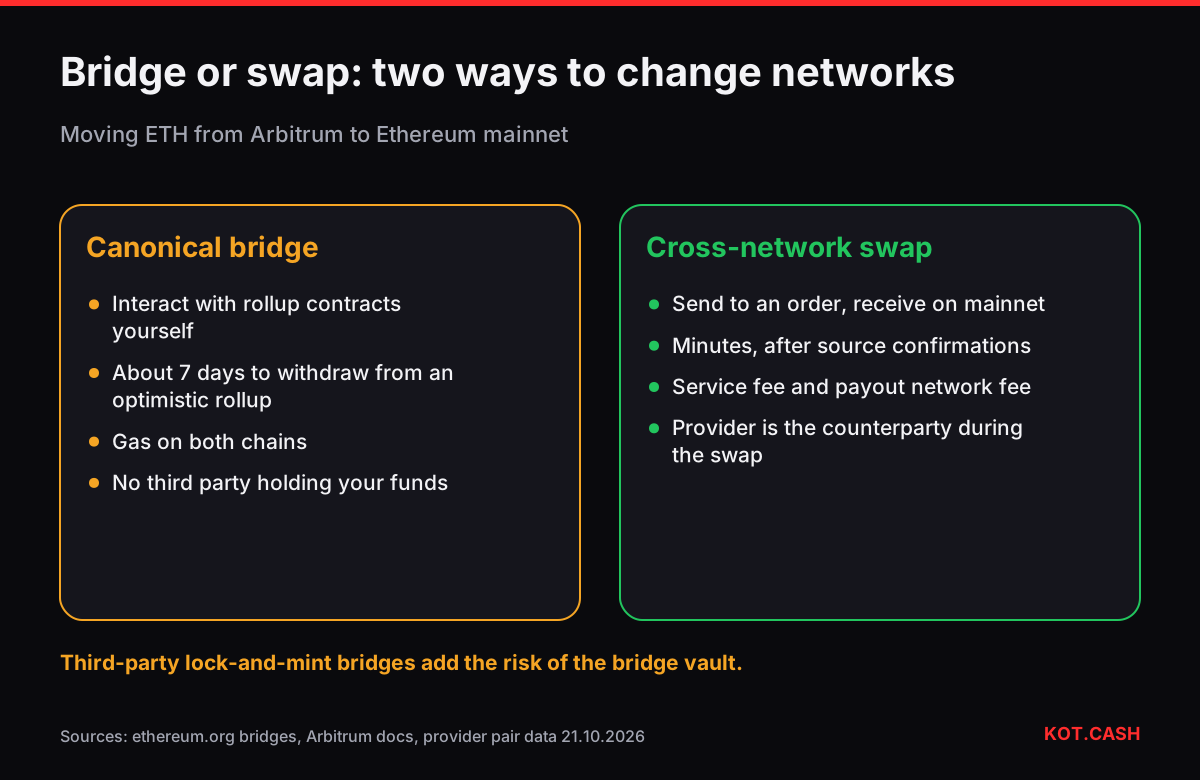
Layer-2 rollups have a canonical bridge in their own contracts on Ethereum. Deposits to the L2 take minutes. Withdrawals from optimistic rollups such as Arbitrum, Optimism and Base wait for a challenge period of about seven days before funds can be claimed on Ethereum, because the system allows time to prove fraud. Zero-knowledge rollups finalise withdrawals once a validity proof is accepted, usually within hours. More in what a layer-2 rollup is.
A swap as an alternative to a bridge
If the goal is simply to have the coin on another network, an exchange can do the same job without you touching a bridge contract. You send ETH on Arbitrum to a swap order and receive ETH on Ethereum mainnet, or send USDC on Polygon and receive USDC on Ethereum. The provider settles from its own liquidity on both chains. You avoid the seven-day exit and wrapped-token risk; you accept the service fee and the provider's counterparty risk for the minutes the swap takes. On KOT.CASH the minimum for ETH from Arbitrum to Ethereum was about 0.011 ETH at the time of writing; the Arbitrum to Ethereum guide covers it step by step.
Before you bridge
- Use the bridge's official domain; fake bridge front-ends are a common phishing lure.
- Check which token you will receive on the destination: native, canonical-bridged or third-party wrapped.
- Make sure you hold the destination chain's gas coin, or you cannot move the bridged tokens.
- Compare total cost: source gas, bridge fee, destination gas. The network fee comparison helps with gas.
- Send a small test amount first for a new route.
FAQ
What does a crypto bridge do?
It moves value between blockchains by locking or burning an asset on one chain and minting or releasing a matching asset on another.
Are bridges safe?
Risk varies by design. Several of the largest crypto hacks hit bridges, where a vault of locked assets is an attractive target.
Why does withdrawing from Arbitrum take seven days?
Optimistic rollups wait for a challenge period before withdrawals via the canonical bridge can be claimed on Ethereum.
Is a swap an alternative to a bridge?
Yes. A swap service can take the coin on one network and pay it out on another from its own liquidity, for a fee.
What is CCTP?
Circle's Cross-Chain Transfer Protocol, which burns USDC on one chain and mints native USDC on another.