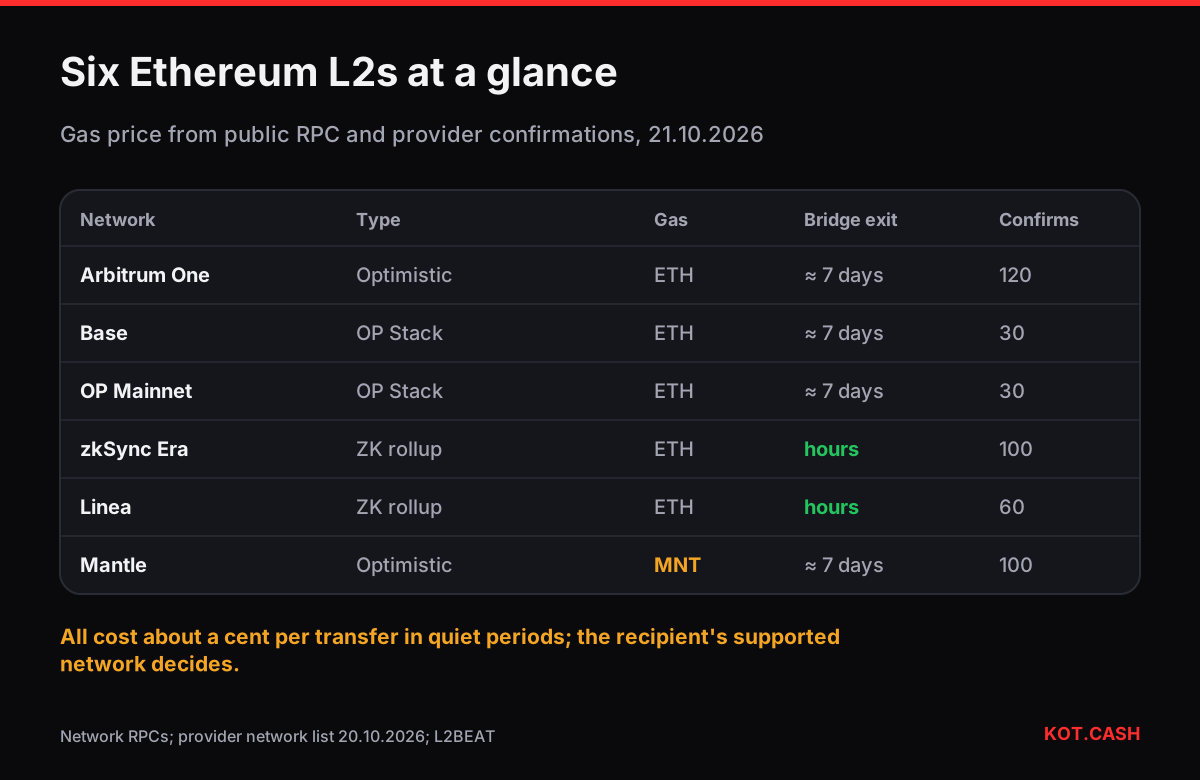
All major Ethereum layer 2 networks make a transfer cost cents instead of dollars, so fee level alone rarely decides which one to use. What differs is what pays gas (ETH on most, MNT on Mantle), how long an exit to Ethereum takes through the official bridge (about a week for optimistic rollups, hours for zk rollups), and whether the service you deal with supports that exact network. The table below puts six networks side by side with data we could verify on 21 October 2026: gas price from each network's public RPC and deposit confirmation counts from the liquidity provider used by KOT.CASH.
The comparison
| Network | Type | Gas token | Gas price (RPC) | Bridge exit | Provider confirmations |
|---|---|---|---|---|---|
| Arbitrum One | Optimistic rollup | ETH | 0.02 gwei | ≈ 7 days | 120 |
| Base | Optimistic (OP Stack) | ETH | 0.006 gwei | ≈ 7 days | 30 |
| OP Mainnet | Optimistic (OP Stack) | ETH | 0.001 gwei | ≈ 7 days | 30 |
| zkSync Era | ZK rollup | ETH | varies | hours | 100 |
| Linea | ZK rollup | ETH | varies | hours | 60 |
| Mantle | Optimistic, modular DA | MNT | varies | ≈ 7 days | 100 |
Gas price alone is not the fee: every rollup also charges for publishing data to Ethereum, and that part is often larger than execution for small transfers. In practice all six cost roughly one cent or less for an ETH transfer in quiet periods and a few cents for token transfers.
Optimistic vs ZK: what the type means for you
Optimistic rollups (Arbitrum, Base, OP Mainnet, Mantle) post transaction data to Ethereum and assume it is valid unless someone proves otherwise during a challenge window. That window is why withdrawals through the official bridge take about a week. ZK rollups (zkSync Era, Linea) post a validity proof with each batch; once the proof is verified on Ethereum, withdrawals can be finalised, typically within hours. For a user moving funds between an L2 and an exchange, neither matters much: exchanges, liquidity bridges and cross-network swaps pay out in minutes from their own balances.
Choosing a network for a specific job
- Receiving USDC from an exchange cheaply: Base or Arbitrum — both have native USDC issued by Circle and wide exchange support.
- DeFi with deep liquidity: Arbitrum and Base have the largest ecosystems by activity; check the specific protocol you need.
- Paying someone: the network the recipient supports, nothing else. An L2 transfer to an address on an unsupported network is the most common loss case.
- Leaving to Ethereum mainnet: compare a cross-network swap or an exchange route with the bridge's week plus two mainnet transactions.
- Mantle specifically: you need MNT for gas, not ETH. Keep both if you hold ETH or USDT there.
Security is not identical
Rollups differ in how decentralised their sequencers are, whether fault or validity proofs are fully live, and who can upgrade their contracts. Independent trackers such as L2BEAT classify rollups into stages from 0 to 2 based on these properties and update them as networks change. For everyday transfers of moderate amounts this is background information; for large balances held long term it is worth reading.
Addresses and the wrong-network trap
All six networks use the same 0x address as Ethereum for the same key. That makes it easy to receive on any of them — and easy to send to the right address on the wrong network. Funds sent to your own address on an L2 your wallet does not show are not lost: add the network to the wallet (MetaMask, Rabby and others support custom networks) and they appear. Funds sent to an exchange or swap deposit address on an unsupported network depend on that service's ability to recover them. The wrong network guide covers the recovery steps.
L2s on KOT.CASH
The liquidity provider accepts ETH on Arbitrum, Base, OP Mainnet, zkSync Era, Linea and Mantle, and USDT or USDC on several of them. You can, for example, send ETH on Arbitrum and receive ETH on Ethereum mainnet without waiting a week; the minimum for that route is about 0.011 ETH. Confirmation counts differ by network, as shown in the table, because block times differ: Arbitrum's 120 blocks take about half a minute, Base's 30 blocks about a minute. All counts are listed in the deposit confirmations tool.
FAQ
Which Ethereum L2 is cheapest?
On 21.10.2026 OP Mainnet, Base and Arbitrum all charged fractions of a gwei for execution. With the L1 data part, simple transfers cost around a cent or less on each.
Why do withdrawals from Arbitrum, Base and OP take a week?
They are optimistic rollups with a challenge window of about seven days on the official bridge.
Are zk rollups faster to withdraw from?
Through the official bridge, yes — typically hours, once the batch proof is verified on Ethereum.
Do all L2s use ETH for gas?
Most do. Mantle uses MNT.
Is my address the same on every L2?
Yes, for the same key. The network you choose decides where funds go.