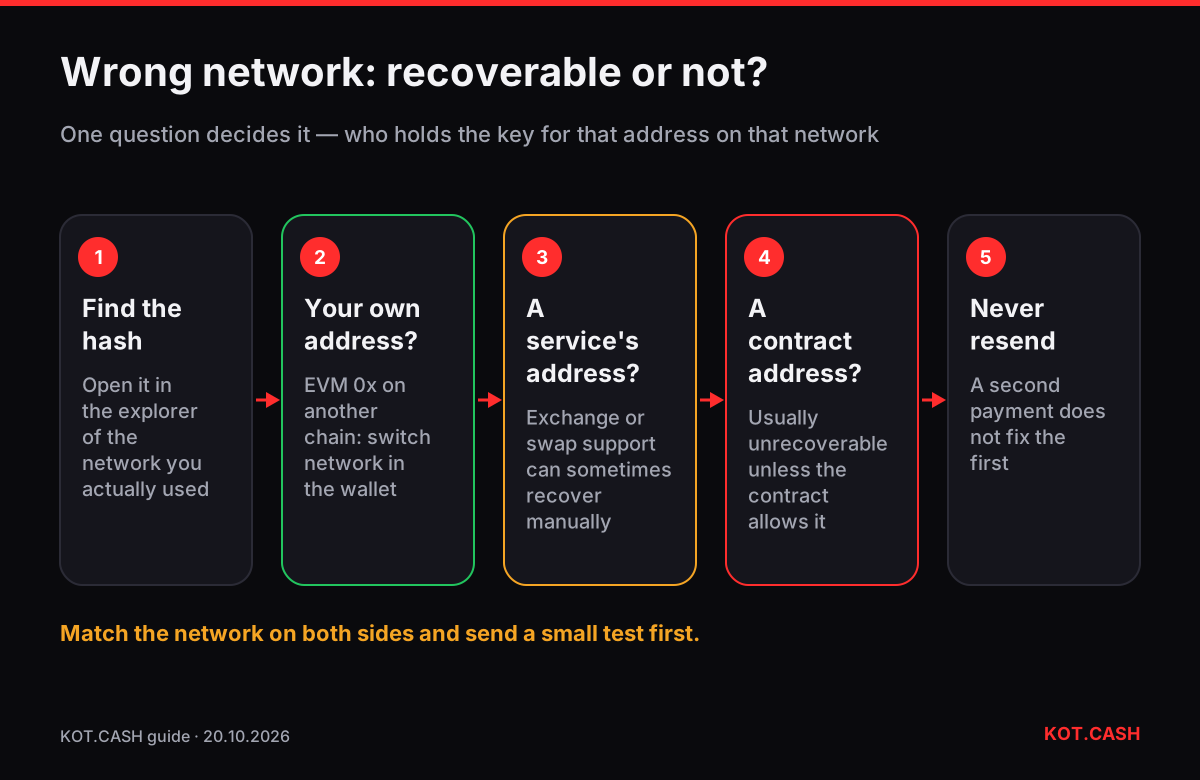
Whether crypto sent on the wrong network can be recovered depends on one question: does someone control the private key for the receiving address on the network where the funds landed? If the receiving address is yours, or belongs to a service that supports that network, recovery is usually possible. If it is a contract or an address nobody controls on that network, it usually is not. Start by finding out exactly what happened — the transaction hash tells you.
First: find the transaction
- Copy the transaction hash (TxID) from your wallet's history or the exchange's withdrawal page.
- Open it in the explorer of the network you actually sent on: Tronscan for TRON, BscScan for BNB Smart Chain, Etherscan for Ethereum, Solscan for Solana, the network's own explorer for L2s.
- Note the network, token, amount, sending and receiving address and the status. A transaction that is not on the explorer of the network you think you used was sent somewhere else.
- Do not send anything else to the same address until you know what happened.
The guide on checking a transaction hash shows how to read an explorer page if you have not done it before.
The usual cases and what they mean
| What happened | Recoverable? | Who can do it |
|---|---|---|
| USDT sent on BNB Smart Chain to your own 0x wallet that you meant to use on Ethereum | Yes — same key, same address on both | You: switch the wallet to BSC, add the token, it is there |
| ETH sent on Arbitrum or Base to your own address | Yes | You: switch the wallet to that L2; bridge back if needed |
| USDT sent on BEP20 to an exchange deposit address that only supports TRC20 | Often, not guaranteed | The exchange, if it controls the 0x key; usually a manual recovery with a fee |
| Tokens sent to a token contract address | Rarely | Only if the contract has a recovery function, which most do not |
| Coins sent to a swap order on the wrong network | Sometimes | Support of the swap service, with the hash |
| Deposit sent without a required memo or tag | Usually | The receiving service, manually — see the memo guide |
Why the same address can exist on two networks
Ethereum, BNB Smart Chain, Polygon, Arbitrum, Base, Avalanche C-Chain and other EVM networks all use 0x addresses derived the same way. If you control a private key, you control that 0x address on every EVM chain. That is why sending USDT on BEP20 to your own MetaMask address, when you meant ERC20, is not a loss: switch MetaMask to BNB Smart Chain and the USDT is there. The flip side is that a 0x address of a service that only watches Ethereum may not notice a BSC deposit at all — the funds are on-chain, but the service has to recover them manually.
TRON (T…), Bitcoin (bc1…, 1…, 3…), Solana (base58) and others use different address formats. Most wallets refuse to send to an address of the wrong format, which prevents the worst mistakes; the address validator checks a format before you paste it.
What an exchange recovery usually looks like
If the funds landed on an exchange's address on a network it does not support for that coin, recovery depends on whether the exchange controls the private key for that address on that network. For EVM chains it usually does, because the same key covers Ethereum, BNB Smart Chain, Polygon and others; for unrelated chains it may not. Exchanges typically ask for a support ticket with the hash, the coin, the network, the amount and your account ID, and some charge a recovery fee or set a minimum amount below which they do not recover.
Expect days to weeks rather than minutes, and keep the conversation in one ticket. Do not engage with people who message you offering to "recover" funds for a fee — that is a common scam targeting exactly this situation. Real support never asks for your seed phrase.
If it happened with a KOT.CASH order
- Open the order page and check its status and the deposit network shown there.
- Find the transaction hash of what you actually sent.
- Contact support through the site chat, Telegram or e-mail with the order link, the hash, the network and the amount.
- Do not create a second order for the same funds and do not send again to the same deposit address.
Whether a wrong-network deposit can be recovered depends on the liquidity provider and on the network; support will tell you what is possible for the specific case. It is never promised in advance.
How to avoid it next time
- Choose the network on the sending side to match exactly what the receiving side lists — TRC20, ERC20, BEP20 and SOL are four different networks for USDT.
- When withdrawing from an exchange, read the network dropdown, not just the coin name.
- Send a small test amount to any new destination first.
- Use the memo and tag checker when a coin might need a tag.
- Keep the gas coin of each network you use (TRX, BNB, ETH, SOL) so you can move funds if they land somewhere unexpected.
FAQ
I sent USDT BEP20 instead of ERC20 to my own wallet. Is it lost?
No. The same 0x address exists on BNB Smart Chain. Switch your wallet to BSC and add the USDT token to see it.
I sent USDT TRC20 to an Ethereum address. What now?
Most wallets block this because the formats differ. If it went through somehow, check the hash on Tronscan and contact the receiving service.
Can a blockchain transaction be reversed?
No. Recovery means the owner of the receiving key sends the funds back, which only works if someone controls it.
Will KOT.CASH refund a wrong-network deposit?
Contact support with the order link and hash. What is possible depends on the network and the liquidity provider; it is not guaranteed.
How do I prevent this?
Match the network on both sides, send a test amount first and check addresses with a validator.