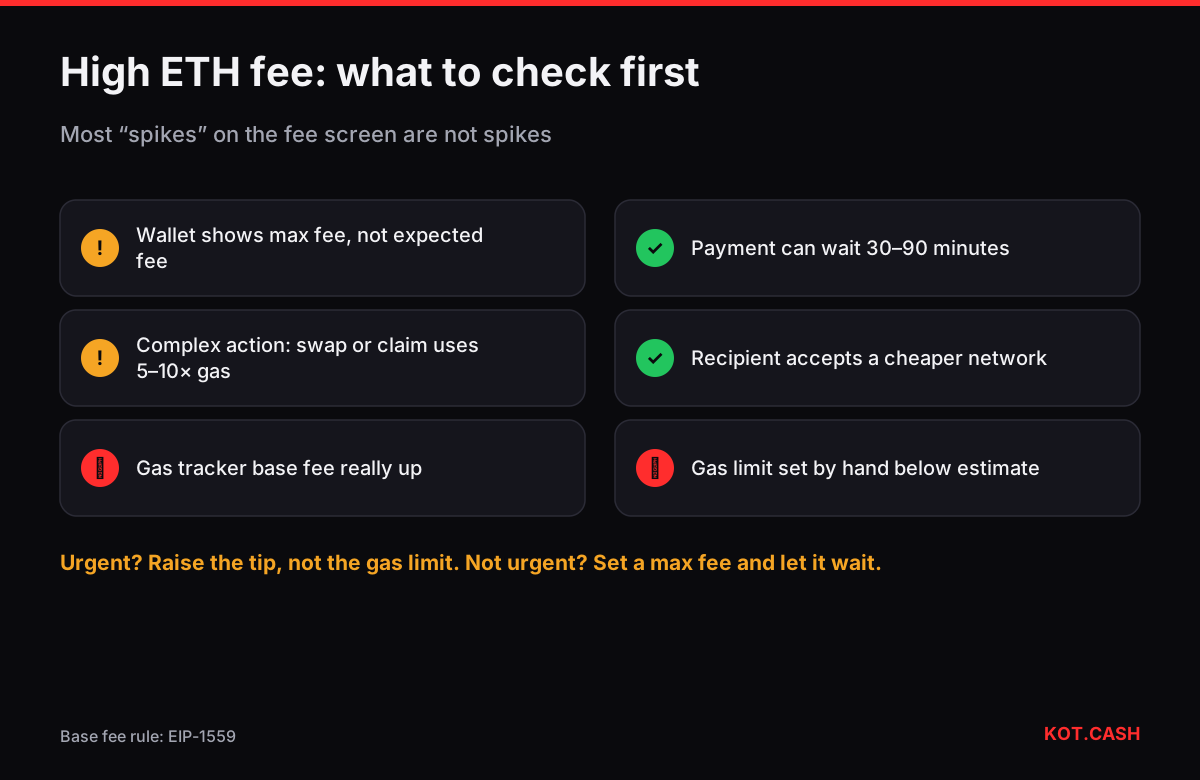
Ethereum fees are high when many people want to get into the next blocks at once. The protocol raises the base fee by up to 12.5% after every block that is fuller than its target, so a burst of demand can multiply the price of gas within minutes. Usually the spike passes in an hour or two. If your transfer cannot wait, you can raise the tip, move the payment to a layer-2 network or use a cheaper chain for stablecoins. Here is how to tell which cause you are looking at and which fix works.
First check: is it the network or your wallet?
Open a gas tracker such as Etherscan's and compare the current base fee with what your wallet proposes. If the tracker shows 1–3 gwei and your wallet asks for 30, the problem is the wallet estimate, not the network. Some wallets add a large safety margin to the max fee, and some show the max fee rather than the expected fee. You are charged base fee plus tip, not the max — but a high max still needs that much ETH in the wallet before you can send.
The second common surprise is the gas amount, not the price. A swap, a token claim or a bridge deposit can use ten times the gas of a simple transfer. The fee screen multiplies a normal price by a large number of units and the result looks like a network spike when it is not.
Seven reasons the base fee is up
- A popular token launch or airdrop claim. Thousands of users and bots submit transactions to the same contract in the same minutes.
- Sharp market moves. When prices fall fast, liquidations and arbitrage bots compete for block space and pay high tips.
- NFT mints with a fixed start time. Everyone hits the contract in the first block after the sale opens.
- Exchange hot-wallet batches. Big withdrawal waves create bursts, especially at the start of the European or US business day.
- Full blocks in a row. Each block above target raises the base fee by up to 12.5%; ten full blocks in a row more than triple it.
- Spam or inscription waves. Cheap periods attract bulk activity that fills blocks until the fee rises enough to stop it.
- Your own transaction type. A complex contract call is expensive even on a quiet day because it needs much more gas.
When to wait and when to pay
Ethereum fees follow a daily rhythm. Weekends and the hours when both America and Europe are asleep are usually cheaper; the overlap of European afternoon and US morning tends to be busy. Because the base fee falls as fast as it rises — down to 12.5% per block when blocks are below target — a spike caused by one event often fades within 30–90 minutes.
If you can wait, set a max fee you are comfortable with and send. The transaction sits in the mempool and gets included once the base fee drops below your max. If the payment is urgent, raise the tip instead of the max fee: in a contested block the tip decides who goes first. Validators order transactions by what they earn, which is your tip.
| Total price | Fee in ETH | ≈ USD |
|---|---|---|
| 0.5 gwei | 0.0000105 | $0.03 |
| 2 gwei | 0.000042 | $0.10 |
| 10 gwei | 0.00021 | $0.51 |
| 30 gwei | 0.00063 | $1.54 |
| 100 gwei | 0.0021 | $5.13 |
Cheaper routes for the same payment
For stablecoins the network is often a choice, not a given. USDT and USDC exist on many chains, and the same dollar amount can be sent on TRON, BNB Smart Chain, Solana or an Ethereum layer 2 for a fraction of the Ethereum fee. The catch is that the recipient must accept that exact network. Ask before you send, and compare costs in the network fee comparison.
Layer 2s such as Arbitrum and Base settle to Ethereum but charge much less, because they batch many transactions and post compressed data to Ethereum. Since the Dencun upgrade in March 2024 they use cheaper blob space for that data. If you already hold ETH on mainnet, moving it to a layer 2 costs one mainnet transaction; after that, each transfer is cheap.
When you swap on KOT.CASH you can often pick the network on both sides. For example, you can send USDT on Ethereum and receive USDT on TRON, or swap ETH and receive the result on a cheaper chain. The quote shows exactly what arrives after the payout network fee.
Settings that save money without risk
- Use the wallet's “market” or “low” preset rather than “aggressive” when the payment is not urgent.
- Do not set the gas limit by hand below the wallet estimate: a transaction that runs out of gas fails and still costs the fee.
- Batch your own payments: one token transfer of $500 costs the same gas as one of $5.
- Approve exact amounts instead of unlimited approvals; it is a separate transaction either way, but it limits risk.
- Check the EIP-1559 max fee calculator to choose a max fee that survives a short spike.
FAQ
Why does my wallet show a much higher fee than the gas tracker?
Wallets often display the max fee with a safety margin. You are charged the block's base fee plus your tip, which is usually lower.
What time of day is Ethereum cheapest?
Typically weekends and the hours when both Europe and North America are asleep. It is a tendency, not a rule; check a gas tracker.
Will a higher gas limit make my transaction faster?
No. Speed depends on the tip and max fee. The gas limit only caps how much gas can be used.
Is it cheaper to send USDT on another network?
Usually yes, if the recipient accepts that network. TRON, BNB Smart Chain, Solana and layer 2s cost far less than Ethereum mainnet.
My transaction is stuck because fees went up. What now?
Wait for the base fee to fall below your max fee, or replace the transaction with the same nonce and a higher fee in your wallet.