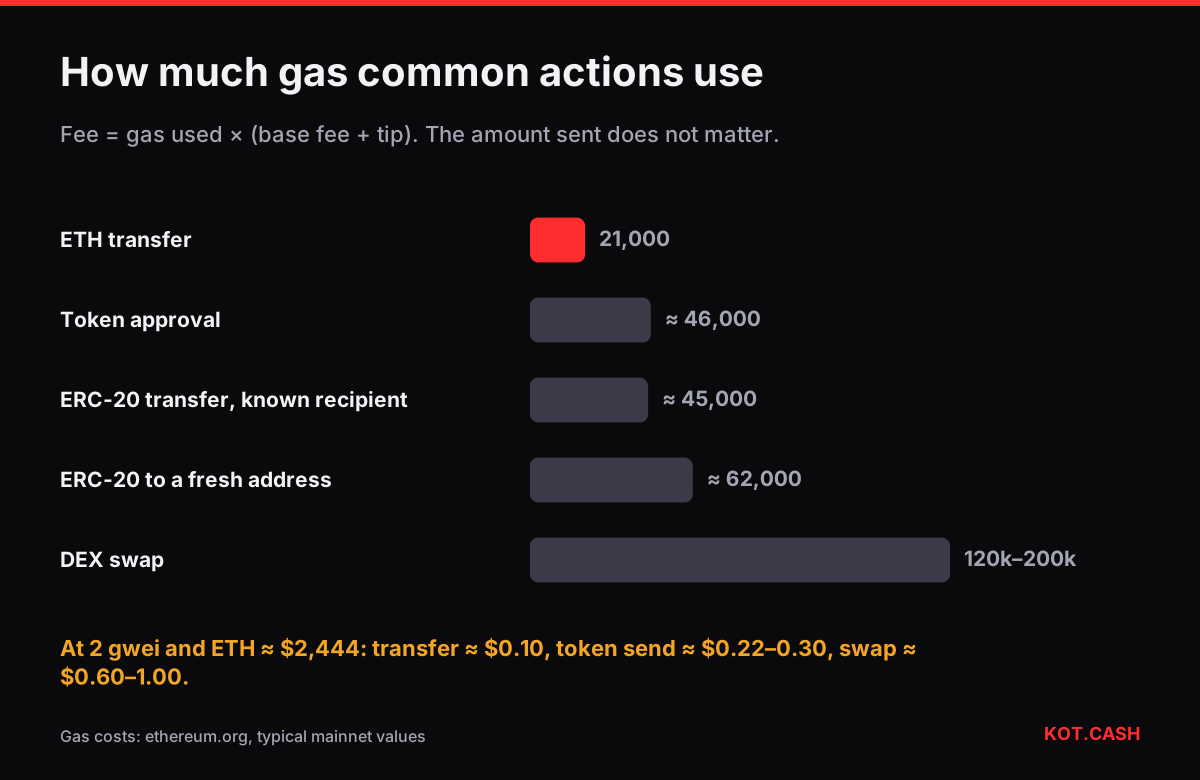
Gas is the unit Ethereum uses to measure how much computation a transaction needs. You pay for it in ETH: fee = gas used × price per unit of gas, and the price is quoted in gwei, one billionth of an ETH. A plain ETH transfer always uses 21,000 gas; at a total price of 2 gwei that is 0.000042 ETH, about ten cents with ETH near $2,444. Everything else in this guide is detail on those two numbers: how much gas an action uses and what each unit costs at the moment you send.
Gas units: the size of the job
Every operation in the Ethereum Virtual Machine has a fixed gas cost set by the protocol: adding numbers is cheap, writing a new value to contract storage is expensive. A transaction's gas usage is the sum of everything it executes, plus a fixed 21,000 for the transaction itself. That is why sending ETH costs the same 21,000 gas whether you send 0.01 ETH or 1,000 ETH — the amount does not change the work.
Token transfers cost more because they run a contract. A USDT or USDC transfer usually uses between 45,000 and 65,000 gas: more when the recipient has never held that token (a new storage slot is written), less when they already have a balance. A swap on a decentralised exchange touches several contracts and often lands between 120,000 and 200,000 gas.
| Action | Gas used | At 2 gwei | ≈ USD at $2,444/ETH |
|---|---|---|---|
| ETH transfer | 21,000 | 0.000042 ETH | $0.10 |
| ERC-20 transfer, recipient already holds the token | ≈ 45,000 | 0.00009 ETH | $0.22 |
| ERC-20 transfer to a fresh address | ≈ 62,000 | 0.000124 ETH | $0.30 |
| Token approval | ≈ 46,000 | 0.000092 ETH | $0.22 |
| DEX swap | 120,000–200,000 | 0.00024–0.0004 ETH | $0.59–0.98 |
Gwei and the price of gas
Since the London upgrade in August 2021 (EIP-1559) the price per gas has two parts. The base fee is set by the protocol for each block and is burned — nobody receives it. The priority fee, or tip, goes to the validator who includes your transaction. You pay base fee + tip for every unit of gas used.
The base fee moves automatically. Each block has a gas target equal to half of its gas limit. If a block is fuller than the target, the next block's base fee rises by up to 12.5%; if it is emptier, the base fee falls by up to 12.5%. A busy hour therefore pushes fees up step by step, and a quiet weekend night lets them drift down to a fraction of a gwei.
Units can be confusing, so keep this conversion at hand: 1 ETH = 1,000,000,000 gwei = 10^18 wei. A tip of 0.5 gwei on a 21,000-gas transfer is 0.0000105 ETH. The unit converter does these conversions exactly if you are reading raw values in an explorer.
Max fee, tip and what you actually pay
A wallet signs two numbers: maxFeePerGas, the highest total price per gas you accept, and maxPriorityFeePerGas, the tip. When the transaction is included you pay the block's base fee plus your tip, never more than the max fee. Whatever is left between the max fee and what was charged stays in your wallet — it is not a deposit that comes back later, it is simply never taken.
- Your wallet reads the current base fee, say 1.6 gwei, and suggests a tip, say 0.4 gwei.
- It sets a max fee with headroom — often about twice the base fee plus the tip — so the transaction survives a few full blocks in a row.
- The transaction is included in a block whose base fee is 1.7 gwei. You pay 1.7 + 0.4 = 2.1 gwei per gas.
- For a 21,000-gas transfer that is 0.0000441 ETH. The rest of the max fee is never charged.
If the base fee climbs above your max fee, the transaction does not fail — it waits in the mempool until the base fee comes back down or you replace it with a higher one. The EIP-1559 max fee calculator shows how high the base fee can climb over a given number of full blocks and what headroom to choose.
The gas limit, and why failed transactions cost money
The gas limit of a transaction is the most gas it is allowed to use. Wallets estimate it by simulating the transaction and add a margin. You are charged only for gas actually used, so a generous limit does not cost extra on success.
If execution runs out of gas or a contract rejects the call (a revert), the state changes are undone but the gas already spent is not refunded: validators did the work. Explorers show such transactions as Failed with a fee. Typical causes are a limit set too low by hand, a swap whose price moved beyond the slippage you allowed, or a token contract that blocks the transfer. Raising the limit helps only in the first case.
Turning a fee into dollars before you send
Multiply gas by price, then by the ETH price: 62,000 gas × 2.1 gwei = 130,200 gwei = 0.0001302 ETH ≈ $0.32. The gas fee calculator does exactly this for Ethereum and other EVM networks. If you are about to send USDT on Ethereum, also keep a small ETH reserve for the next transfer — without ETH a token balance cannot move at all.
On KOT.CASH the payout side is handled for you: when you swap into ETH or an ERC-20 token, the network fee of the payout is already included in the quote the widget shows. You only pay gas for your own deposit transfer. The ETH to USDT and USDT to ETH pages show the current minimum amounts.
FAQ
What is gwei?
A unit of ETH: one gwei is 0.000000001 ETH. Gas prices are quoted in gwei because whole ETH would need many leading zeros.
Why does sending 1 ETH cost the same as sending 100 ETH?
Gas measures computation, not value. Any plain ETH transfer uses exactly 21,000 gas.
Do I get unused gas back?
You are only charged for gas actually used, at the base fee plus tip. The unused part of the gas limit and of the max fee is never taken from your wallet.
Why did my failed transaction still cost ETH?
Validators executed it until it failed. The work is paid for even though the state changes are reverted.
Is the base fee the same for everyone in a block?
Yes. Every transaction in a block pays the same base fee per gas; only the tip differs.