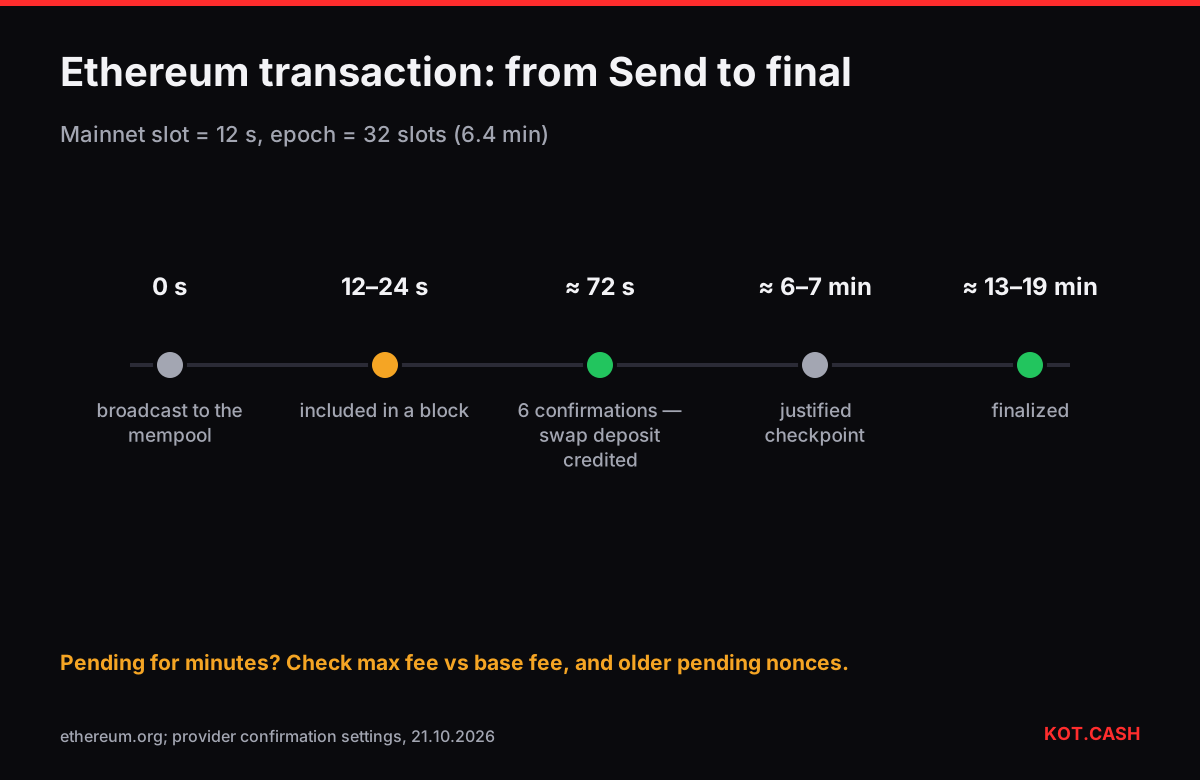
An Ethereum transaction with a sensible fee is usually included in a block within 12–24 seconds, gets 6 confirmations in about 72 seconds and becomes final — irreversible without destroying a large share of staked ETH — after two epochs, roughly 13 minutes. Ethereum's clock is fixed: one slot every 12 seconds since the switch to proof of stake in September 2022. When a transfer takes longer than a minute to be included, the cause is almost always the fee settings or the order of transactions from your address, not the network's speed.
The Ethereum clock
Time on the beacon chain is divided into slots of 12 seconds and epochs of 32 slots (6.4 minutes). In each slot one validator proposes a block. Occasionally a proposer is offline and the slot stays empty, so the next block comes 24 seconds later; under normal conditions about 99% of slots carry a block.
Finality is decided per epoch. When two-thirds of staked ETH has attested to a checkpoint and the next checkpoint is justified on top of it, the earlier one is finalised. In practice a transaction is final 12.8–19 minutes after inclusion depending on where in the epoch it landed. The slot and epoch converter turns any slot number into a time and shows which epoch it belongs to.
Three milestones, three different meanings
| Milestone | Typical time | What it means |
|---|---|---|
| Included | 12–24 s | In a block; visible in Etherscan as Success or Fail |
| 6 confirmations | ≈ 72 s | Six blocks on top — what the provider behind KOT.CASH waits for on ETH deposits |
| Safe head | ≈ 6–7 min | Justified checkpoint; reorgs beyond this are practically impossible |
| Finalized | ≈ 13–19 min | Reverting would require burning at least a third of staked ETH |
Exchanges choose different thresholds. Some credit ETH after a dozen blocks, others wait for finality. If an exchange shows 'confirmations 12/64', it is counting blocks toward its own threshold — the network itself has already done its part.
Why a transaction stays pending
- Max fee below the base fee. Under EIP-1559 every block has a base fee that rises up to 12.5% when blocks are full. If your max fee per gas is below the current base fee, the transaction waits until the base fee falls. The EIP-1559 max fee calculator shows how many full blocks your max fee survives.
- A tip of zero. Block builders prefer transactions that pay them a priority fee. A zero tip still gets included eventually, but not first.
- A nonce gap. Transactions from one address are processed strictly in nonce order. If nonce 41 is stuck, nonce 42 waits behind it, however high its fee.
- A wallet that never broadcast it. Sometimes the RPC endpoint accepted the transaction but did not propagate it. If Etherscan does not know the hash after a minute, it is not in the public mempool.
Fixing a stuck transaction
- Open the hash in Etherscan. 'Pending' with a max fee below the base fee shown at the top of the page confirms the diagnosis.
- Use your wallet's Speed Up button. It resends the same nonce with a higher fee; the new version replaces the old one. A replacement must raise the tip by at least about 10% to be accepted by nodes.
- To abandon it, use Cancel: the wallet sends a 0 ETH transaction to yourself with the same nonce and a higher fee.
- Never 'fix' it by sending the same payment again with a new nonce — that one will wait behind the stuck one and both may go through.
ERC20 tokens and contract calls
A USDT or USDC transfer is a contract call, but its timing is the same as a plain ETH transfer: it lands in the next block if the fee is right. It costs more gas (about 45,000–65,000 instead of 21,000), so it is slightly more sensitive to a low max fee. Swaps on decentralised exchanges sometimes fail rather than wait, because the price moved beyond the slippage limit while the transaction was pending — you pay gas for the failed attempt.
Layer 2 timing is different
Arbitrum, Base and Optimism confirm transfers in under a few seconds on their own chains, and swap providers credit their deposits within a minute. Their finality on Ethereum comes later, when batches are posted and, for withdrawals to mainnet, after a seven-day challenge period. The guide on moving ETH from Arbitrum to Ethereum covers that case.
FAQ
How long does an Ethereum transaction take?
Usually 12–24 seconds to be included in a block, about 72 seconds for 6 confirmations and 13–19 minutes to finality.
Why is my Ethereum transaction pending?
Most often its max fee is below the current base fee, or an earlier transaction from the same address (lower nonce) is stuck.
How long is Ethereum finality?
Two epochs, about 12.8 minutes after the epoch boundary — 13 to 19 minutes after inclusion in practice.
Is a USDT ERC20 transfer slower than ETH?
No, it lands in the next block if the fee is right. It uses more gas, so it costs more.
How do I speed up a pending transaction?
Use Speed Up in your wallet: it replaces the transaction with the same nonce and a higher fee.