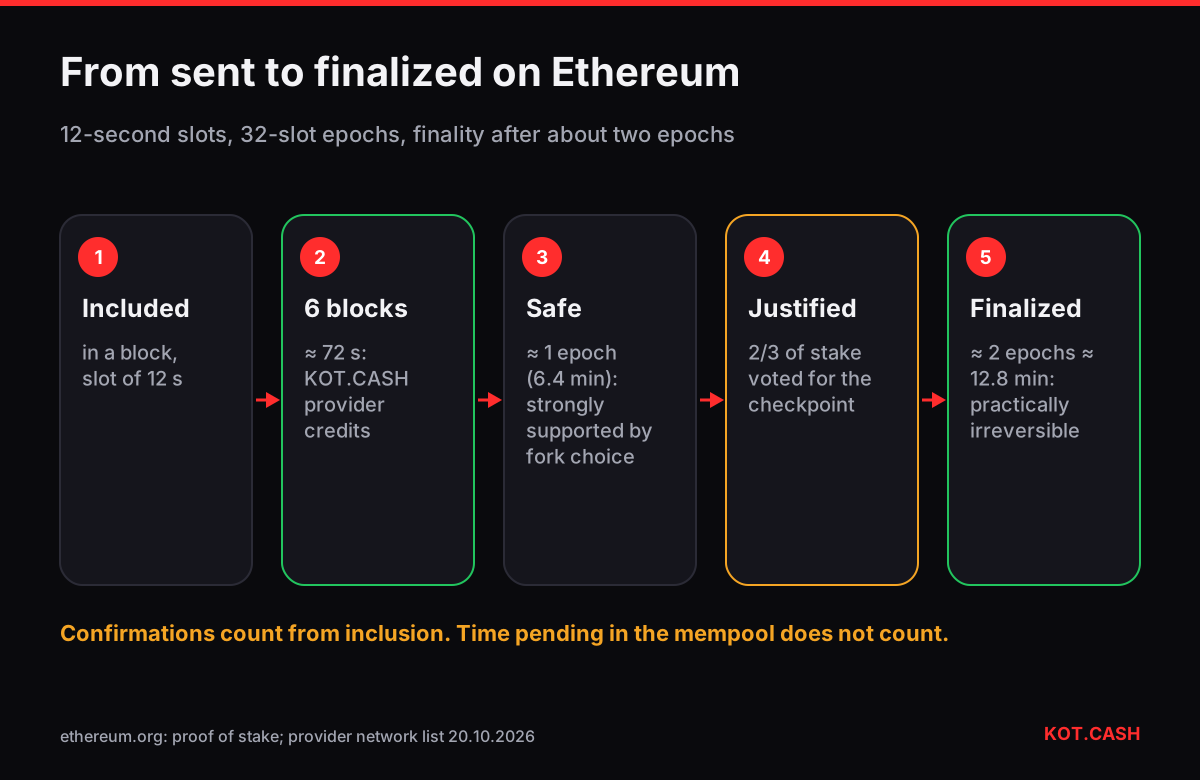
On Ethereum a new block can be proposed every 12 seconds, so a transaction usually has its first confirmation within seconds of being sent. But a block becomes finalized — irreversible without destroying a huge amount of staked ETH — only after about two epochs, roughly 12.8 minutes. Between those points the chain is very unlikely to change, but not guaranteed not to. That is why receiving services choose different waits: the liquidity provider behind KOT.CASH credits ETH deposits after 6 blocks, about 72 seconds, while some exchanges wait for finality.
Slots, epochs and checkpoints
Ethereum's proof-of-stake consensus divides time into slots of 12 seconds; each slot has one validator chosen to propose a block (sometimes the slot stays empty). Epochs are 32 slots, 6.4 minutes. At each epoch boundary validators vote on a checkpoint. When two-thirds of all staked ETH votes for a checkpoint, it becomes justified; when the next checkpoint is justified on top of it, the earlier one becomes finalized. In the normal case this takes two epochs.
1 slot = 12 s · 1 epoch = 32 slots = 6.4 min
finality ≈ 2 epochs ≈ 64 slots ≈ 12.8 min (up to ~95 slots ≈ 19 min depending on where in the epoch the block falls)
Beacon chain time started at 1 December 2020, 12:00:23 UTC, so any slot number converts to an exact time. The slot and epoch converter does it both ways.
What the block tags mean
| Tag | Meaning | Typical age |
|---|---|---|
| latest | Head of the chain the node sees now | 0–12 s |
| safe | Block that the current fork-choice strongly supports (justified or attested by a majority) | ≈ 1 epoch |
| finalized | Behind a finalized checkpoint; reverting it would cost at least a third of all staked ETH | ≈ 13 min |
Wallets, explorers and exchanges use these tags. Etherscan, for example, marks a transaction's block as finalized once it is behind the latest finalized checkpoint.
How often do recent blocks get reorganised?
Since the move to proof of stake in September 2022, reorganisations of more than one block on mainnet have been extremely rare; one-block reorgs happen occasionally when a proposer publishes late. That is why waiting a handful of blocks is the common compromise for deposits: it covers the realistic short reorgs while keeping waiting time around a minute. Waiting for finality removes even the theoretical risk but takes about 13 minutes.
Why services choose 6, 12, 64 or more
- A few blocks (6–12): enough to rule out the short reorgs that actually happen; used by many swap services and wallets for normal amounts.
- 64 blocks or finality: two epochs; protects against any reorg short of a catastrophic consensus failure. Exchanges with large inflows often choose this.
- Layer 2 deposits: rollups have their own block times and rules; a deposit on Arbitrum or Base is credited on the L2's terms, not Ethereum's finality.
Some provider data lists two numbers for Ethereum networks; for ETH and ERC-20 tokens on mainnet the list used by KOT.CASH's provider shows 6 for crediting and 64 as a second value, matching two epochs. The deposit confirmations tool shows those figures for every coin.
When finality is delayed
Finality requires two-thirds of the stake to be online and voting. If more than a third of validators go offline at once — for example because of a bug in a popular client — the chain keeps producing blocks but stops finalizing. That happened briefly on mainnet in May 2023. During such periods services that wait for finality pause crediting, while services that use a block count keep going with higher caution. For a user the practical symptom is an exchange deposit that stays “confirming” longer than usual while blocks keep coming.
ETH deposits on KOT.CASH
Send ETH or an ERC-20 token from Ethereum mainnet to the deposit address on the order page. After 6 blocks (about 72 seconds) the provider counts the deposit; the payout follows on the network you chose. For ETH to USDT the current minimum is about 0.0028 ETH, and ETH to BTC about 0.0039 ETH. If the order still shows waiting after several minutes, look up the hash on Etherscan: if the transaction is pending there, the fee was too low; if it is confirmed, the order will update shortly. Routes: ETH to USDT and ETH to BTC.
FAQ
How long does Ethereum finality take?
About two epochs, roughly 12.8 minutes, in normal conditions.
What is the difference between a confirmation and finality?
A confirmation is a block built on top of yours. Finality is a consensus checkpoint after which reverting the block would require destroying at least a third of staked ETH.
How many confirmations does KOT.CASH need for ETH?
6 blocks, about 72 seconds.
What is an epoch on Ethereum?
32 slots of 12 seconds, 6.4 minutes. Validators vote on checkpoints at epoch boundaries.
Can a confirmed Ethereum transaction disappear?
One-block reorgs happen occasionally; deeper ones are extremely rare. Once finalized, a block is practically irreversible.