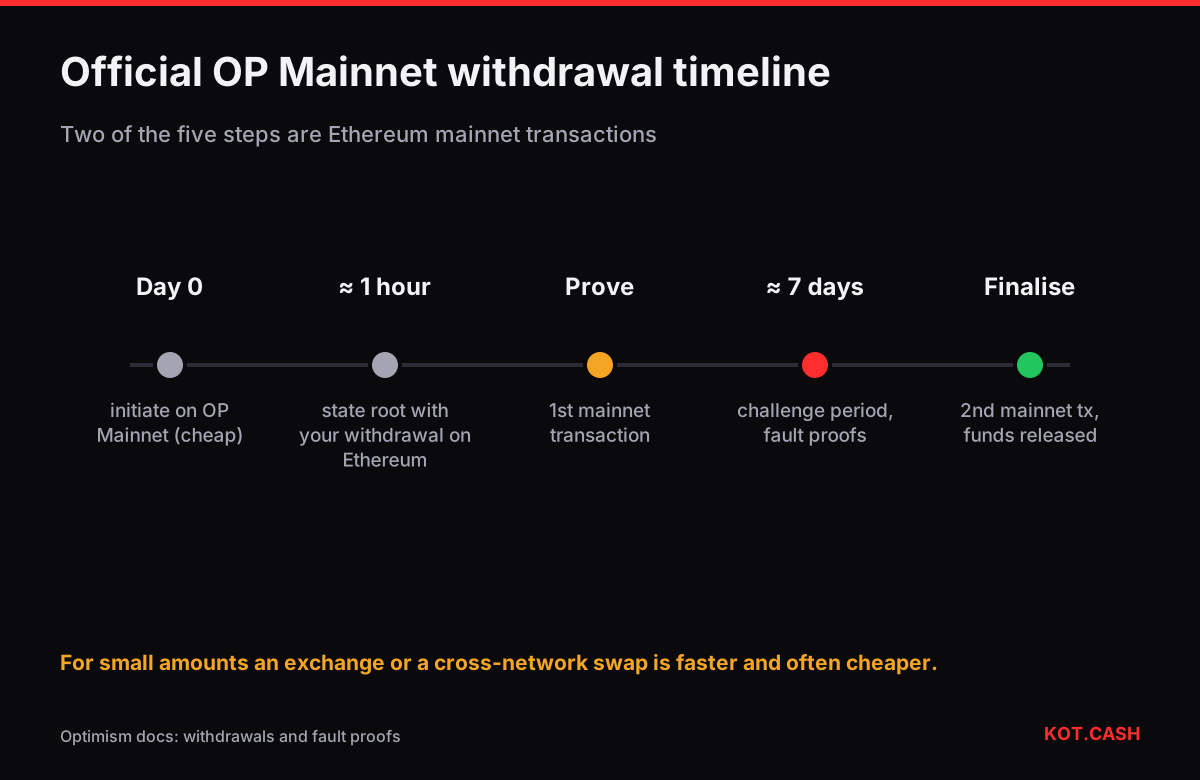
On OP Mainnet — the chain most people still call Optimism — you pay gas in ETH, and a normal transfer costs well under a cent to a few cents. The OP token does not pay fees; it is used for governance of the Optimism Collective. What surprises users more than fees is leaving the chain: a withdrawal through the official bridge takes about seven days and needs two transactions on Ethereum. This guide covers both, with the timeline of a withdrawal and the faster alternatives.
What you pay on OP Mainnet
OP Mainnet uses the same OP Stack fee model as Base and other Superchain networks: an execution fee (gas used × OP Mainnet base fee plus tip) and an L1 data fee for publishing your compressed transaction to Ethereum. Since Ethereum's Dencun upgrade the data goes into blobs, which is why typical fees fell to fractions of a cent. Busy periods on the chain itself or expensive blob space on Ethereum push the fee up temporarily.
| ETH | OP | |
|---|---|---|
| Pays gas | Yes | No |
| Used for | Fees, payments, DeFi | Governance votes, incentives |
| Needed in wallet to send tokens | Yes, a small amount | No |
| Swap minimum on KOT.CASH (OP → ETH) | — | ≈ 231 OP |
A wallet that holds only OP or only USDC on OP Mainnet cannot send anything until it receives a little ETH on the same chain. Withdraw ETH to OP Mainnet from an exchange that supports it, or swap into ETH with the OPTIMISM network as the payout.
The seven-day withdrawal, step by step
- Initiate the withdrawal on OP Mainnet. This is a cheap L2 transaction.
- Wait for the output root. The chain publishes a state commitment to Ethereum that includes your withdrawal; this can take up to an hour or more.
- Prove the withdrawal on Ethereum. This is the first mainnet transaction and costs mainnet gas.
- Wait the challenge period, about seven days, during which anyone can dispute an invalid state. Since June 2024 OP Mainnet uses permissionless fault proofs for this.
- Finalise on Ethereum. The second mainnet transaction releases your funds.
The two mainnet transactions are the expensive part: on a busy Ethereum day they can cost more than months of OP Mainnet activity. For small amounts the official route often does not make economic sense.
Faster ways off the chain
- Exchange withdrawal in reverse. If your exchange accepts deposits on OP Mainnet, deposit there and withdraw on any network the exchange supports.
- Third-party bridges use liquidity on both sides and pay you out in minutes for a fee. Check the bridge's reputation and contract carefully.
- Cross-network swap. On KOT.CASH the provider accepts ETH and OP on the OPTIMISM network and can pay out on Ethereum, Bitcoin or another chain. It waits for 30 OP Mainnet blocks — about a minute — before the deposit counts.
Fees vs Base and Arbitrum
OP Mainnet and Base share the OP Stack fee formula, so the structure is identical and only the demand on each chain differs. Arbitrum charges the L1 part differently — as extra gas units — and orders transactions first come, first served, which is why its gas numbers look larger. In everyday use all three cost cents for a transfer. The layer 2 comparison puts them side by side with withdrawal times and the confirmation counts a receiving service uses.
Checklist before you send to OP Mainnet
- The receiving service lists OP Mainnet or Optimism, not just “Ethereum”.
- You have some ETH on OP Mainnet for the next transaction.
- For USDC you know whether the recipient expects native USDC or the older bridged USDC.e.
- You are not planning to withdraw a small amount through the official bridge.
Deposits into OP Mainnet
Going the other way is quick. A deposit through the official bridge is one Ethereum transaction; the funds appear on OP Mainnet after the deposit is picked up from Ethereum, usually within a few minutes. Many exchanges also withdraw ETH and USDC directly to OP Mainnet, which costs only the exchange's withdrawal fee and avoids paying mainnet gas yourself. Before choosing, compare that fee with what one mainnet bridge transaction costs at the moment.
Once on the chain, budget for gas in ETH just as on Ethereum, only with numbers a hundred or more times smaller. A typical wallet with a few thousandths of an ETH on OP Mainnet can make hundreds of ordinary transfers. The deposit confirmations table shows how many OP Mainnet blocks different coins need before a provider credits them.
FAQ
Is gas on Optimism paid in OP?
No. Gas on OP Mainnet is paid in ETH. OP is a governance token.
How much does an OP Mainnet transaction cost?
Usually a fraction of a cent to a few cents, depending on chain activity and Ethereum blob prices.
Why does the Optimism bridge withdrawal take 7 days?
The challenge period gives anyone time to dispute an invalid state with a fault proof before funds are released on Ethereum.
Is there a faster way to move funds from OP Mainnet to Ethereum?
Yes: an exchange that supports OP Mainnet, a liquidity bridge, or a cross-network swap.
How many confirmations does an OP Mainnet deposit need on KOT.CASH?
The provider waits for 30 blocks, about a minute.