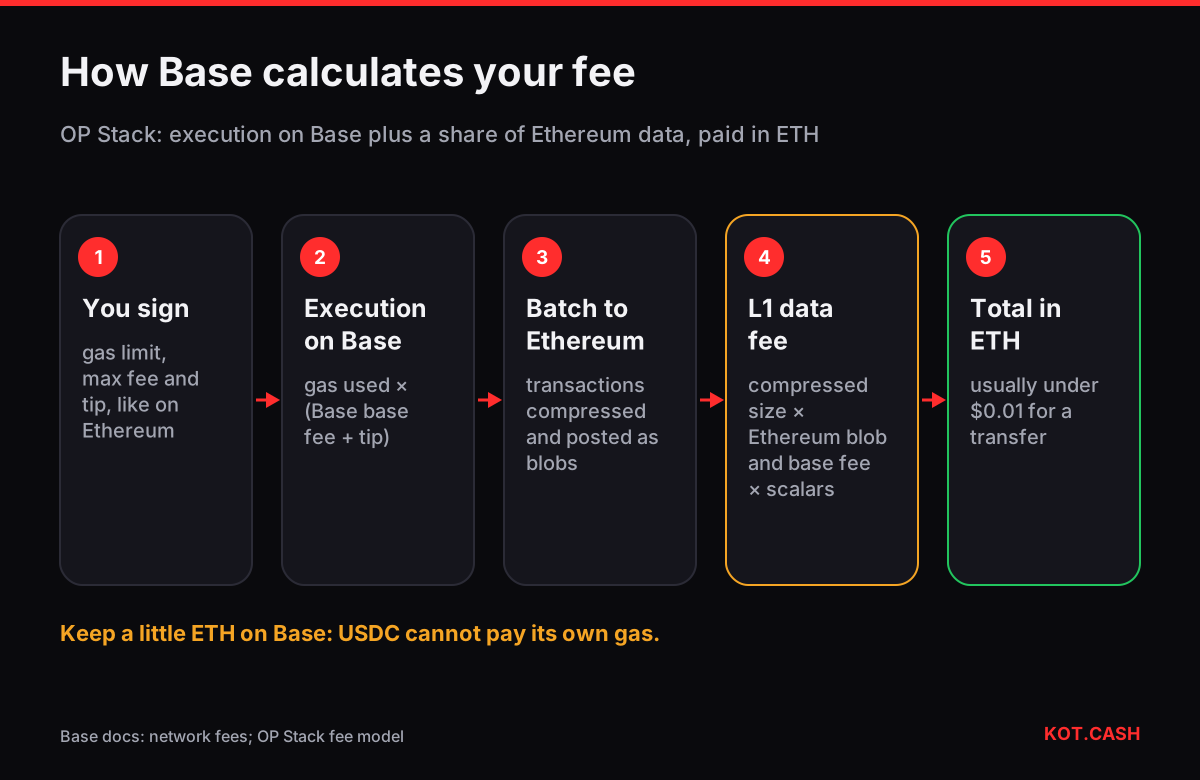
A simple transfer on Base, the Ethereum layer 2 launched by Coinbase in 2023, typically costs less than a cent, and a USDC transfer a cent or two. Fees are paid in ETH. Base is built on the OP Stack, so every transaction pays two things: an L2 execution fee for the work on Base, and an L1 data fee for the share of Ethereum data space the batch uses. Wallets show the sum; explorers such as Basescan show both parts separately, which is the easiest way to see what you actually paid for.
The formula in one line
Total = gas used × (L2 base fee + priority fee) + L1 data fee. The first half works exactly like Ethereum's EIP-1559, with Base's own base fee that rises and falls with demand on Base. The second half is calculated by a system contract on Base from the estimated compressed size of your transaction and two Ethereum prices: the regular base fee and the blob base fee, each weighted by scalars the chain operator sets.
| Field | Meaning | Example |
|---|---|---|
| Gas used | L2 execution units | 21,000 (ETH transfer) |
| Gas price | L2 base fee + tip | ≈ 0.005 gwei |
| L1 fee | Share of Ethereum data cost | a few hundredths of a cent to a cent |
| Transaction fee | Execution + L1 fee, in ETH | usually under $0.01 |
The numbers in the example are typical for quiet periods, not guarantees. The point is the proportion: on Base the execution part is often tiny, and the L1 data part decides the fee for small transactions.
Why Base became cheap
Before March 2024 rollups posted their data to Ethereum as ordinary transaction calldata, and that cost was passed on in every L2 fee. The Dencun upgrade (EIP-4844) introduced blobs: a separate data lane with its own fee market that is much cheaper and is pruned after a couple of weeks. OP Stack chains switched to blobs immediately, and the L1 data fee dropped sharply. Since then Base fees mostly reflect demand on Base itself.
When Base fees go up
- Busy minutes on Base. Popular mints and token launches fill blocks; Base's base fee then climbs like Ethereum's, block by block.
- Priority-fee bidding. Unlike a first-come sequencer, Base orders by tip when blocks are full, so bots bidding high tips push others back.
- Expensive Ethereum blobs. If blob space on Ethereum gets crowded, the L1 data fee of every OP Stack transaction rises.
For a USDC payment that is not time-critical, the wallet's normal setting is enough; there is no reason to bid a high tip.
USDC on Base: the practical case
Base is popular for stablecoins because Circle issues native USDC there and many exchanges support withdrawals to Base. Moving $500 of USDC on Base costs cents; the same transfer on Ethereum mainnet costs far more at most times. Two cautions apply:
- Keep a little ETH on Base for gas. USDC cannot pay its own fee; with zero ETH the tokens are stuck until you top up.
- Check that the recipient accepts USDC on Base specifically. The 0x address is the same as on Ethereum, so a deposit address for Ethereum will “accept” the transfer technically, but the receiving service may not see it.
On KOT.CASH you can swap USDC on Base to USDT on TRON or another network; the minimum is around 30 USDC and the payout network fee is included in the quote. The provider waits for 30 Base blocks before crediting a deposit — about a minute with two-second blocks.
Withdrawing from Base to Ethereum
The official bridge works like other OP Stack chains: you start the withdrawal on Base, prove it on Ethereum, wait the challenge period of about seven days, then finalise it on Ethereum. That means two mainnet transactions and a week. Exchanges that support Base and cross-network swaps are faster; the Base to Ethereum guide compares the options.
A worked example
Suppose you send 200 USDC on Base. The transfer uses about 45,000–60,000 gas. If Base's base fee is 0.005 gwei and your tip 0.001 gwei, the execution part is 60,000 × 0.006 gwei = 360 gwei, or 0.00000036 ETH — less than a tenth of a cent. The L1 data fee for a transaction of this size during normal blob prices adds a similar or somewhat larger amount. The total stays around a cent or below. Compare that with the same transfer on Ethereum mainnet: 60,000 gas at 2 gwei is 0.00012 ETH, about 30 cents, and much more on a busy day.
If your wallet shows a gas limit noticeably above the gas a transfer needs, that is normal headroom; you are charged for gas used only. What matters for budgeting is the ETH balance: keep at least a few thousandths of an ETH on Base if you move tokens regularly, because a wallet with USDC and zero ETH cannot send anything.
FAQ
What does a Base transaction cost?
Usually less than a cent for an ETH transfer and around a cent for a token transfer. Busy periods cost more.
What is the L1 data fee on Base?
Your share of the cost of publishing Base transaction data on Ethereum. It depends on your transaction's compressed size and Ethereum data prices.
What token pays gas on Base?
ETH. Base has no separate gas token.
How many confirmations does a Base deposit need?
The provider behind KOT.CASH waits for 30 Base blocks, about a minute.
Can I send USDC on Base to an Ethereum address?
The address format is the same, but the token stays on Base. Make sure the receiving service supports Base.