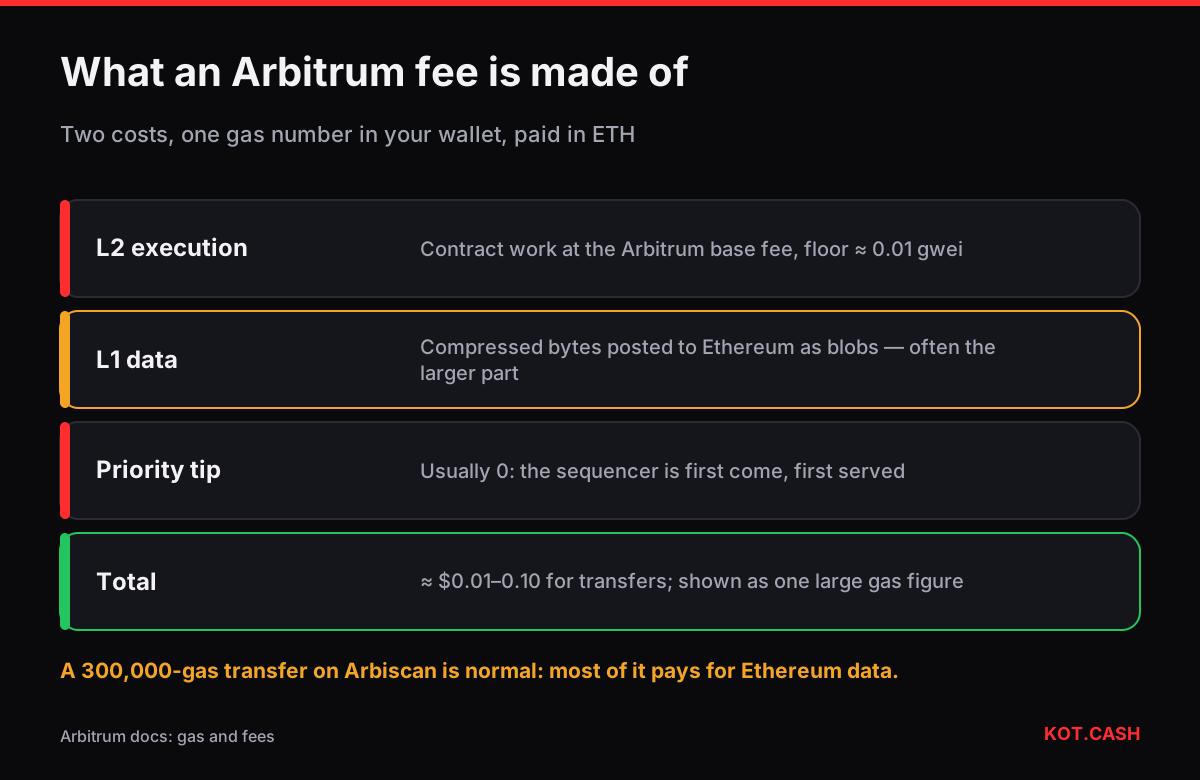
An Arbitrum One transaction usually costs one to a few cents, paid in ETH. The fee has two parts: the gas your transaction uses on Arbitrum itself (execution), and a charge for the data Arbitrum must post to Ethereum so anyone can reconstruct the chain. Both are rolled into a single gas number in your wallet, which is why an Arbitrum transfer can show a gas limit of hundreds of thousands while costing less than a mainnet transfer of 21,000 gas.
Part 1: execution on Arbitrum
Arbitrum runs an EVM-compatible chain, so contracts use the same gas schedule as on Ethereum. The L2 base fee is set by Arbitrum's own congestion pricing and has a protocol floor; on Arbitrum One that floor is 0.01 gwei at the time of writing, and the base fee sits at or near it most of the time. Arbitrum blocks are produced every quarter of a second by the sequencer, which orders transactions first come, first served, so a priority tip does not buy you a better place and wallets generally set it to zero.
Part 2: the L1 data component
Every Arbitrum transaction is compressed and posted to Ethereum in batches. Your share of that cost depends on how many bytes your transaction adds after compression and on the current price of Ethereum data. Since Ethereum's Dencun upgrade in March 2024 rollups post this data as blobs, a separate, much cheaper type of space; that change cut typical Arbitrum fees by a large factor.
Arbitrum charges the L1 part by adding extra gas units to your transaction at the L2 gas price. The extra amount is the L1 cost divided by the L2 base fee. That is the reason for the odd-looking numbers: a simple ETH transfer may show 300,000 or more gas used on Arbiscan. It is not wasted computation — most of it represents data posting.
| Component | What drives it | Typical share |
|---|---|---|
| L2 execution gas | Contract work × L2 base fee (≈ 0.01 gwei floor) | Small |
| L1 data cost | Compressed bytes × Ethereum blob/data price | Often the larger part |
| Priority tip | Ignored by the first-come sequencer | Usually 0 |
| Total | Charged in ETH from your Arbitrum balance | ≈ $0.01–0.10 |
Why fees occasionally jump
- Ethereum data gets expensive. When blob demand on Ethereum spikes, the L1 component of every Arbitrum transaction rises with it.
- Arbitrum itself is congested. Heavy activity raises the L2 base fee above the floor for a while.
- Your transaction is large. A batch payout or a complex DeFi call adds more bytes and more execution.
Even in those moments the result is usually cents, not dollars. If your wallet quotes something much higher, check whether it shows the max fee rather than the expected fee — the EIP-1559 max fee calculator explains the difference.
Getting funds in and out
Arbitrum uses ETH for gas, and your address is the same 0x address you use on Ethereum. To use the chain you need some ETH on Arbitrum specifically — ETH on Ethereum mainnet does not pay Arbitrum fees.
- Deposit through the official bridge: one Ethereum mainnet transaction; funds appear on Arbitrum in about ten to fifteen minutes.
- Withdraw through the official bridge: you start on Arbitrum, then wait for the challenge period of about a week before claiming on Ethereum, which costs a mainnet transaction.
- Withdraw from an exchange directly to Arbitrum: many exchanges support the network, which avoids the bridge entirely.
- Swap across networks: on KOT.CASH you can send ETH on Arbitrum and receive ETH on Ethereum (or another coin) without the one-week wait. The current minimum is about 0.011 ETH; the payout network fee is included in the quote.
The swap provider waits for 120 Arbitrum blocks before crediting a deposit. With quarter-second blocks that is about half a minute, so the Arbitrum side is fast; the total time depends mostly on the payout network.
Arbitrum One is not Arbitrum Nova
Offchain Labs also runs Arbitrum Nova, a cheaper chain that keeps data with a committee instead of posting it all to Ethereum. Both use 0x addresses and ETH for gas. Exchanges and providers list them as separate networks; KOT.CASH's provider supports Arbitrum One under the label ARBITRUM. Do not send from Nova to an Arbitrum One deposit address.
Estimating an Arbitrum fee yourself
Wallets call a special node method that returns the gas needed including the L1 part, so their estimate is usually accurate. If you want to check it, look at a recent transaction of the same kind on Arbiscan: the “gas used” field and the effective gas price give the real cost, and similar transactions cost similar amounts within the same hour. For a quick dollar figure, multiply gas used by the gas price in gwei, divide by a billion to get ETH and multiply by the ETH price, as in the gas fee calculator. Remember that the gas limit a wallet sets on Arbitrum is generous on purpose; the unused part is never charged.
FAQ
How much is a typical Arbitrum transaction?
Usually one to a few cents in ETH. Large or complex transactions and periods of expensive Ethereum data cost more.
Why does Arbiscan show 300,000+ gas for a simple transfer?
Arbitrum adds gas units to cover the cost of posting your data to Ethereum. Most of that number is the L1 data charge, not computation.
Does a higher tip speed up an Arbitrum transaction?
Generally no. The sequencer orders transactions as they arrive, so the tip is usually set to zero.
How long does a withdrawal from Arbitrum to Ethereum take?
Through the official bridge about a week plus a claim transaction. Exchanges and cross-network swaps avoid the wait.
Can I pay Arbitrum gas in ARB?
No. ARB is a governance token. Gas on Arbitrum One is paid in ETH.