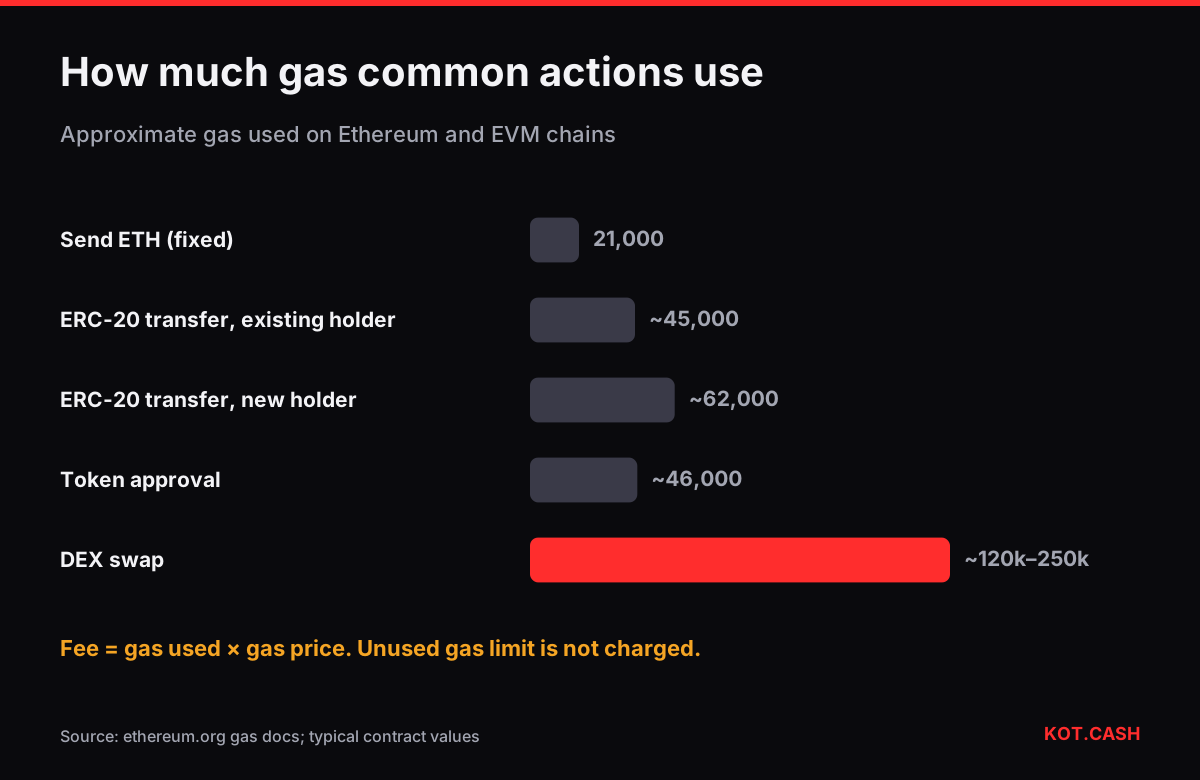
The gas limit is the maximum amount of gas a transaction is allowed to consume on Ethereum or another EVM chain. Gas measures computation: every operation the transaction triggers has a fixed gas cost. You pay for the gas actually used times the price per gas, and the limit is a safety cap you set in advance. A plain ETH transfer always uses exactly 21,000 gas; a token transfer or a swap uses more, depending on the contract. If the limit is too low the transaction fails and you still pay for the gas it burned.
Gas limit, gas used, gas price
Three numbers appear on every EVM transaction and are easy to confuse:
- Gas limit: the cap you allow, set by the wallet from an estimate.
- Gas used: what the transaction actually consumed, known only after execution.
- Gas price: what you pay per unit, in gwei. Since EIP-1559 it is the base fee plus your priority tip, capped by the max fee you set.
Fee paid = gas used × effective gas price. The unused part of the limit is not charged. Setting a limit of 100,000 for a transfer that uses 21,000 costs the same as setting 21,000. That is why wallets add a margin above their estimate. The gas fee calculator multiplies gas by price for different actions and networks.
Typical gas use by action
Values vary by contract, but these orders of magnitude hold on Ethereum and EVM chains like BNB Smart Chain, Polygon, Arbitrum and Base:
| Action | Gas used | Why |
|---|---|---|
| Send ETH / BNB / POL to an address | 21,000 | fixed base cost of a transaction |
| ERC-20 transfer, recipient already holds the token | ~35,000–50,000 | updates two balances in the contract |
| ERC-20 transfer, recipient has zero balance | ~50,000–65,000 | creating a new storage slot costs more |
| Token approval | ~45,000 | writes an allowance |
| Swap on a DEX | ~120,000–250,000 | router plus one or more pools |
| NFT mint | ~80,000–200,000+ | depends on the collection contract |
The difference between sending to a fresh address and to one that already holds the token is real: writing a storage slot from zero to a non-zero value is one of the most expensive operations in the EVM. TRON has a similar effect in energy terms for USDT, explained in the USDT TRC20 fee guide.
What happens when gas runs out
If execution reaches the gas limit before finishing, the EVM stops with an out-of-gas error. All state changes are reverted, as if the transaction had never happened, except one: the gas consumed up to that point is paid to the network. You lose the fee and the transfer or swap does not take place. On Etherscan the transaction shows as failed with gas used equal to the gas limit.
- Check the failed transaction on a block explorer: if gas used equals gas limit, it ran out of gas.
- Send it again with a higher limit. Wallets usually estimate correctly; manual edits to the limit are the most common cause.
- If the estimate itself fails, the transaction would revert for another reason, such as insufficient token balance or an expired swap deadline. Raising the limit will not help then.
A different error, insufficient funds for gas, means your balance of the native coin cannot cover gas limit × max fee before the transaction even starts. It is covered in this guide.
The block gas limit
Each block also has a gas limit: the total gas all its transactions may use. On Ethereum, validators signal adjustments, and the limit has been raised several times, which increases throughput. Under EIP-1559, the base fee targets half of the block limit: when blocks are fuller than the target, the base fee rises by up to 12.5% per block, and when emptier, it falls. A single transaction cannot use more gas than the block limit, which caps how large a contract call can be. The EIP-1559 max fee calculator shows how fast the base fee can climb.
Gas limit on other chains
The concept carries over to every EVM chain with its own native coin for gas: BNB on BNB Smart Chain, POL on Polygon, ETH on Arbitrum, Base and Optimism, AVAX on the Avalanche C-Chain. Layer-2 networks add a data fee for posting the transaction to Ethereum, so the total cost on Arbitrum is not just gas used × L2 gas price. Non-EVM chains use other models: Solana has compute units with a limit per transaction, TRON has energy and bandwidth.
In practice
When you pay a KOT.CASH order from an EVM wallet, let the wallet set the gas limit. Leave enough of the native coin for gas: for a USDT ERC-20 deposit you need a little ETH, for a USDT BEP-20 deposit a little BNB. If the payment fails with out of gas, the USDT never left your wallet; send again to the same order while it is still open.
FAQ
What is a gas limit?
The maximum gas a transaction may use. You pay only for gas actually used; the limit protects against runaway execution.
Why is an ETH transfer 21,000 gas?
21,000 is the fixed intrinsic cost of any Ethereum transaction; a plain transfer does nothing beyond that.
What happens if my gas limit is too low?
The transaction fails with out of gas, all changes are reverted, and the gas consumed is still paid.
Does a higher gas limit cost more?
No, not by itself. The fee is gas used × gas price; unused gas is not charged.
What gas limit does an ERC-20 transfer need?
Usually about 35,000–65,000 gas, more when the recipient holds none of the token yet.