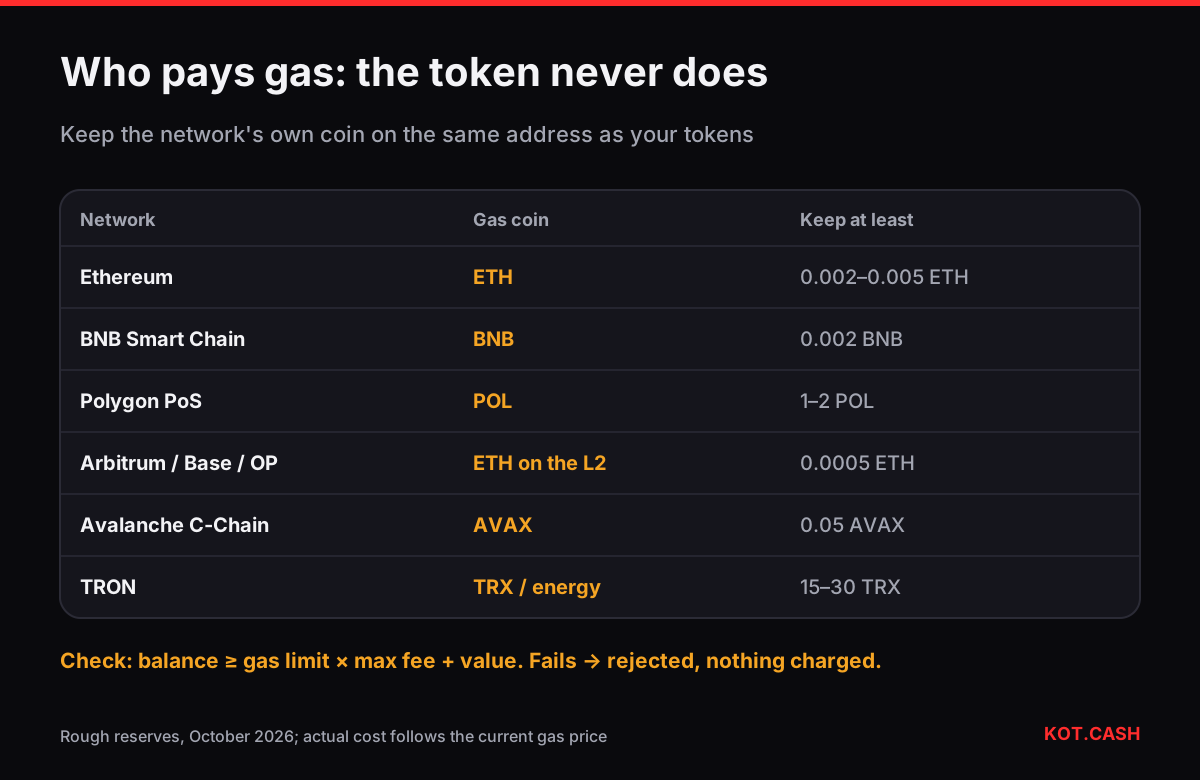
The message insufficient funds for gas * price + value means your address does not hold enough of the network's own coin to pay for the transaction. Tokens like USDT, USDC or SHIB cannot pay gas. On Ethereum gas is paid in ETH, on BNB Smart Chain in BNB, on Polygon in POL, on Arbitrum and Base in ETH on that network. Add a small amount of the right coin to the same address and the transfer will go through.
Read the error literally
An Ethereum node checks one inequality before accepting your transaction: your native balance must be at least gas limit × max fee per gas + value. Value is the amount of the native coin you are sending (zero for a token transfer). If the inequality fails, the node rejects the transaction immediately; nothing is broadcast and nothing is charged. That is why this error is harmless in itself — you lose nothing, you just cannot send yet.
Two details surprise people. First, the check uses the maximum fee, not the expected one. A wallet that sets max fee to twice the current base fee needs twice as much ETH available as the transfer will actually cost; the difference is not spent. Second, when you try to send your whole ETH balance, the value plus the fee exceeds the balance. Wallets usually offer a Max button that subtracts the fee for you.
Which coin pays gas, and roughly how much
| Network | Gas coin | Token transfer gas | Reserve to keep |
|---|---|---|---|
| Ethereum | ETH | ~45,000–65,000 gas | 0.002–0.005 ETH |
| BNB Smart Chain | BNB | ~45,000–65,000 gas | 0.002 BNB |
| Polygon PoS | POL | ~50,000–65,000 gas | 1–2 POL |
| Arbitrum / Base / Optimism | ETH on that L2 | L2 gas + L1 data cost | 0.0005 ETH |
| Avalanche C-Chain | AVAX | ~50,000–65,000 gas | 0.05 AVAX |
| TRON (TRC20) | TRX (energy) | ~65,000–130,000 energy | 15–30 TRX without energy |
These reserves are rough, deliberately generous figures; actual cost depends on the current gas price. The gas fee calculator gives the exact number for your gas limit and gwei, and the EIP-1559 max fee calculator shows how much balance the wallet's max fee setting ties up. TRON has its own model with energy and bandwidth; the USDT TRC20 fee calculator covers it.
Four ways to get the gas coin
- Withdraw from an exchange on the right network. Buy a few dollars of ETH, BNB or POL and withdraw it directly to your address, choosing the same network the tokens are on.
- Ask someone to send a small amount. Any transfer of the gas coin to your address works; 2–3 dollars is plenty on most chains.
- Swap part of something else into the gas coin. For example, swap a small amount of another coin into BNB with payout to the address that holds your BEP20 tokens.
- Use the wallet's built-in gasless option if it has one. Some wallets offer paying fees in the token for certain transfers through their own relay; check the fee before you confirm.
Variants of the same problem
gas required exceeds allowance— the wallet's gas limit is too low for this transfer or the transaction would fail. Do not raise the limit blindly; a token with transfer restrictions or a paused contract also triggers it.intrinsic gas too low— the gas limit is below the 21,000 minimum of any Ethereum transaction. Let the wallet estimate it.max fee per gas less than block base fee— the max fee you set is below the current base fee; the transaction cannot be included until base fee drops. Raise the max fee.replacement transaction underpriced— you are trying to replace a pending transaction with the same nonce at too small a fee increase. Most nodes want at least about 10% more.
If a transaction was accepted but later failed on-chain (status Fail or Reverted in the explorer), that is a different situation: the gas used up to the failure point is charged. Read the error reason in the explorer before retrying with more gas.
Plan gas before a swap payout
If you receive tokens from a swap, think one step ahead: will you need to move them later? When KOT.CASH pays out USDT on BNB Smart Chain or Ethereum, it sends the token only. Keep a small balance of BNB or ETH on that address, or choose a payout network where you already hold gas. For frequent small transfers, a network with cheap fees saves more than the swap fee difference; see which network is best for USDT transfers.
FAQ
I have 500 USDT. Why can't I send it?
Because the fee is paid in the network's own coin, not in USDT. Add a little ETH, BNB, POL or TRX to the same address, depending on the network.
Do I lose money when this error appears?
No. The node rejects the transaction before broadcasting it, so no fee is charged.
Why does the wallet want more ETH than the fee it shows?
The balance check uses the maximum fee you allow, not the expected fee. The unused part is never charged.
Can I pay gas on Arbitrum with ETH on Ethereum?
No. You need ETH on Arbitrum itself. Withdraw on the Arbitrum network or bridge a small amount.
How much gas coin should I keep?
Enough for two or three transfers at busy times: a few dollars on most chains, more on Ethereum mainnet during congestion.