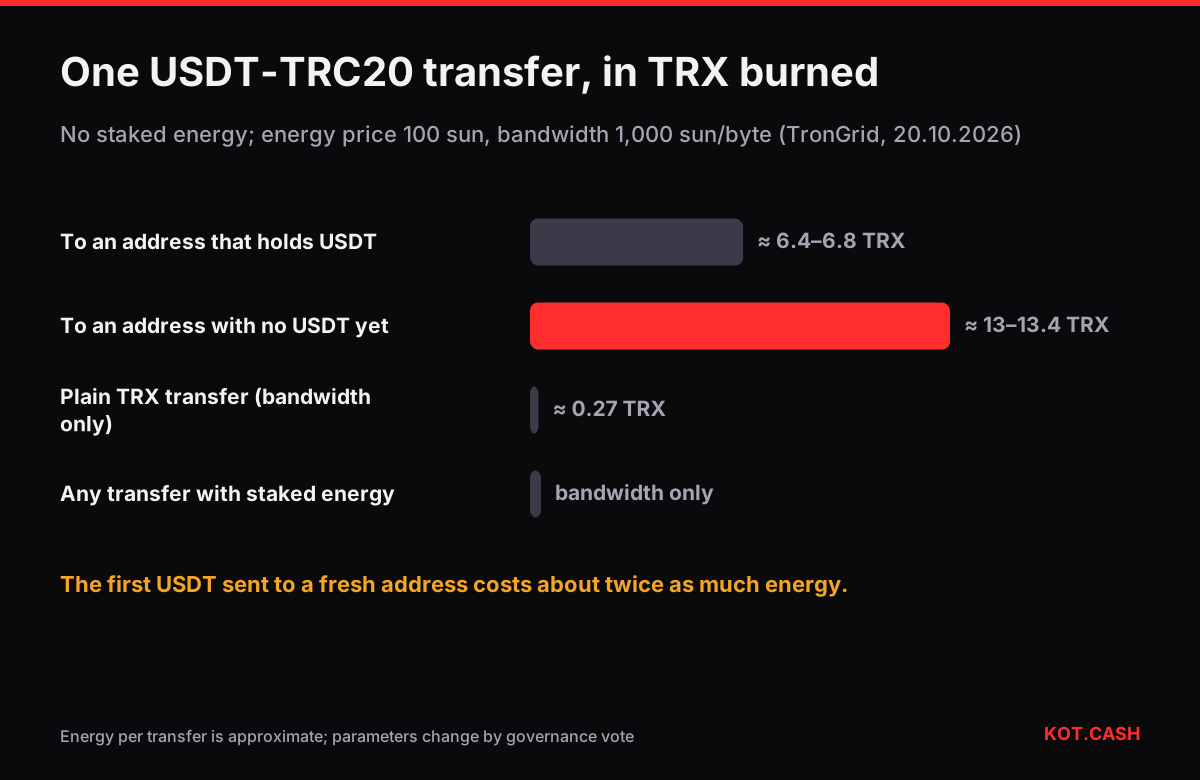
A USDT transfer on TRON does not have a fixed fee. It consumes two network resources — energy and bandwidth — and if your account has none of its own, TRON burns TRX to pay for them. With the parameters read from the network on 20 October 2026, a transfer to an address that already holds USDT burns about 6.4 TRX, a transfer to an address that has never held USDT about 13 TRX, plus about 0.35 TRX of bandwidth once your free daily allowance is used. The USDT TRC20 fee calculator does the arithmetic for your own case.
Energy: the expensive part
USDT on TRON is a smart contract, and running contract code costs energy. A standard USDT transfer needs roughly 64,000 energy when the recipient already has a USDT balance. When the recipient has never held USDT, the contract has to create a new balance entry, and the transfer needs roughly 130,000 energy. That is why the same wallet sometimes pays twice as much for the same amount.
If you have no energy, TRON burns TRX at the network's energy price. On 20.10.2026 the chain parameter getEnergyFee was 100 sun per unit (1 TRX = 1,000,000 sun), so 64,000 energy cost about 6.4 TRX and 130,000 about 13 TRX. The parameter is set by vote of TRON's super representatives and has been lowered before; the calculator's fields are editable for that reason.
Bandwidth: the small part
Every transaction also uses bandwidth, roughly one unit per byte. A USDT transfer is about 345 bytes. Each account gets 600 bandwidth points free per day — enough for one such transfer. Beyond that, TRON burns 1,000 sun per byte, about 0.35 TRX per transfer. Plain TRX transfers use only bandwidth, which is why they are so cheap.
| Recipient | Energy | Energy burned | Bandwidth (after free 600/day) | Total |
|---|---|---|---|---|
| Already holds USDT | ≈ 64,000 | ≈ 6.4 TRX | ≈ 0.35 TRX | ≈ 6.4–6.8 TRX |
| Never held USDT | ≈ 130,000 | ≈ 13 TRX | ≈ 0.35 TRX | ≈ 13–13.4 TRX |
Zero TRX means you cannot send USDT
If a wallet holds USDT-TRC20 but no TRX and no energy, the transfer simply fails — there is nothing to pay with. This is the most common surprise after receiving USDT on TRON for the first time. Keep enough TRX for the transfers you plan, or receive USDT on a network where you already hold the gas coin. Getting TRX is one small swap: ADA to TRX, BTC to USDT on TRON plus a little TRX, or buying TRX directly.
Staking or renting energy
- Stake 2.0. Freeze TRX in TronLink and choose energy. Staked TRX gives a share of the network's daily energy pool, regenerating over 24 hours. Unstaking takes 14 days. This suits people who send USDT every day.
- Energy rental. Third-party services delegate energy to your address for a fee. Compare their price per energy unit with the burn price (100 sun at the time of writing) before paying; some offers are cheaper than burning, some are not.
- Do nothing. For a few transfers a month, burning TRX is the simplest option and costs a few dollars.
Checking what a transfer actually cost on Tronscan
Open the transaction hash on tronscan.org. The Resources Consumed section shows energy and bandwidth used and how they were paid: from your staked energy, from delegated energy, or burned TRX. The Fee line shows the TRX burned in total. If it says roughly 6–7 TRX, the recipient already held USDT; roughly 13 TRX means a first-time recipient. A result of "OUT OF ENERGY" means the transaction failed and the fee limit was too low — no USDT moved.
This is also how to verify a wallet's "free transfer" promise: if Tronscan shows energy delegated by another address, someone paid for it, usually built into a spread or a service fee somewhere else.
When you receive USDT-TRC20 from a KOT.CASH swap, the payout transaction's resources are paid on the sending side; on 20 October 2026 the provider's payout fee for USDT on TRON was 1.3 USDT, included in the quoted amount.
Ways to pay less
- Batch: one transfer of $1,000 costs the same energy as one transfer of $10.
- Send to addresses that already hold USDT when you have the choice — about half the energy.
- If the recipient accepts it, use a cheaper network: BNB Smart Chain or Solana usually cost cents or fractions of a cent per transfer. The stablecoin fee comparison puts them side by side.
- When you receive USDT through a swap, the payout's network cost is part of the quote; you do not need TRX to receive, only to send later.
TRC20 vs other USDT networks
TRON remains the network many exchanges and P2P desks expect, and it is still far cheaper than Ethereum during busy periods. But it is no longer the cheapest: on BNB Smart Chain a USDT transfer usually costs a few cents of BNB, on Solana a fraction of a cent of SOL. If you choose a network for regular payments, compare total yearly cost in the network fee comparison, and read which network to choose for USDT for the trade-offs beyond fees.
FAQ
How much TRX does a USDT TRC20 transfer cost?
About 6.4 TRX to an address that holds USDT and about 13 TRX to one that never did, plus about 0.35 TRX of bandwidth if your free allowance is used — at the parameters of 20.10.2026.
Why did my second transfer cost less than the first?
The first went to an address with no USDT balance, which needs about twice the energy.
Can I pay the fee in USDT?
Not on TRON itself. Some wallets offer to swap a little USDT for energy behind the scenes; check their price.
How long does unstaking TRX take?
14 days under Stake 2.0.
Do I need TRX to receive USDT-TRC20?
No. You need TRX or energy only to send it.