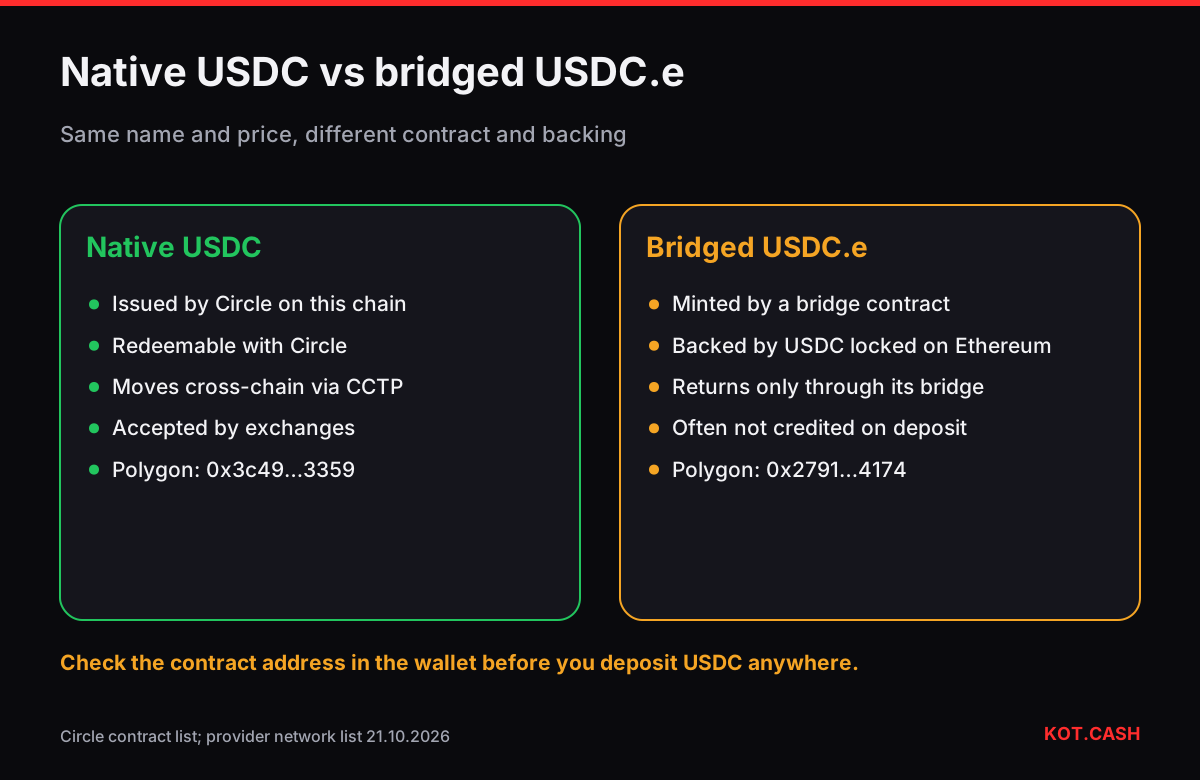
Native USDC is issued directly by Circle on a given blockchain and can be redeemed with Circle for dollars. Bridged USDC, usually labelled USDC.e, is a token minted by a bridge contract on that chain while the real USDC stays locked on Ethereum. Both are worth about a dollar, both are called “USD Coin” in many wallets, but they are different contracts. Exchanges increasingly accept only native USDC on a network, so depositing USDC.e to an address that expects native USDC can leave the funds uncredited.
Why two versions exist
New networks get USDC through bridges first, because Circle launches native issuance only after its own integration. Polygon, Arbitrum, Optimism, Avalanche and Base all went through this phase. When Circle later issued native USDC, the bridged token did not disappear: liquidity pools, lending markets and wallets kept holding it. Circle's Bridged USDC Standard describes how a chain can later hand the bridged contract over to Circle, but until that happens the two tokens coexist.
| Network | Native USDC | Bridged (USDC.e) |
|---|---|---|
| Polygon PoS | 0x3c499c542cEF5E3811e1192ce70d8cC03d5c3359 | 0x2791Bca1f2de4661ED88A30C99A7a9449Aa84174 |
| Arbitrum One | 0xaf88d065e77c8cC2239327C5EDb3A432268e5831 | 0xFF970A61A04b1cA14834A43f5dE4533eBDDB5CC8 |
| Avalanche C-Chain | 0xB97EF9Ef8734C71904D8002F8b6Bc66Dd9c48a6E | 0xA7D7079b0FEaD91F3e65f86E8915Cb59c1a4C664 |
| Base | 0x833589fCD6eDb6E08f4c7C32D4f71b54bdA02913 | USDbC 0xd9aAEc86B65D86f6A7B5B1b0c42FFA531710b6CA |
Always confirm addresses against Circle's official contract list before relying on them; explorers label the native token “USDC” with Circle as the verified issuer, while the bridged one often reads “USD Coin (PoS)” or “Bridged USDC”.
What is different for a holder
- Redemption. Native USDC is a direct claim on Circle's reserves. USDC.e is a claim on the bridge, which holds USDC on Ethereum; if the bridge fails, USDC.e can lose its backing.
- Moving between chains. Native USDC moves through Circle's CCTP, which burns on one chain and mints on another. USDC.e can only go back through its own bridge.
- Acceptance. Exchanges and OTC desks prefer native USDC. Some still accept USDC.e on Polygon under a separate network label.
- Price. Both trade near $1. In stress events the bridged version can trade at a small discount.
How the provider treats them
KOT.CASH's liquidity provider lists both versions on Polygon: “POLYGON” for native USDC and “MATIC.E” for USDC.e, each with 60 confirmations. On Arbitrum, Base, Avalanche and Optimism it lists one USDC network each, the native one. A conversion inside Polygon from USDC.e to native USDC is possible as a swap: on 21.10.2026 the provider quoted a minimum of about 30 USDC and a payout network fee of about 0.12 USDC for that route. A DEX on Polygon is usually cheaper for this specific conversion; a swap service is useful when you also want to change the network.
Convert USDC.e to native USDC: three routes
- DEX on the same chain. Uniswap, Curve or another stable pool swaps USDC.e to USDC with a small fee and price impact. Check the pool depth for large amounts.
- Exchange deposit. If your exchange still accepts USDC.e (some list it as a separate network), deposit it and withdraw native USDC.
- Swap service. Send USDC.e and receive native USDC or USDT on any supported network in one order.
Recognising USDC.e in a wallet
MetaMask and Rabby show token names from the contract. On Polygon the bridged token is named “USD Coin (PoS)” with the symbol USDC, which is why people mix them up; newer token lists rename it USDC.e. Trust Wallet and exchange apps may show only “USDC” with a network badge. The reliable check is the contract address: tap the token, open it in the explorer and compare with the table above.
If you already deposited USDC.e by mistake
Exchanges usually control the same deposit key on every EVM chain, so a USDC.e deposit to an address that expected native USDC is technically recoverable. Recovery is manual: open a ticket with the transaction hash, the token contract and the amount, and expect a review period and sometimes a fee or a minimum amount. For a swap order, contact support with the order link and the hash. Do not try to fix the mistake by sending the native token as well — that creates a second deposit rather than replacing the first.
What happens to bridged tokens later
Under Circle's Bridged USDC Standard a chain can upgrade its bridged USDC into native USDC by transferring control of the contract to Circle. Where that happened, the bridged token became native without any action from holders. Where it has not, USDC.e stays a separate asset, and liquidity slowly migrates to the native token. If you hold USDC.e long term, plan to convert it rather than waiting for an upgrade that may not happen on that chain.
FAQ
Is USDC.e worth the same as USDC?
It trades near $1 like USDC, but it is backed through a bridge rather than issued by Circle directly, so in stress it can trade at a discount.
Can I send USDC.e to an exchange?
Only if the exchange lists USDC.e or a bridged network explicitly. Otherwise convert it to native USDC first.
How do I know which USDC I have?
Compare the token contract in your wallet with Circle's official list or the table in this article.
Does KOT.CASH accept USDC.e?
The provider lists USDC.e on Polygon (network MATIC.E) in addition to native USDC on Polygon.
What is USDbC on Base?
The bridged USDC that existed on Base before Circle issued native USDC there in 2023.