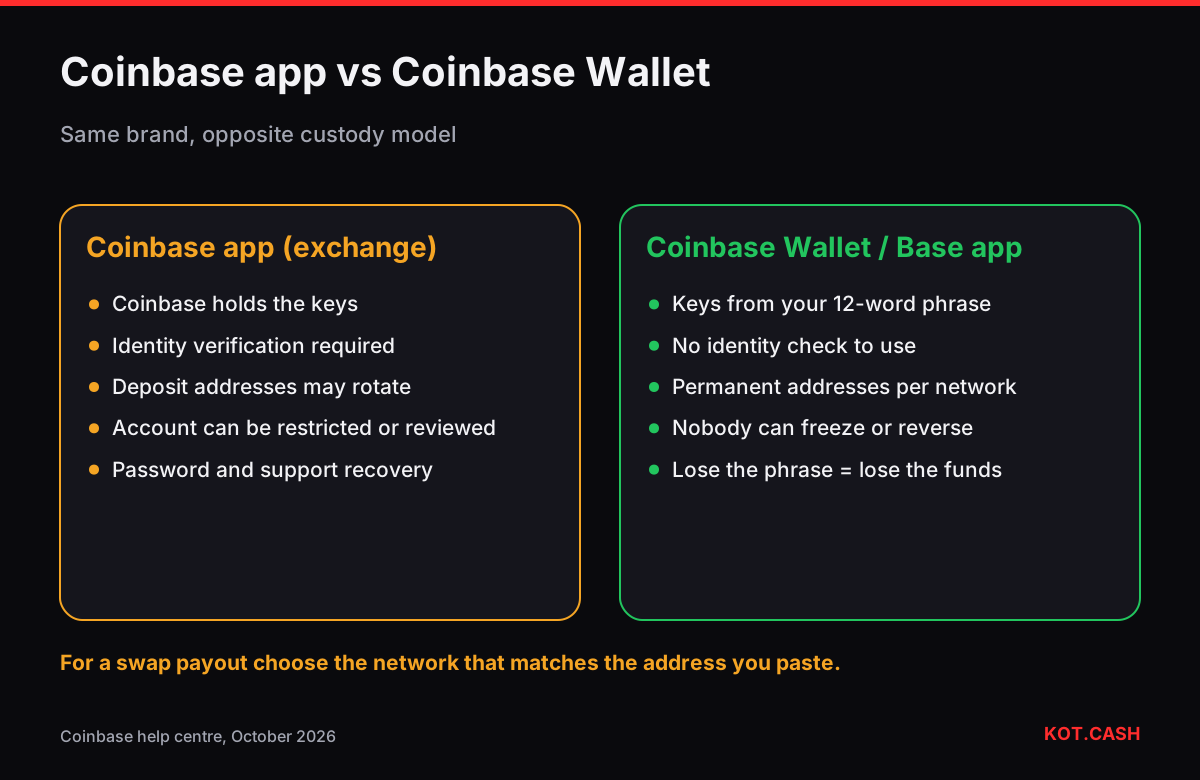
The Coinbase app is an account at the Coinbase exchange: Coinbase holds the private keys, your identity is verified, and the addresses you see are deposit addresses that Coinbase controls on your behalf. Coinbase Wallet is a separate self-custody app: the keys come from a recovery phrase on your device, Coinbase cannot freeze or recover them, and the addresses are yours in the same way as in MetaMask or Trust Wallet. Since 2025 Coinbase has been bringing the self-custody wallet under the name Base app, so you may see either name.
The difference in one table
| Coinbase app | Coinbase Wallet / Base app | |
|---|---|---|
| Who holds the keys | Coinbase | You (recovery phrase) |
| Identity verification | Required | Not required to use the wallet |
| Deposit address | Generated by Coinbase per asset and network, may change | Derived from your phrase, permanent |
| Memo / tag for some coins | Sometimes, on shared deposit addresses | Never needed to receive |
| Can funds be frozen or reviewed? | Yes, by Coinbase | No |
| Lost access | Account recovery with Coinbase | Only the recovery phrase restores it |
Addresses in the Coinbase app
In the exchange app you press Receive, choose the asset and then the network. Coinbase supports several networks for some assets — USDC, for example, on Ethereum, Base, Solana and others — and shows a different deposit address or the same 0x address with a network label. The network choice is binding: Coinbase credits a deposit only if it arrives on a network it supports for that asset. Deposits on an unsupported network may be unrecoverable, which Coinbase's help pages state explicitly.
Exchange deposit addresses are not guaranteed to be permanent. Coinbase can rotate them, and it recommends checking the address before each deposit rather than saving it in an address book long-term.
Addresses in Coinbase Wallet
Coinbase Wallet derives addresses from your 12-word recovery phrase: one 0x address for Ethereum and all EVM networks it supports (Base, Arbitrum, Optimism, Polygon, BNB Chain and others), plus separate addresses for non-EVM networks such as Solana and Bitcoin. These addresses never change and can be restored in other wallets that support the same derivation. Coinbase Wallet can also be linked to your Coinbase account for convenient transfers between the two, but linking does not give Coinbase your keys.
Which one to use as a swap payout
Both work as a destination, with different trade-offs:
- Payout to Coinbase Wallet: you receive directly to keys you control. Pick the payout network in the KOT.CASH widget that matches the address you paste — USDC on Base, ETH on Ethereum and so on. Nobody can hold or reverse the payout.
- Payout to the Coinbase app: possible if Coinbase supports the asset on that network. Coinbase may run its own compliance checks on incoming funds and can delay or ask questions about deposits; that is part of using a regulated custodial account.
- Either way, a payout on a network Coinbase or the wallet does not support for that asset will not show up where you expect.
Recovery and responsibility
Lose the phone with the Coinbase app and you log in again with your credentials and identity verification. Lose the Coinbase Wallet recovery phrase and nobody — including Coinbase — can restore the wallet. Coinbase Wallet offers an encrypted cloud backup of the phrase protected by a password you choose; it is convenient, but the password then becomes the weak point. A paper or metal backup kept offline is independent of any cloud account. The wallet security checklist walks through the remaining settings.
Fees when moving between them
Transfers from the Coinbase app to an external address pay the network fee Coinbase shows at withdrawal time. Moving USDC or ETH on the Base network is usually a matter of cents; on Ethereum mainnet it depends on gas prices. Inside Coinbase Wallet you pay network fees yourself in the gas coin of each network, so keep a little ETH on Base or Ethereum, SOL on Solana and so on. The network fee comparison shows how much the same transfer costs on different networks.
Quick decision
If you want an account with fiat on-ramps, customer support and password recovery, and you accept that the exchange holds the keys, the Coinbase app fits. If you want the assets to be yours regardless of any company, use a self-custody wallet — Coinbase Wallet or another — and treat the recovery phrase as the asset itself. Many people use both: the app to buy and sell for fiat, the wallet to hold and to receive from swaps.
FAQ
Is Coinbase Wallet the same as my Coinbase account?
No. The Coinbase app is a custodial exchange account. Coinbase Wallet is a separate self-custody wallet with its own recovery phrase.
Can Coinbase freeze funds in Coinbase Wallet?
No. Coinbase does not hold the keys of the self-custody wallet. It can restrict the exchange account, not the wallet.
Is the Base app the same as Coinbase Wallet?
Coinbase has been rebranding its self-custody wallet as the Base app since 2025. The recovery phrase and addresses carry over.
Why does my Coinbase deposit address change?
Exchange deposit addresses can be rotated. Copy a fresh one from the app before each deposit.
Can I receive USDT TRC20 in Coinbase Wallet?
Only if the wallet supports the Tron network; check the network list in the app. Otherwise use USDT on an EVM network or a Tron wallet.