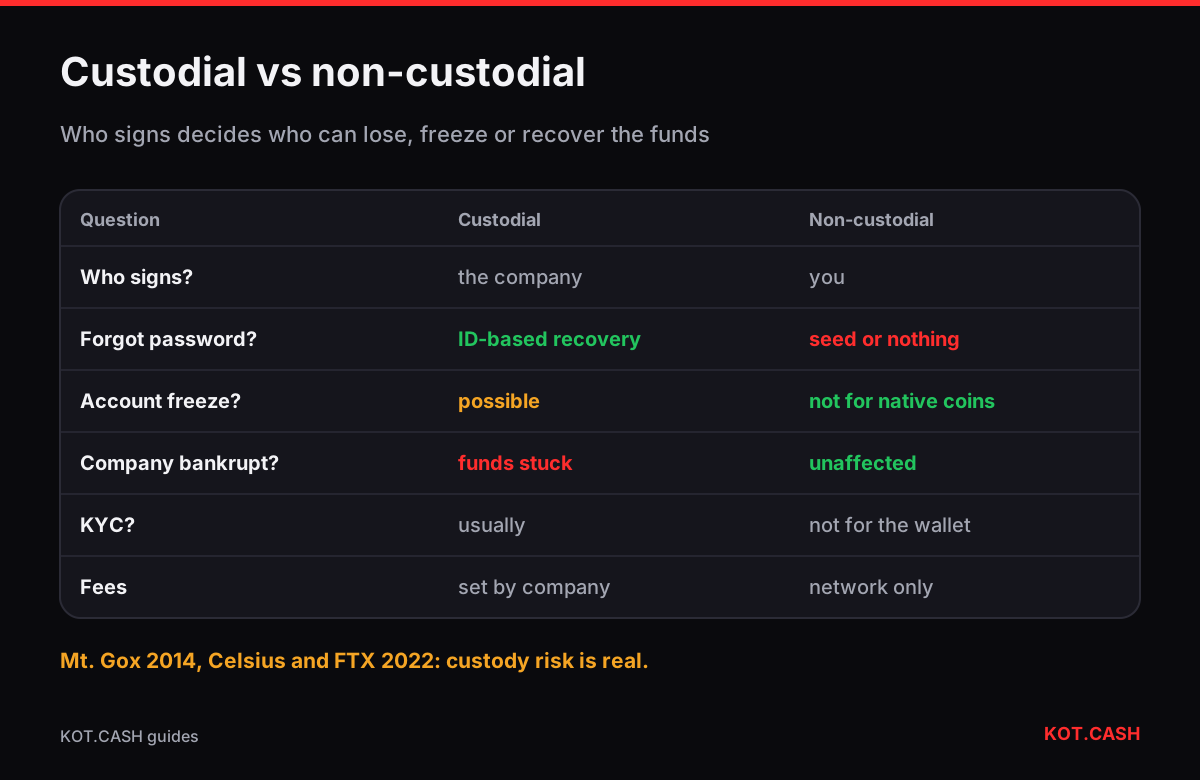
A custodial wallet is one where a company — usually an exchange — holds the private keys and keeps a record of how much belongs to you. A non-custodial (self-custody) wallet is one where you hold the keys, usually as a seed phrase, and nobody else can move the funds. Custodial is easier: forgotten passwords can be reset and support can help. Non-custodial removes the company risk: no freezes, no insolvency, no withdrawal limits — but also no one to call if you lose the seed.
What “holding the keys” means
On a blockchain, coins move only with a valid signature from the private key of the address that holds them. When you deposit to an exchange, the coins go to the exchange’s addresses, and your account balance is an entry in the exchange’s database. When you withdraw, the exchange signs a transaction from its own wallet. In a non-custodial wallet the addresses belong to keys derived from your seed phrase, and your device signs.
The phrase “not your keys, not your coins” summarises the consequence: an exchange balance is a claim against a company, not coins under your control.
Side by side
| Custodial (exchange, custodian) | Non-custodial (your wallet) | |
|---|---|---|
| Who signs | The company | You, on your device |
| Lost password or device | Account recovery with ID | Restore from seed; lost seed = lost funds |
| Freezes and limits | Possible: compliance checks, court orders, sanctions | No one can freeze native coins in your wallet (issuers can still freeze stablecoins) |
| Company failure | Funds tied up in insolvency | Not affected |
| Identity checks | Usually KYC required | None for the wallet itself |
| Fees | Withdrawal fees set by the company | Network fees only |
Why custody risk is not theoretical
- Mt. Gox (2014): the largest bitcoin exchange of its time lost around 850,000 BTC and went bankrupt; repayments to creditors only began in 2024, a decade later.
- Celsius (June 2022): the lending platform paused all withdrawals and filed for bankruptcy a month later.
- FTX (November 2022): one of the largest exchanges halted withdrawals and filed for bankruptcy within days; customer funds were tied up in proceedings for years.
Exchanges can also freeze a single account for compliance reasons — unusual activity, a request from law enforcement, an unclear source of funds — sometimes for weeks. That is part of how regulated services work, not a sign of fraud, but it is a reason not to keep everything there.
The responsibilities of self-custody
- Back up the seed phrase offline and test the restore — where not to store a seed phrase.
- Protect the device: updates, official apps only, no unknown extensions — fake wallet apps.
- Check addresses before sending and read what you sign — blind signing explained.
- Plan access for your family — the inheritance checklist walks through it.
A sensible mix
Most active users combine both: an exchange account for fiat deposits and trading, and a self-custody wallet for holdings. The hot vs cold wallet guide describes how to split amounts. Moving funds from an exchange to your own wallet is covered step by step in move crypto from Binance to self-custody.
Where a swap service fits
An instant swap service like KOT.CASH sits between the two models. It does not keep balances or accounts for standard swaps: you send coins to an order’s deposit address and receive the other coins at an address you control. During the order, while the deposit is being confirmed and exchanged, the service and its liquidity provider handle the coins in transit — that is the only custody involved, usually for minutes. The payout goes to your non-custodial wallet, so after the swap the coins are under your keys. Like any regulated liquidity route, the provider applies AML checks and can ask about the source of funds before completing an order.
FAQ
Is an exchange account a custodial wallet?
Yes. The exchange holds the keys and records your balance in its database.
What is the main risk of a non-custodial wallet?
Losing the seed phrase or signing a malicious transaction. There is no support desk that can restore access.
Can a non-custodial wallet be frozen?
Native coins cannot be frozen by anyone. Some tokens, notably USDT and USDC, can be frozen by their issuers at the contract level.
Is MetaMask custodial?
No. MetaMask, Trust Wallet, Exodus, Phantom and hardware wallets are non-custodial: the seed phrase is yours.
Does KOT.CASH hold my funds?
Only in transit during an order. Standard swaps have no account balances; the payout goes to your own address.