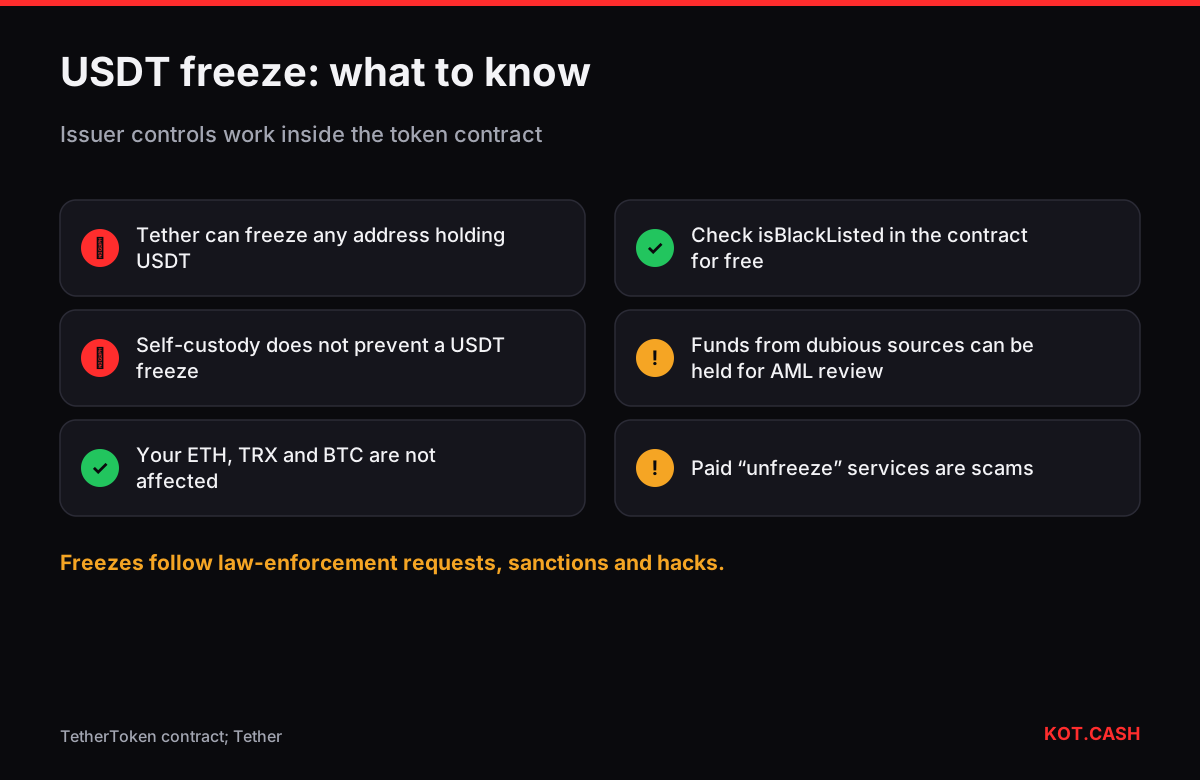
Yes. Tether can freeze USDT held at any address on the networks where it issues the token. The USDT contracts on Ethereum, TRON and other chains contain an admin blacklist: once an address is added, it can no longer send or receive USDT, and Tether can later destroy the frozen balance and reissue it. Freezes are usually linked to law-enforcement requests, sanctions and hacks. Circle has the same capability for USDC. Self-custody protects you from an exchange failing, but not from the issuer's controls over its own token.
How the blacklist works technically
The Ethereum USDT contract (TetherToken) keeps a public mapping called isBlackListed. Functions available to the contract owner add or remove addresses and destroy the funds of a blacklisted address. Transfers check the mapping: if the sender is listed, the transfer fails. The TRON USDT contract has equivalent functions. The controls work at the token level, so they do not depend on which wallet you use or whether you hold your own keys.
| Asset at the frozen address | Affected? |
|---|---|
| USDT on that network | Yes — cannot be sent; may be destroyed and reissued |
| USDT on another network at the same 0x address | Only if that address is blacklisted on that network too |
| ETH, TRX, BTC and other coins | No — the freeze is inside the USDT contract |
| USDC or other stablecoins | Not by Tether; their own issuers have their own controls |
Who asks for freezes and why
Tether states that it freezes addresses in response to requests from law-enforcement agencies, to comply with sanctions lists such as OFAC's, and in cases of identified hacks and scams. In 2024 Tether, TRON and the analytics firm TRM Labs launched the T3 Financial Crime Unit, which coordinates freezes of USDT linked to criminal activity on TRON. The numbers involved are large: Tether reports having frozen hundreds of millions of dollars' worth of USDT over the years. Ordinary users are rarely affected directly; the indirect risk is receiving USDT from an address that is later frozen or flagged.
How to check whether an address is frozen
- Open the USDT contract on Etherscan (or Tronscan for TRC20) and go to the Read Contract tab.
- Find the blacklist read function —
isBlackListedon Ethereum — and enter the address. - A result of true means the address is frozen for USDT on that network; false means it is not.
- Repeat for each network if you use the same address on several EVM chains.
Reading a contract is free and needs no wallet connection. Analytics providers and some wallets also show blacklisted addresses, but the contract itself is the authoritative source.
The indirect risk: tainted funds
Even if your own address is never frozen, USDT you receive may come from an address associated with fraud. Exchanges and swap providers run AML screening; incoming funds with a high-risk history can be held for review, and the provider may ask about the source of funds before completing an order. KOT.CASH's liquidity providers apply their own checks, as described in the AML policy. When you accept USDT from strangers, for example in P2P trades, that screening can affect you later.
- Accept USDT from counterparties you can identify, and keep records of what the payment was for.
- Be careful with P2P offers above market rates; they are a common way to pass on stolen funds.
- Do not reuse an address that received funds from a dubious source for important savings.
- Never interact with addresses that send you unexpected tiny amounts — see address poisoning.
Freezes on TRON versus Ethereum
Most frozen USDT by count sits on TRON, simply because TRC20 is where most USDT transfers happen, including the ones scammers use. The mechanism is the same: the TRON USDT contract at TR7NHqjeKQxGTCi8q8ZY4pL8otSzgjLj6t has owner functions to add an address to the blacklist and to destroy its balance. Tronscan shows a warning label on blacklisted addresses in many cases. One difference users notice: a frozen TRON address can still receive and send TRX and other TRC20 tokens, so the wallet looks active even though its USDT is stuck.
Tether can also reissue destroyed funds to a new address controlled by the rightful owner, which is how victims of some hacks have had USDT returned. That process goes through Tether and law enforcement, not through a wallet or exchange.
Reducing issuer risk
If the possibility of an issuer freeze matters to you, the options are diversification and different asset types. Splitting holdings between USDT and USDC spreads issuer risk but both have freeze functions. Decentralised stablecoins such as DAI have fewer central controls but carry collateral and governance risks of their own. Bitcoin and other native coins cannot be frozen by an issuer, at the price of volatility. There is no option without trade-offs; the stablecoin depeg risk article compares the main ones.
FAQ
Can Tether freeze USDT in my own wallet?
Yes. The freeze works in the USDT contract, so it applies whether the address is on an exchange or in a self-custody wallet.
Does a freeze affect my ETH or TRX?
No. Only the USDT balance at that address on that network is frozen.
How do I check if an address is blacklisted?
Read the USDT contract on Etherscan or Tronscan: the blacklist function returns true for frozen addresses.
Can USDC be frozen too?
Yes. Circle's USDC contracts also have a blacklist function.
What should I do if my USDT is frozen?
Contact Tether's official support. Ignore paid services that promise to unfreeze funds; they are scams.