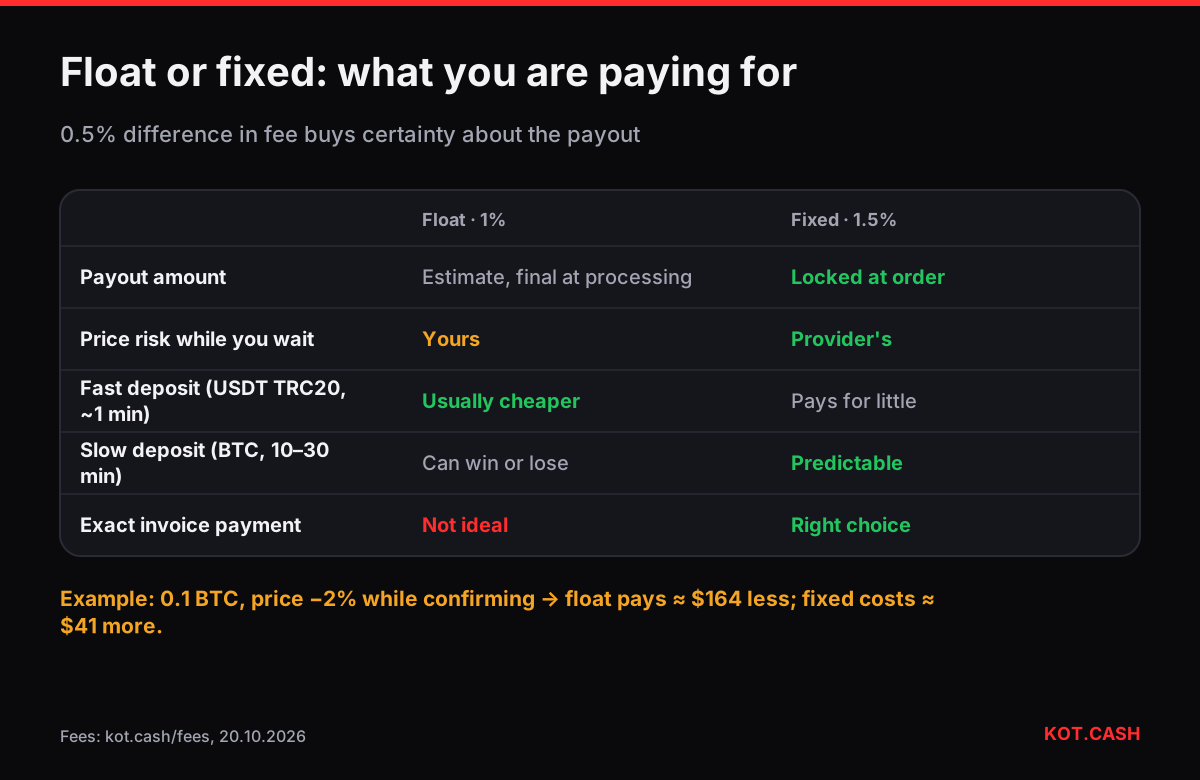
A floating (float) rate gives you the market rate at the moment your deposit is confirmed, at a lower fee; a fixed rate locks the payout amount when you create the order, at a higher fee. On KOT.CASH the float rate costs 1% and the fixed rate 1.5%. Pick float when the coin you send confirms quickly and the market is calm; pick fixed when you need to know the exact payout — paying an invoice, sending a precise amount — or when your deposit will take a long time to confirm in a volatile market.
How the two rates work
With the float rate the widget shows an estimate, and the order follows the market. The final amount is calculated when the provider processes your confirmed deposit. If the price of what you send rises in the meantime, you get more; if it falls, you get less. The order page notes that the received amount is not fixed and may change slightly at the moment of exchange.
With the fixed rate the amount you will receive is locked for the order. You have a time window to send the deposit; within it, market moves are the provider's risk, not yours. That risk is what the extra 0.5% pays for.
| Float | Fixed | |
|---|---|---|
| Service fee | 1% | 1.5% |
| Payout amount | Estimate; final at processing | Locked when the order is created |
| Who carries price risk while you wait | You | The provider, within the payment window |
| Best for | Fast-confirming coins, calm markets | Exact payments, slow deposits, volatile markets |
| If you send a different amount | Recalculated for what arrived (above the minimum) | Send exactly the shown amount |
When float is cheaper — and when it is not
The difference in fee is 0.5% of the amount. Float is cheaper whenever the price of the coin you send does not fall by more than 0.5% between creating the order and processing the deposit. For USDT on TRON, BNB Smart Chain or Solana, where the deposit confirms in about a minute, a 0.5% move against you is rare outside very turbulent hours. For Bitcoin, where 1–2 confirmations take 10–30 minutes, a 0.5% move is ordinary, and it can go either way.
Worked example 1: USDT to BTC, $1,000
Your deposit is USDT, so the value you send does not move; what moves is the price of BTC you receive. With float you pay 1% ($10). With fixed you pay 1.5% ($15) and know the BTC amount. Because a USDT deposit on TRON confirms in about a minute, the BTC price has little time to move; float is usually the better choice.
Worked example 2: BTC to USDT, 0.1 BTC in a falling market
0.1 BTC at $82,000 is $8,200. Float costs about $82; fixed about $123. If BTC drops 2% during the 20 minutes your deposit takes to confirm, the float payout is about $164 lower than the original estimate, while the fixed payout stays as quoted. In that scenario fixed saves about $123. If BTC rises 2%, float gains about $164 instead. Fixed is insurance: you pay $41 more for certainty.
When fixed is the right choice regardless of price
- You are paying an invoice or a person who expects an exact amount in the receiving coin.
- You send from an exchange that may delay the withdrawal for an unknown time.
- You send a slow-confirming coin during a news event or a sharp move.
- You simply do not want to watch the price while the order is open.
Float in practice: what moves the final amount
On the float rate, the amount you see when creating the order is the provider's estimate at that moment. When your deposit is confirmed, the provider exchanges it at the market price at processing time and sends the result minus the payout network fee. Three things therefore move the final number: the market price of both coins between order and processing, the exact amount that arrived (a float order is recalculated for the amount received, as long as it is above the minimum), and, rarely, a change in the payout network fee.
For stablecoin-to-stablecoin swaps — USDC to USDT, or USDT between networks — the price part is close to zero, so float is almost always the better choice. For volatile coins with slow confirmations it is a genuine bet. If you are not sure, look at how long the deposit network takes in the deposit confirmations lookup: the longer the wait, the more the fixed rate is worth.
What neither rate changes
Network fees for your own transfer, the minimum amount, the number of confirmations and the payout time are the same with both rates. Neither rate protects you from sending to the wrong network or without a required memo; read the order page carefully either way. And with fixed, the lock only lasts for the payment window: an order paid after it expires is not executed at the old rate.
The swap fee calculator compares the total cost of a swap with each rate type, and the crypto converter shows the current market rate for the pair.
FAQ
What is the difference between fixed and floating rate?
Float follows the market until your deposit is processed (1% fee); fixed locks the payout amount when you create the order (1.5% fee).
Which rate is cheaper?
Float, by 0.5%, unless the price moves against you by more than that while your deposit confirms.
Can the float amount go up?
Yes. If the price of what you send rises before processing, you receive more than the estimate.
How long is a fixed rate valid?
For the payment window shown on the order page. Pay within it; an expired order is not executed at the old rate.
Do network fees differ between the two?
No. Only the service fee and who carries the price risk differ.