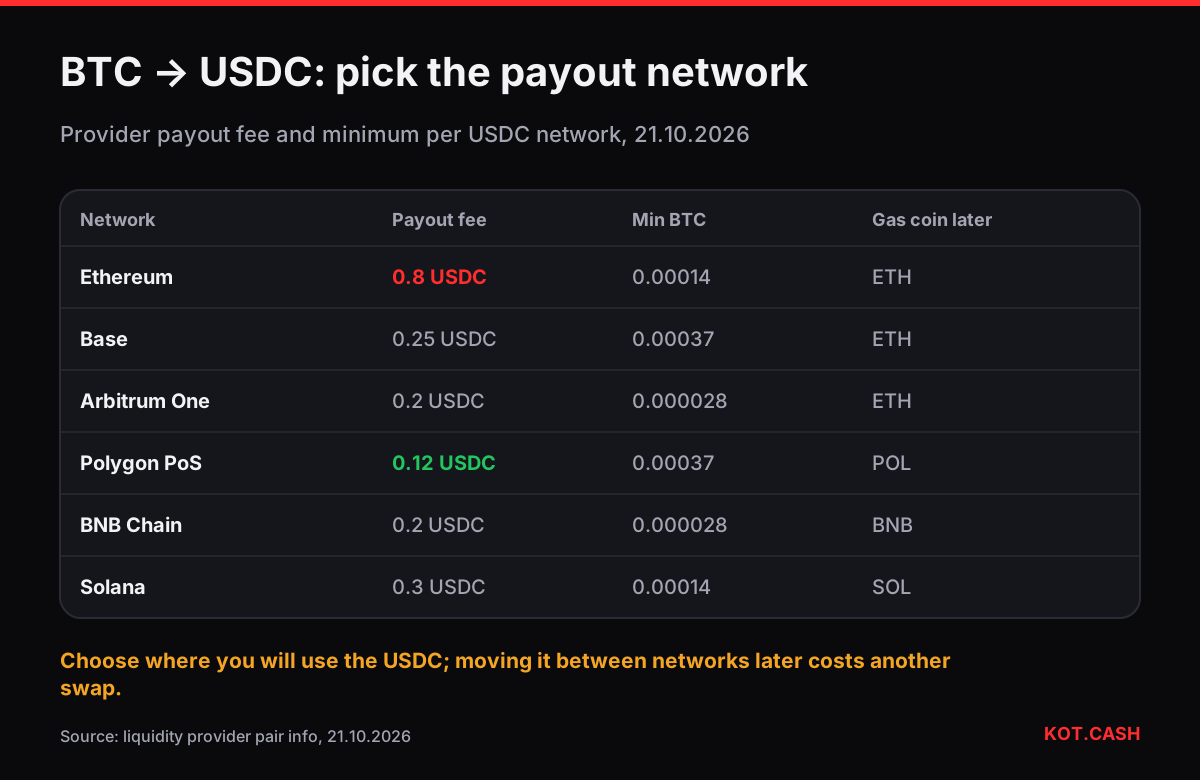
Converting BTC to USDC is a single swap: you send bitcoin to the order's deposit address and receive USDC, Circle's dollar stablecoin, on the network you choose. The choice of network is the decision that matters. On 21 October 2026 the provider's USDC payout fee was 0.8 USDC on Ethereum but 0.12–0.3 USDC on Polygon, BNB Chain, Arbitrum, Base and Solana, and the minimum BTC amount also differed by network. The BTC to USDC page quotes every option before you send.
USDC networks side by side
| USDC network | Payout fee | Min BTC | Address format |
|---|---|---|---|
| Ethereum (ERC20) | 0.8 USDC | 0.00014 | 0x… |
| Base | 0.25 USDC | 0.00037 | 0x… |
| Arbitrum One | 0.2 USDC | 0.000028 | 0x… |
| Polygon PoS | 0.12 USDC | 0.00037 | 0x… |
| BNB Smart Chain | 0.2 USDC | 0.000028 | 0x… |
| Solana | 0.3 USDC | 0.00014 | base58, 32–44 chars |
The minimums look very different because they are set per route by the provider's liquidity, not by a rule you can predict. They change, so treat the table as a snapshot and read the widget. What does not change is the logic: the payout fee is a flat amount, so it matters on small swaps and disappears on large ones.
Which network to choose
Choose the network where you will use the USDC, not the one with the lowest payout fee. Moving USDC between networks later costs another swap or a bridge. A few common cases:
- You will deposit it to an exchange. Check which USDC networks that exchange accepts. Many accept Ethereum, Solana and Base; fewer accept Polygon or Arbitrum. Sending USDC on a network the exchange does not support is the classic way to lose it.
- You use DeFi on Ethereum mainnet. Take ERC20, even at 0.8 USDC, unless your app also runs on an L2 you already use.
- You want to hold dollars cheaply in a self-custody wallet. Base, Arbitrum, Polygon or Solana. You will need a little ETH (Base, Arbitrum), POL (Polygon) or SOL (Solana) later to move it.
- You actually need USDT. Swap BTC to USDT directly instead of going through USDC.
All EVM networks use the same 0x address format, so one MetaMask or Rabby address can receive USDC on Ethereum, Base, Arbitrum, Polygon and BNB Chain. That convenience is also the trap: the address will accept the payout on any of them, and your wallet will only show it if it is set to the right network.
Native USDC, not a bridged copy
Circle issues native USDC on Ethereum, Base, Arbitrum, Polygon PoS and Solana, among others. Older bridged versions such as USDC.e on Polygon and Arbitrum still exist and are separate tokens with different contract addresses. If your wallet shows a USDC balance you did not expect, or none at all, add the token by its contract address from Circle's official list rather than searching by name. The provider's list for USDC also contains a separate entry for bridged USDC on Polygon (MATIC.E), so read the network name in the widget carefully.
The Bitcoin side: one confirmation
The provider credits a BTC deposit after one confirmation. How long that takes depends on the fee rate you pay and on luck: a block every ten minutes on average, with wide variation. If you send from your own wallet, choose a fee rate that gets into the next few blocks; the Bitcoin fee calculator helps estimate it. Exchanges choose the fee for you and sometimes batch withdrawals, which adds their own delay before the transaction even appears.
The provider gave 14–16 minutes as the typical processing time for BTC routes. Once the payout is sent, USDC on an L2 or Solana arrives within seconds; on Ethereum within a minute or so.
Step by step
- Open the BTC to USDC swap, enter the BTC amount and select the USDC network.
- Compare the quotes across networks if you are unsure — the difference is the payout fee.
- Paste your USDC address and double-check that the network in the widget matches the one your wallet or exchange expects.
- Send BTC to the deposit address. Native SegWit and Taproot senders pay less in Bitcoin fees.
- After one confirmation the swap is processed and USDC is sent; the order page shows the payout hash for the explorer of that network.
USDC or USDT?
Both track the dollar, but they are run differently. USDC is issued by Circle, which publishes monthly reserve attestations and obtained an e-money licence in France in 2024, so USDC can be offered to users in the EU under MiCA. USDT from Tether has the larger trading volume and is the default on TRON and many P2P desks. For a payment to someone else, use whichever they ask for; for holding, the difference is mostly about which issuer and which regulatory regime you prefer. Switching later costs a USDC to USDT swap at about 1%.
FAQ
Which USDC network is cheapest to receive?
On 21.10.2026 the lowest provider payout fee was on Polygon (0.12 USDC); Arbitrum and BNB Chain were 0.2 USDC, Base 0.25, Solana 0.3 and Ethereum 0.8 USDC.
Can I receive USDC on Base to my MetaMask address?
Yes. The same 0x address works on Base. Add the Base network in MetaMask to see the balance.
How many Bitcoin confirmations are needed?
One. After it the swap is processed; the provider's typical processing time on BTC routes was 14–16 minutes.
Is USDC.e the same as USDC?
No. USDC.e is a bridged token with its own contract. Native USDC is issued by Circle directly on the network. Check which one your exchange or app expects.
Can I convert BTC to USDC without KYC?
A standard swap needs no account or documents. The liquidity provider runs its own AML checks and may ask about the source of funds in some cases.