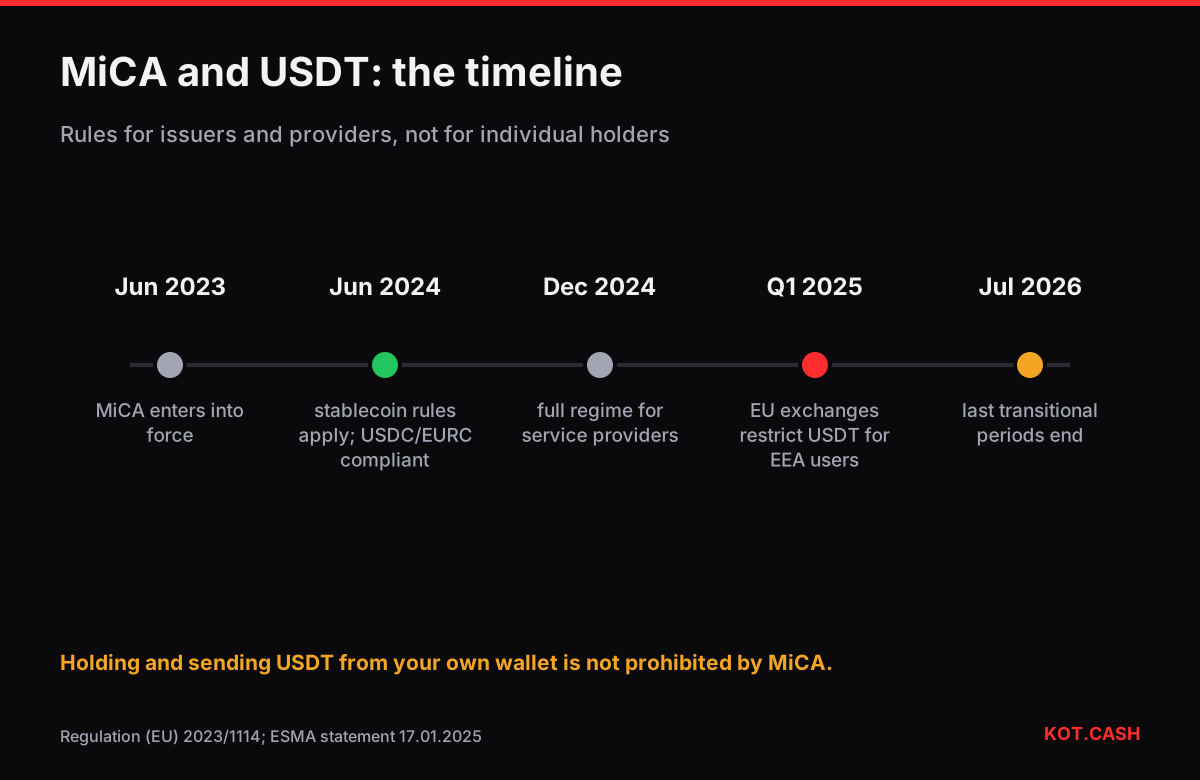
USDT is not banned in the European Union. What changed under MiCA, the EU's Markets in Crypto-Assets Regulation, is that licensed crypto-asset service providers may no longer offer stablecoins whose issuer is not authorised in the EU. Tether has not obtained that authorisation, so by early 2025 the large exchanges serving EU customers removed USDT trading pairs and offers for them. Holding USDT in your own wallet, sending it and receiving it are not prohibited by MiCA.
The key dates
| Date | What happened |
|---|---|
| 29 June 2023 | MiCA (Regulation (EU) 2023/1114) entered into force |
| 30 June 2024 | Rules for stablecoins (asset-referenced and e-money tokens) apply |
| 30 December 2024 | Full MiCA regime for crypto-asset service providers applies |
| 17 January 2025 | ESMA statement: providers should restrict non-compliant stablecoins by the end of Q1 2025 |
| By 31 March 2025 | Major EU-facing exchanges remove USDT pairs for EEA users |
| 1 July 2026 | End of the longest national transitional periods for existing providers |
Why USDT, specifically
Under MiCA a stablecoin that references a single official currency, such as the dollar, is an e-money token (EMT). An EMT may be offered to the public in the EU only if its issuer is authorised as a credit institution or an electronic money institution in the EU and publishes a MiCA white paper. Circle obtained an electronic money institution licence in France in 2024, which made USDC and EURC compliant. Tether chose not to seek authorisation and criticised parts of the rules, including requirements on reserve composition held in European banks.
What an EU resident can still do
- Hold USDT in a self-custody wallet. MiCA regulates issuers and service providers, not individual holders.
- Send and receive USDT between wallets, including to people outside the EU.
- Sell or convert USDT where providers still allow it: many exchanges let EEA users sell or convert existing USDT into compliant assets even after removing trading pairs.
- Use USDC or EURC for trading on EU-licensed exchanges, where they replaced USDT as the main quote currency.
The practical effect is liquidity, not legality: fewer euro on-ramps and order books for USDT, and more friction when moving between USDT and EU banking. Check the terms of each venue for EEA users, because they differ and have changed several times.
What it means for swaps
KOT.CASH swaps run through non-EU liquidity providers and are not an EU-licensed crypto-asset service provider. The service does not ask for documents for standard swaps; the providers' AML policy still applies. Whether you may use a given service from your country is a question of local law and the service's terms, which you should read before swapping. For EU residents who want to stay within the MiCA framework, a common route is to keep USDC on EU-licensed exchanges and use USDT only where counterparties outside the EU require it. The USDC to USDT pair converts between them when needed.
Compliant stablecoins at a glance
ESMA maintains an interim register of MiCA white papers, authorised issuers and service providers. Compliant dollar and euro stablecoins include Circle's USDC and EURC and euro tokens issued by EU banks and e-money institutions. The register is the place to check a specific token; marketing pages are not. Compliance is about the issuer's authorisation, not about the token's network: USDC is MiCA-compliant whether it is on Ethereum, Solana or Base.
Practical routes for EU residents
- If you receive USDT from a client or employer outside the EU, decide in advance where you will convert it: an exchange that still allows EEA users to sell USDT, or a swap into USDC that you then move to an EU-licensed exchange.
- If you send money abroad, ask the recipient which stablecoin and network they accept; many accept USDC as readily as USDT.
- If you hold USDT long term, note that your exit options inside the EU are narrower than before and may narrow further.
- Keep records of every conversion for tax purposes; the tax lot calculator helps when amounts arrive in parts.
Fees matter here too: converting between stablecoins costs a trading or service fee each time, plus network fees. The swap fee calculator compares a direct swap with a route through an exchange.
Taxes are a separate matter
MiCA does not change how stablecoin gains or swaps are taxed. In many EU countries converting USDT to USDC or to euros is a taxable disposal, although the gain is usually small. From 2026 the DAC8 directive requires crypto service providers to report users' transactions to tax authorities — see DAC8 and CARF reporting.
FAQ
Is USDT illegal in the EU?
No. MiCA restricts licensed service providers from offering non-compliant stablecoins; individuals may still hold and transfer USDT.
Why did Binance and Coinbase remove USDT for EU users?
Tether is not an authorised e-money token issuer under MiCA, so EU-licensed providers had to restrict its offer, by the end of Q1 2025 according to ESMA.
Which stablecoins are MiCA-compliant?
Those whose issuer is authorised in the EU, such as Circle's USDC and EURC. ESMA's register lists them.
Can I still sell my USDT as an EU resident?
Usually yes; many exchanges allow selling or converting existing USDT even after removing trading pairs. Check your venue's terms.
Does MiCA change crypto taxes?
No. Taxes are national; reporting under DAC8 starts in 2026.