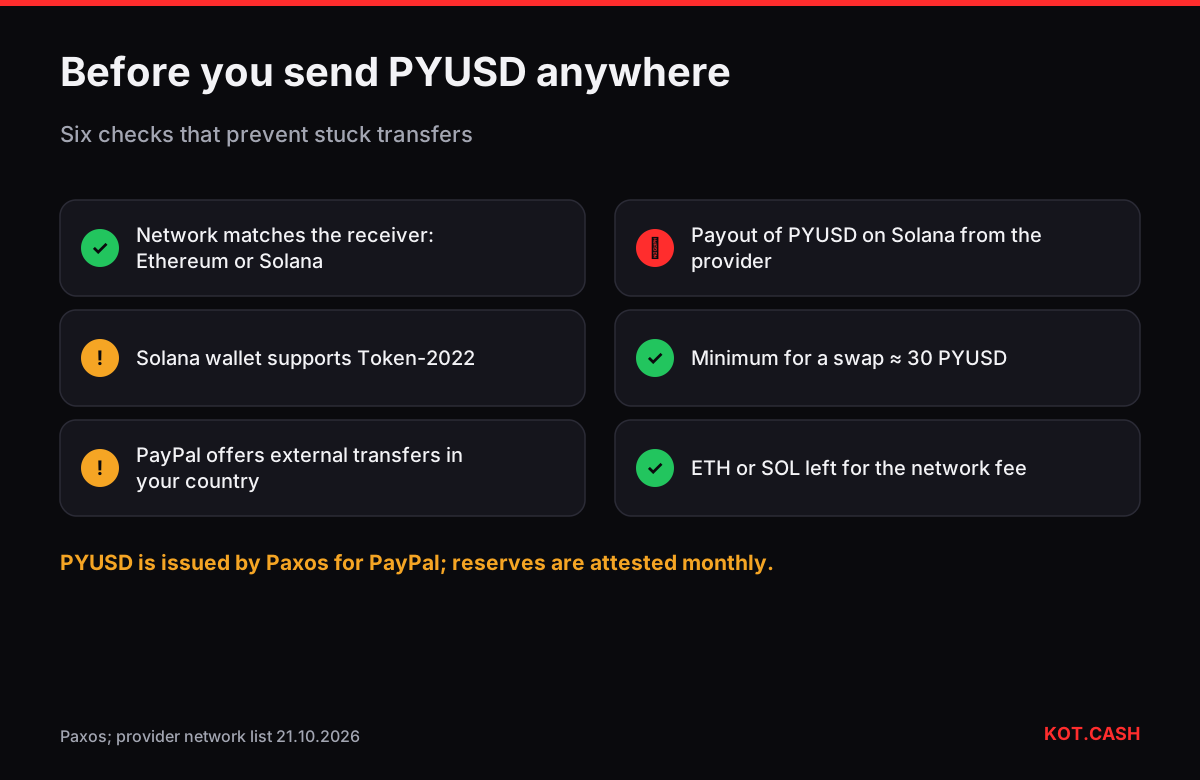
PYUSD (PayPal USD) is a US-dollar stablecoin issued by Paxos Trust Company for PayPal. Each token is meant to be redeemable 1:1 for dollars and is backed by dollar deposits, short-term US Treasuries and similar cash equivalents. It launched in August 2023 on Ethereum and was later issued on Solana. Inside PayPal and Venmo it behaves like a balance you can buy and sell; outside them it is an ordinary token you can send to a wallet, swap or use in DeFi.
Who issues it and what backs it
Paxos is the legal issuer, PayPal is the brand and distribution channel. Paxos publishes monthly attestation reports from an independent accounting firm and reserve composition reports. Reserves are held separately from Paxos's own funds for the benefit of token holders. That structure is similar to USDC and differs from USDT, whose issuer is not a US trust company. None of this removes risk, but it explains why PYUSD is popular with US users and payment businesses that need a regulated issuer.
Chains: Ethereum and Solana
| Network | Standard | Decimals | Provider support (21.10.2026) |
|---|---|---|---|
| Ethereum | ERC-20 | 6 | Deposit and payout |
| Solana | SPL Token-2022 | 6 | Deposit only, no payout |
On Solana PYUSD uses the Token-2022 program, which supports extensions such as transfer hooks and confidential transfers. Some older Solana wallets and tools only handle the original token program and either hide PYUSD or cannot send it. If your wallet shows PYUSD on Solana but refuses to transfer, update it or use a wallet that lists Token-2022 support. Token-2022 accounts are larger than classic token accounts, so creating one costs slightly more rent in SOL.
Moving PYUSD out of PayPal
- In PayPal's crypto section choose PYUSD and the transfer option. PayPal shows the networks it supports for external transfers.
- Paste an address from your own wallet on the matching network — a 0x address for Ethereum, a base58 address for Solana.
- Confirm the network fee shown by PayPal; Ethereum transfers cost noticeably more than Solana ones.
- Wait for the transfer to appear in the explorer, then use it like any other token.
PayPal availability depends on your country and account type. Where external crypto transfers are not offered, PYUSD stays inside PayPal and cannot be sent to a wallet or a swap.
Swapping PYUSD to USDT or BTC
The liquidity provider accepts PYUSD on Ethereum as a deposit, and on Solana as a deposit only. On 21.10.2026 the quoted minimum for PYUSD (ERC-20) to USDT TRC20 was about 30 PYUSD, with 6 Ethereum confirmations before the deposit is credited and a payout network fee of about 1.3 USDT. The usual service fee applies: 1% at a float rate or 1.5% at a fixed rate. Because the provider does not pay out PYUSD on Solana, choose PYUSD on Ethereum if you need to receive it, or receive USDC/USDT instead.
Reading PYUSD in an explorer
On Etherscan PYUSD is the verified PayPal USD token issued by Paxos; on Solscan it is shown with the Token-2022 badge. When you check a transfer, look at the token's mint or contract rather than the name, and note the 6 decimals when reading raw values from the API: 10,000,000 base units are 10 PYUSD. The token decimals converter does the arithmetic. For a Solana transfer the transaction may show extra instructions for the Token-2022 program — that is normal and does not mean a fee was taken from your PYUSD.
A practical tip for first-time users: send a small test amount out of PayPal to your wallet before moving a larger sum. PayPal's external transfer screens differ between countries and versions of the app, and a test shows you exactly which network and fee you get.
Risks specific to PYUSD
- Freeze capability. Like USDC and USDT, the PYUSD contract has admin functions that can freeze addresses on legal request.
- Liquidity. PYUSD's market is smaller than USDT's or USDC's; large swaps can move the price on DEXs.
- Platform dependence. If PayPal changes its crypto offering in your country, conversions back to dollars may need a third-party exchange.
- Yield offers. Some platforms advertise high yields on PYUSD, often as a temporary promotion. A yield is paid by someone; check who pays, for how long and why with the stablecoin yield comparison.
PYUSD compared with USDC and USDT
PYUSD and USDC are both issued by US-regulated companies and publish attestations; USDT is far larger and more liquid, especially on TRON. For payments inside the PayPal ecosystem PYUSD is the natural option; for moving money between exchanges and OTC desks USDT and USDC are accepted far more widely. Depeg risk in general is covered in stablecoin depeg risk.
FAQ
Who issues PYUSD?
Paxos Trust Company issues PYUSD for PayPal; PayPal distributes it in its apps.
Which networks is PYUSD on?
Ethereum (ERC-20) and Solana (Token-2022). Check PayPal for the networks available for transfers in your account.
Can I swap PYUSD to USDT on KOT.CASH?
Yes, from PYUSD on Ethereum or Solana. The minimum on 21.10.2026 was about 30 PYUSD.
Can I receive PYUSD on Solana from a swap?
Not through the current provider: PYUSD on Solana is supported for deposits only.
Is PYUSD the same as USDC?
No. Both are dollar stablecoins from US-regulated issuers, but PYUSD is issued by Paxos for PayPal and USDC by Circle.