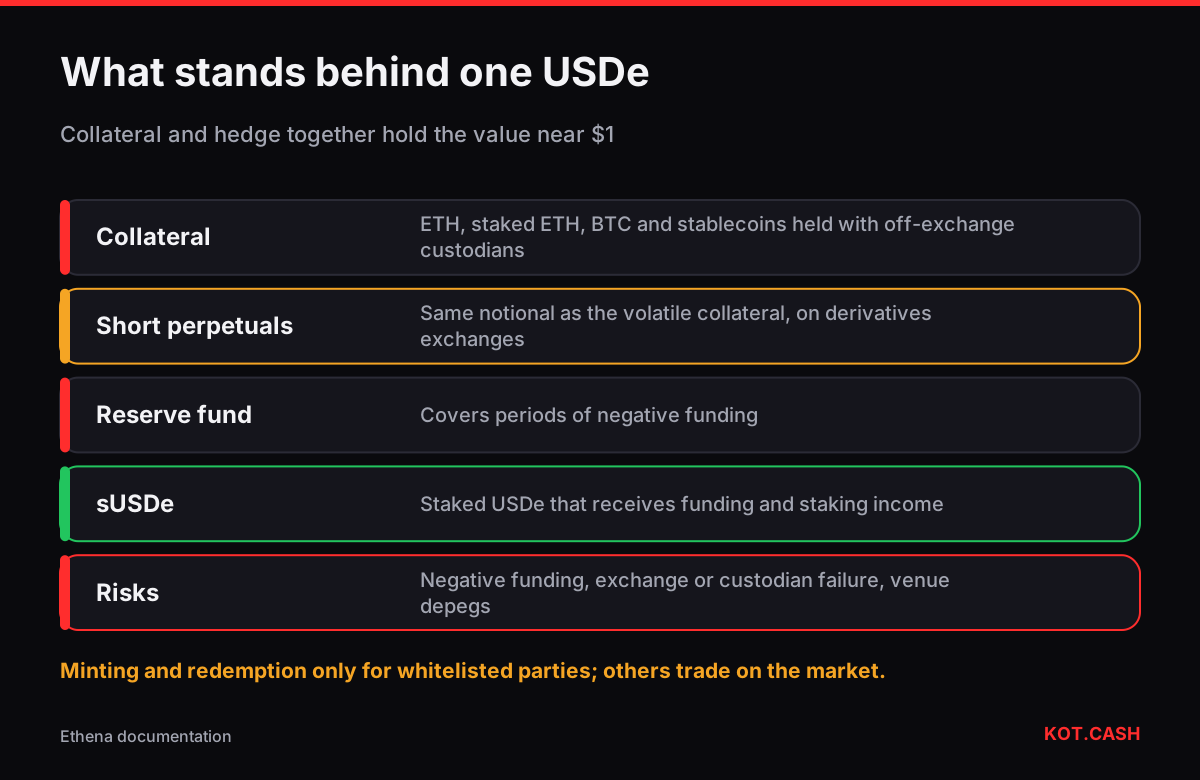
USDe is a synthetic dollar issued by Ethena. It is not backed by bank deposits: each USDe is backed by crypto collateral (ETH, staked ETH, BTC and stablecoins) combined with an equal short position in perpetual futures, so the value of the package stays near one dollar whatever ETH or BTC does. Holders who stake USDe receive sUSDe, which earns the funding payments and staking rewards that the position generates. That design works well while funding is positive and exchanges are healthy, and it carries risks that a cash-backed stablecoin does not.
The mechanism in four steps
- An approved minter deposits collateral, for example stETH worth $1 million, and receives about 1 million USDe.
- Ethena opens a short perpetual position of the same notional on derivatives exchanges. If ETH falls 10%, the collateral loses $100,000 and the short gains about $100,000.
- The collateral is held with off-exchange custodians and mirrored to exchanges, so the margin is not deposited directly on an exchange balance.
- Redemption reverses it: the minter returns USDe, Ethena closes the matching short and releases collateral.
Minting and redeeming directly with Ethena is limited to whitelisted parties that pass its checks. Everyone else buys and sells USDe on exchanges and DEX pools, which means the market price can move away from $1 when those pools are stressed, even if the backing is intact.
Where the yield comes from
Perpetual futures pay funding between longs and shorts. When traders are mostly long, funding is positive and shorts receive it. Ethena's short collects that funding, plus the staking yield of staked ETH collateral and interest on stablecoin collateral. The protocol passes most of it to sUSDe holders. Funding rates are cyclical: in bullish periods annualised funding on ETH can exceed 10–20%, in quiet or bearish periods it falls close to zero or turns negative. The funding rate calculator converts a per-8-hour rate into an annual figure if you want to check quoted yields yourself.
| Factor | Effect on yield | Why |
|---|---|---|
| High positive funding | Up | Longs pay shorts more |
| ETH staking rewards | Small steady part | Staked ETH collateral earns ~3% a year |
| Funding near zero | Down | Little income from the hedge |
| Negative funding | Negative, covered by the reserve fund | Shorts pay longs |
| More USDe supply than demand for longs | Down | Ethena's shorts push funding lower |
Risks to understand
- Negative funding for a long time. Ethena keeps a reserve fund to cover it; a long and deep negative period could exhaust it.
- Exchange counterparty risk. The hedge lives on centralised derivatives exchanges. An exchange failure or forced position closure breaks the hedge for that part.
- Custody risk. Off-exchange settlement providers hold the collateral; their failure would matter.
- Liquidity and secondary-market depegs. During the market crash of 10–11 October 2025 USDe briefly traded far below $1 on one large exchange's order book while on-chain pools stayed much closer to the peg. Price on a venue and backing are two different things, but a user selling at that moment would have received the venue price.
- Collateral basis risk. Staked ETH can trade slightly below ETH, so the hedge is not perfect.
USDe and regulation
USDe is not a fiat-backed e-money token. In the European Union, MiCA treats dollar stablecoins offered to the public as e-money tokens that need an authorised issuer; Ethena wound down its German entity in 2025 after objections from the regulator BaFin. Whether USDe is available to you depends on the venue and your country. Treat it as a crypto product with a yield, not as a dollar in a bank.
USDe on KOT.CASH
The liquidity provider supports USDe on Ethereum (ERC-20), on TON (with a required memo on deposit) and on Mantle. On 21.10.2026 the quoted minimum for USDe on Ethereum to USDT TRC20 was about 30 USDe, credited after 6 Ethereum confirmations, with a payout network fee of about 1.3 USDT. sUSDe is a separate token and is not listed. Unstake sUSDe in Ethena's interface first; the cooldown before you can withdraw USDe from sUSDe has been 7 days for most users.
USDe compared with USDT and DAI
USDT is backed mostly by US Treasuries and cash held by Tether and redeemable for verified customers; it pays holders nothing. DAI and its successor USDS are overcollateralised loans against crypto and real-world assets, with a savings rate set by governance. USDe is backed by a hedged crypto position and pays a market-driven rate through sUSDe. Each design fails differently: USDT through its issuer and reserves, DAI through collateral crashes and governance, USDe through funding, exchanges and custodians.
FAQ
Is USDe a stablecoin?
It is a synthetic dollar that aims to stay at $1 through hedged collateral, not through bank deposits.
Where does sUSDe yield come from?
Funding payments on Ethena's short perpetual positions, staking rewards on staked ETH collateral and interest on stablecoin collateral.
Can USDe lose its peg?
Its market price can fall below $1 on a venue during stress, and prolonged negative funding or an exchange failure could affect backing.
Can I redeem USDe directly?
Only whitelisted minters redeem with Ethena; other users sell USDe on exchanges or DEXs.
Can I swap USDe to USDT on KOT.CASH?
Yes, from USDe on Ethereum, TON or Mantle. The minimum on 21.10.2026 was about 30 USDe.