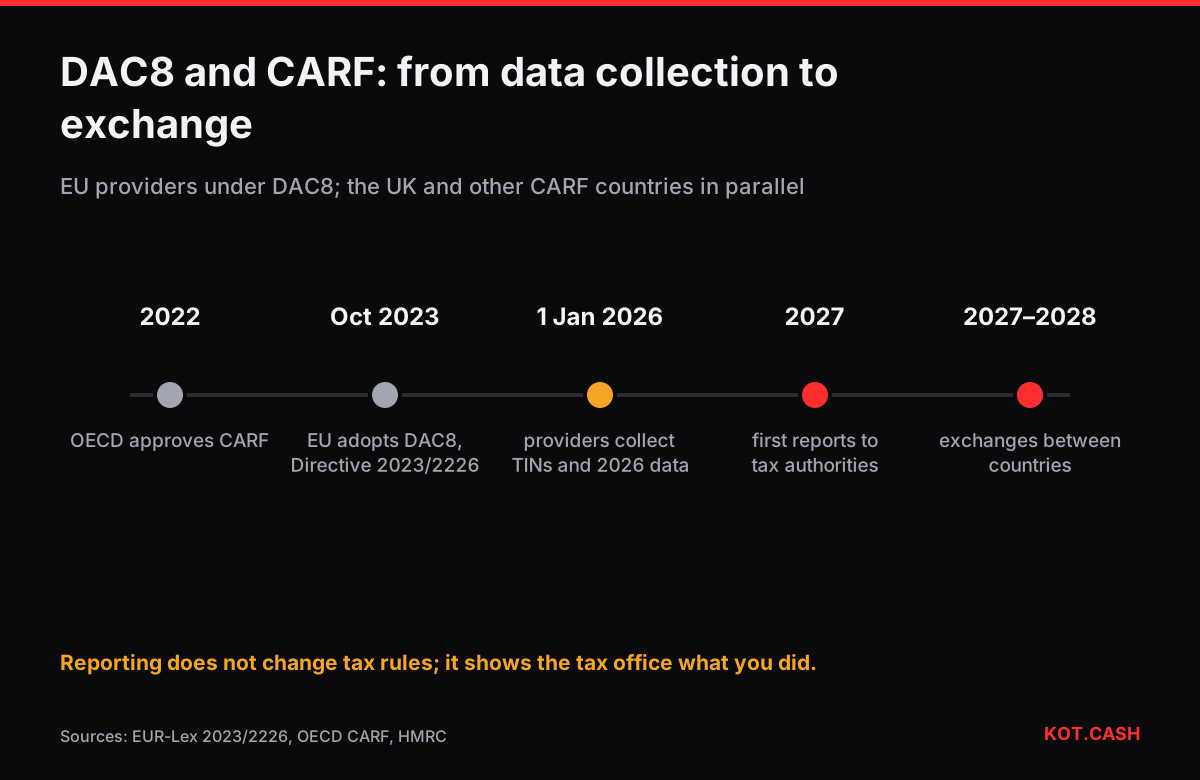
Since 1 January 2026, crypto-asset service providers in the European Union collect tax information about their users and their transactions under DAC8, the eighth amendment of the EU directive on administrative cooperation in taxation. Outside the EU, the OECD's Crypto-Asset Reporting Framework (CARF) does the same job; the United Kingdom applies it from the same date. The first reports, covering 2026, go to tax authorities in 2027, and authorities then exchange them with the user's country of residence. In practice this ends the period when crypto held on regulated platforms was invisible to the tax office at home.
Timeline
The OECD approved CARF in 2022 and more than 60 jurisdictions have committed to implement it, most of them with first exchanges in 2027 or 2028. The EU adopted DAC8 as Council Directive (EU) 2023/2226 in October 2023, aligning it closely with CARF so that one set of procedures serves both. Member states had to transpose it by the end of 2025.
Who has to report
Reporting crypto-asset service providers: businesses that carry out exchange transactions for or on behalf of customers, such as exchanges, brokers and some wallet providers that facilitate exchanges. Under DAC8 this covers providers authorised under the EU's MiCA regulation and also operators from outside the EU that serve EU residents. Non-custodial software that only lets you hold your own keys is generally outside the scope, because it does not carry out exchange transactions for you.
What is reported
| Category | Examples |
|---|---|
| Identity | name, address, date and place of birth |
| Tax residence | country or countries of residence |
| Tax identification number | TIN for each residence country |
| Exchanges crypto ↔ fiat | aggregate amounts per crypto-asset, number of transactions |
| Exchanges crypto ↔ crypto | aggregate fair market value, both directions |
| Transfers | transfers to wallets not known to be with a provider, retail payments over a threshold |
The amounts are reported per type of crypto-asset and aggregated for the year, not as a line-by-line trade history. They show the tax authority that you disposed of crypto and the gross values involved; they do not compute your gain. You still need your own records to show acquisition costs.
What users have to do
- Provide a self-certification of tax residence and a TIN when a provider asks. New customers are asked at onboarding; existing customers during 2026.
- Keep the information up to date when you move country.
- Expect accounts to be restricted if you do not provide the information; the rules oblige providers to enforce it, and countries set penalties for false or missing self-certification.
- Check that your own tax return matches what the provider reports. A mismatch is what triggers questions.
How it fits with tax rules
Reporting does not change how crypto is taxed in each country. A German resident is still taxed under §23 EStG, a Portuguese resident still benefits from the 365-day rule, and a Dutch resident is still in Box 3. What changes is that the authority sees the activity and can compare it with the return. Country guides: Germany, Portugal, Netherlands, UK.
How it relates to MiCA, CRS and US reporting
MiCA, the EU regulation on markets in crypto-assets, decides who may offer crypto services in the EU; DAC8 uses that licensing to define most of the providers that must report. CARF is designed to sit next to the Common Reporting Standard (CRS), which has covered bank and securities accounts since 2017; DAC8 also updated the EU's CRS rules so that e-money and some digital assets are not missed. The United States is not part of CARF exchanges yet and uses its own broker reporting on Form 1099-DA for 2025 transactions onwards, described in the US guide.
One practical effect is that reporting is based on residence, not citizenship. If you live in Spain and use a German exchange, the German provider reports to the German authority, which passes the data to Spain. If you hold a second residence certificate, the provider may report to both countries.
Non-custodial swaps
When you swap through a service that does not hold your funds or keep an account, such as a standard KOT.CASH order, there is no account to attach a self-certification to. That does not make the swap tax-free: your tax obligations come from your residence, not from reporting. Keep the order link with both amounts and transaction hashes so that you can document the swap in your own return, and so that a later sale on a reporting platform can be matched with its acquisition cost.
FAQ
When does DAC8 start?
It applies from 1 January 2026. Providers collect data for 2026 and report in 2027, after which EU tax authorities exchange it.
What is CARF?
The OECD Crypto-Asset Reporting Framework, a global standard for collecting and exchanging tax data on crypto users. The UK applies it from 1 January 2026.
Will my exchange report my gains?
It reports aggregate gross amounts of exchanges and transfers per crypto-asset, not your gains. You still compute gains yourself.
Do I have to give my exchange my tax number?
Yes. Reporting providers must obtain a self-certification of tax residence and a TIN, and can restrict accounts that do not provide it.
Does DAC8 cover self-custody wallets?
Software that only lets you hold your own keys generally is not a reporting provider. Transfers from a provider to such wallets can be reported.