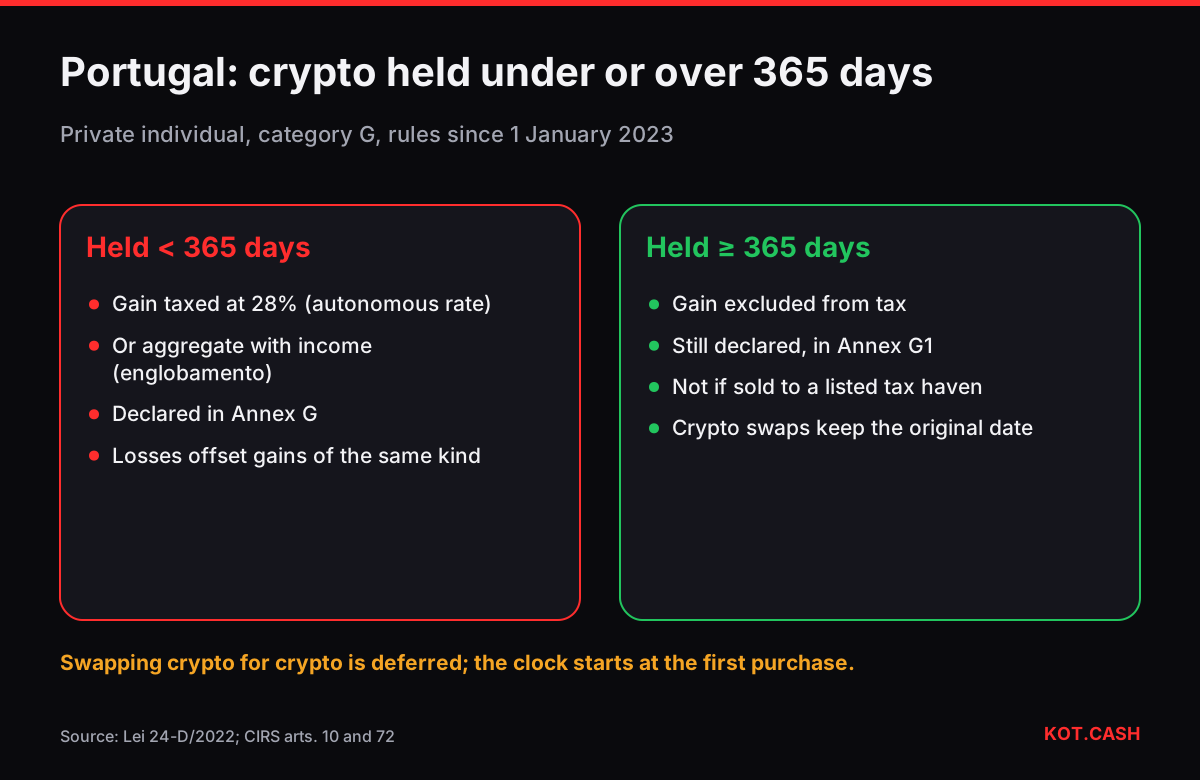
Portugal stopped being a crypto tax haven on 1 January 2023, but not completely. Under the State Budget law for 2023 (Lei 24-D/2022), a private individual who sells crypto held for less than 365 days pays 28% on the gain. Crypto held for 365 days or more is excluded from tax when sold. Swapping one crypto for another does not trigger tax at all; the tax waits until you convert to euros or spend. This guide sets out how each of those rules works in practice, as of October 2026.
Short holdings versus long holdings
The distinction sits in the Personal Income Tax Code (CIRS). Gains on crypto that is not a security are category G income (capital increments). If the holding period is under 365 days, the net gain is taxed autonomously at 28%. If it is 365 days or longer, the gain is excluded from taxation, though you still declare it in the annual return. The exclusion does not apply when the buyer or counterparty is resident in a jurisdiction on Portugal's list of tax regimes that are clearly more favourable, so selling into such a venue keeps the gain taxable.
As with any category G income, you can opt to aggregate (englobamento) and have the gain taxed at your progressive IRS rates instead of 28%. That only makes sense when your total income is low enough that your marginal rate is below 28%. Choosing englobamento applies to all income of the same type for the year, so run both scenarios first. The Portugal crypto tax calculator does the 28% version lot by lot.
Why swaps are deferred
A crypto-to-crypto exchange is not a taxable event in Portugal. The law treats the new coins as acquired at the acquisition value of the coins you gave up, and on the original acquisition date for the holding period. In plain terms: swapping BTC bought two years ago into ETH does not reset the clock and does not create a gain today. When you later sell the ETH for euros, the gain is the euro proceeds minus what you paid for the BTC, and the holding period counts from the BTC purchase.
This makes Portugal one of the countries where moving between coins, or into stablecoins, is neutral. The exception is a swap into something that is not a crypto-asset under the law, such as a token that qualifies as a security. Stablecoins are crypto-assets for this purpose, so parking gains in USDT is not a sale. The comparison of countries is in the guide is a crypto-to-crypto swap taxable.
Worked example
- February 2025: you buy 1 ETH for €2,400.
- June 2025: you swap it for 0.032 BTC. No tax; the BTC inherits €2,400 cost and February 2025 as its date.
- December 2025: you sell the BTC for €2,900. Holding period from February is under 365 days: gain €500, tax 28% = €140.
- Had you waited until after February 2026 to sell, the €500 gain would have been excluded from tax.
Staking, mining and professional activity
Income from validating transactions, mining and similar operational activity falls under category B (business and professional income) when it is regular. Issuing crypto, providing services around it and trading as a business also go into category B. In category B the rules on when a gain arises are different: tokens received as payment are income at their value, and later disposals are measured from there. Occasional passive rewards can still be tricky to classify, which is one reason to ask a Portuguese contabilista before filing.
NFTs and security tokens
Tokens that qualify as securities are taxed like securities, not under the crypto rules. Unique, non-fungible tokens are excluded from the crypto-asset definition used for the 365-day rule. If you hold tokenised shares or bonds, the general 28% capital gains rules apply regardless of holding period.
Declaring
| Situation | Annex | Taxed? |
|---|---|---|
| Sold < 365 days | Annex G | 28% or englobamento |
| Sold ≥ 365 days | Annex G1 | excluded, declared |
| Swap crypto → crypto | not a disposal | deferred |
| Mining, validation, business | Annex B | category B rules |
The IRS return for a year is filed between April and June of the following year on the Portal das Finanças. Keep evidence of every acquisition and disposal: exchange statements, wallet exports and, for swaps without an account such as on KOT.CASH, the order link that shows both amounts and both transaction hashes. Because swaps carry forward the original cost and date, you need records of the first purchase in a chain even years later.
FAQ
Is crypto tax-free in Portugal?
Gains on crypto held for 365 days or more are excluded from tax for individuals. Shorter holdings are taxed at 28%.
Is swapping crypto taxable in Portugal?
No. A crypto-to-crypto exchange is deferred: the new coins keep the original cost and acquisition date.
Can I choose my income tax rate instead of 28%?
Yes, through englobamento (aggregation) with your other income. It helps only if your marginal rate is below 28%.
Are stablecoins treated as cash in Portugal?
No. Stablecoins are crypto-assets, so converting into them is a swap, not a sale for euros.
Since when does Portugal tax crypto?
The current rules came in with the State Budget for 2023, Lei 24-D/2022, effective 1 January 2023.