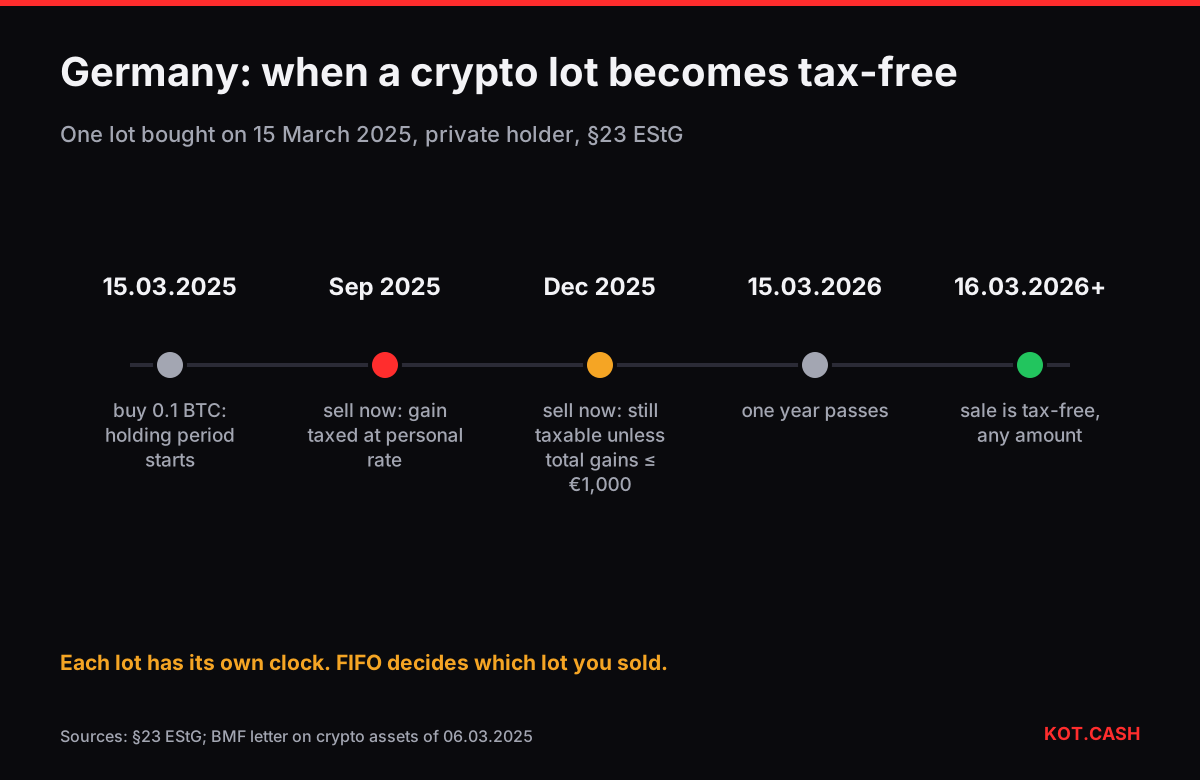
For a private person in Germany, selling crypto is a private sale transaction under §23 of the Income Tax Act (EStG). If you held the coins for more than one year, the gain is tax-free. If you sold within a year, the gain is added to your income and taxed at your personal rate, unless your total gains from such private sales stay at or below €1,000 for the year. That is the core of German crypto tax as of October 2026; the rest of this guide covers how the year is counted, which events count as a sale and what the tax office expects you to keep.
The one-year holding period
§23 (1) no. 2 EStG treats crypto like other assets that are not securities: a sale is taxable only if acquisition and sale are no more than one year apart. The period runs per lot. If you bought 0.1 BTC on 15 March 2025 and another 0.1 BTC on 1 October 2025, the first lot becomes tax-free after 15 March 2026 and the second after 1 October 2026.
When you sell part of a balance, the tax office needs to know which lot you sold. The Federal Ministry of Finance (BMF) letter on crypto assets, updated on 6 March 2025, accepts first in, first out (FIFO) as the standard: the oldest coins leave first. That works in your favour in a rising market, because the oldest lots are the first to cross the one-year line. The tax lot calculator shows how FIFO assigns your sales to lots, and this explainer compares FIFO with other methods.
Staking or lending coins does not extend the holding period to ten years. Older commentary claimed it might; the BMF letter settled the question, and the one-year period applies.
What counts as a sale
- Selling for euros or another fiat currency.
- Swapping one coin for another, for example ETH to BTC or BTC to USDT. A swap is an exchange of assets, so for tax purposes you sold the first coin at its market value.
- Paying for goods or services with crypto.
- Not a sale: moving coins between your own wallets, buying crypto with euros, holding.
The swap rule surprises people most. Converting a coin bought eight months ago into a stablecoin is a taxable disposal even though no euros reached your bank account. The gain is the euro value of what you received minus what you originally paid, including fees.
The €1,000 Freigrenze
Since the 2024 tax year the exemption limit (Freigrenze) for private sale transactions is €1,000 per person per year; before that it was €600. It is a limit, not an allowance. If your total net gain from all private sales within the holding period is €1,000 or less, nothing is taxed. If it is €1,001, the full €1,001 is taxable, not just the excess. Married couples filing jointly each have their own €1,000.
| Net gain in the year | Taxable amount | Why |
|---|---|---|
| €800 | €0 | at or below the limit |
| €1,000 | €0 | exactly at the limit |
| €1,050 | €1,050 | limit exceeded: everything is taxable |
| €3,000 gain, €2,400 loss | €0 | net €600 is below the limit |
Rate, solidarity surcharge and church tax
Short-term gains are taxed at your personal income tax rate, which is progressive up to 45%. The flat 25% withholding tax on capital income does not apply to crypto held privately, because coins are not capital assets in the sense of §20 EStG. On top of income tax come the solidarity surcharge (5.5% of the tax, which most taxpayers no longer pay because of high exemption thresholds) and, if you are a member of a church that levies it, church tax of 8% or 9% of the income tax. The Germany crypto tax calculator applies these to your lots.
Losses
Losses from private sales within the holding period can only be offset against gains of the same kind. You can carry a net loss back one year or forward indefinitely, but only against future §23 gains, not against salary. Losses on coins held for more than a year do not count at all, just as those gains are tax-free. Report losses in the year they arise, even when you have no gains, so the tax office records the carry-forward.
Staking, mining and airdrops
Rewards from staking and lending are usually other income under §22 no. 3 EStG at their euro value when received. That category has its own exemption limit of €256 a year, which again is a limit, not an allowance. Mining on a commercial scale is business income. When you later sell reward coins, a new one-year holding period applies from the day you received them.
Records the tax office expects
- Exports of every exchange and wallet: date, asset, amount, euro value and fees.
- Proof of acquisition cost, including transaction fees, for every lot you sell.
- A lot-by-lot calculation showing the holding period of each sale.
- For swaps done outside an exchange, the order confirmation and the transaction hashes on both chains.
When you swap on KOT.CASH, the order page shows the amounts and the hashes of the deposit and the payout. Save that page or its link together with your own records: you will need the euro value at the time of the swap, which you can take from a reputable price source for that day.
FAQ
Is Bitcoin tax-free in Germany after one year?
Yes, for private holders. Gains on coins held for more than one year are not taxable under §23 EStG.
Is swapping crypto to crypto taxable in Germany?
Yes, if the coin you give away was held for one year or less. The swap counts as a sale at market value.
What is the crypto tax-free amount in Germany?
Since 2024 there is a €1,000 exemption limit per person for private sale gains. Above it, the whole gain is taxable.
Do staking rewards restart the holding period?
Each reward lot has its own holding period starting on the day it was received. Staking does not extend the period to ten years.
Can crypto losses reduce my salary tax?
No. Losses from private sales offset only gains from private sales in the same year, the year before or future years.