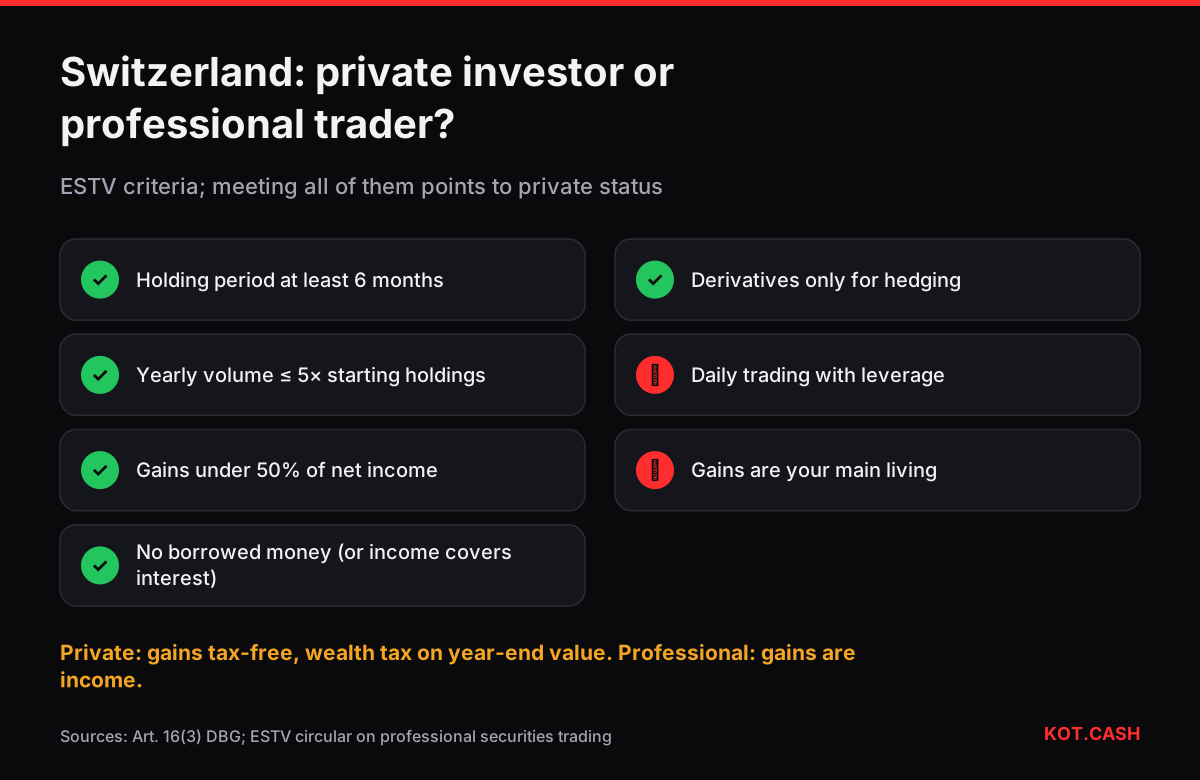
For a private individual resident in Switzerland, capital gains on movable private assets, crypto included, are tax-free under article 16 paragraph 3 of the Federal Direct Tax Act (DBG). What you do pay is wealth tax: crypto you hold on 31 December is part of your taxable assets, valued at the rate the Federal Tax Administration (ESTV) publishes. Income from crypto, such as staking rewards or a salary paid in bitcoin, is taxable income. The exception that changes everything is professional trading: if the tax office classifies you as a professional, gains become taxable income.
Three different taxes, three treatments
| Tax | What it covers | Crypto treatment |
|---|---|---|
| Income tax (federal, cantonal, communal) | income of the year | gains: tax-free for private wealth; rewards and pay: taxable |
| Wealth tax (cantonal, communal) | net assets on 31 December | crypto at the ESTV year-end rate |
| No federal capital gains tax | — | private gains not taxed |
Wealth tax is cantonal, so the rate depends on where you live, typically a few per mille of net wealth with allowances that differ by canton. Crypto is declared in the securities list (Wertschriftenverzeichnis) of your return with the number of units and the year-end value. The ESTV publishes year-end rates for many cryptocurrencies in its price list; for coins not on it, you use the year-end price from the trading venue you use, documented.
Example
You live in a canton with a wealth tax of 3 per mille on your bracket and hold 2 BTC on 31 December. If the ESTV year-end rate is CHF 75,000 per BTC, the coins add CHF 150,000 to your taxable assets and roughly CHF 450 to the year's wealth tax. Selling the same BTC in January at a profit of CHF 40,000 would add nothing to income tax, as long as you are a private investor and the sale fits your usual pattern of holding. The numbers are illustrative; your canton sets the actual rate and allowances.
When you are treated as a professional trader
The ESTV's circular on professional securities trading sets out criteria that tax offices also use for crypto. If all of the following are met, you are generally treated as a private investor:
- You hold the assets for at least six months.
- Your annual transaction volume does not exceed five times your holdings at the start of the year.
- Capital gains are not a necessary part of your living: they are less than 50% of your net income in the year.
- You do not finance the investments with borrowed money, or the income from them covers the interest.
- Derivatives are only used to hedge your own positions.
Failing a criterion does not automatically make you a professional; the tax office then looks at the whole picture. But if you are classified as a professional, gains are taxed as self-employment income, losses become deductible and social security contributions (AHV/AVS) are due on the profit. For active traders this is the most important question in Swiss crypto tax.
Income from crypto
- Staking rewards: income at their market value when received, according to most cantonal practice.
- Mining: income; at a commercial scale, self-employment income.
- Airdrops: generally income at market value when received, unless worthless.
- Salary in crypto: employment income at the value on the payment date, with social security contributions.
- Lending interest: income.
Coins received as income join your private wealth at their taxed value. A later price increase on them is then a private capital gain, tax-free unless you trade professionally. The staking APY calculator helps estimate reward income for planning, but the declared value is the market price on each receipt date.
Swaps and tax-free gains in practice
Because private capital gains are not taxed, a swap of BTC into ETH or into a stablecoin has no income tax consequence for a private investor. What matters is the year-end position for wealth tax and that your trading pattern stays within the private investor criteria. Many swaps within short periods push you towards the professional trader assessment, which is the real risk.
Records
Keep evidence of acquisitions and disposals in case the tax office examines whether you trade professionally: exchange statements, wallet addresses, and for non-custodial swaps such as on KOT.CASH the order links. For the wealth tax, a snapshot of balances per wallet on 31 December with the price source used is what tax offices typically ask for. The portfolio tracker can produce such a list.
FAQ
Are crypto gains taxed in Switzerland?
Not for private individuals: capital gains on private movable assets are tax-free under article 16(3) DBG. Professional traders are taxed.
Do I pay tax on crypto I hold in Switzerland?
Yes, wealth tax. Crypto held on 31 December is part of your net assets at the ESTV year-end rate.
When am I a professional crypto trader in Switzerland?
The ESTV criteria include holding under six months, volume above five times your holdings, gains over half your income, leverage and speculative derivatives.
Are staking rewards taxable in Switzerland?
Generally yes, as income at their market value when received, per cantonal practice.
Is swapping BTC to ETH taxable in Switzerland?
Not for a private investor, since private capital gains are tax-free; frequent swaps can affect professional trader status.