The IRS treats digital assets as property, not currency. Every time you sell crypto, swap it for another token or spend it, you realise a capital gain or loss: the dollar value you received minus your basis. Hold for more than one year and the gain is long-term, taxed at 0%, 15% or 20% depending on your income; hold for one year or less and it is short-term, taxed at your ordinary income rate. That rule has applied since IRS Notice 2014-21. What changed recently is reporting: brokers now send Form 1099-DA.
Taxable events and non-events
| Action | Taxable? | What you report |
|---|---|---|
| Sell BTC for USD | yes | capital gain or loss |
| Swap ETH for USDC | yes | gain or loss on the ETH |
| Pay for a service in crypto | yes | gain or loss on the coins spent |
| Receive staking rewards | yes, as income | fair market value when you gain control |
| Buy crypto with USD | no | record the basis |
| Move coins between your own wallets | no | keep records; network fee adds to basis rules |
| Gift under the annual exclusion | no tax for the giver | recipient takes your basis |
Swaps catch many people out. A trade from ETH to a stablecoin is a sale of the ETH, even though the dollar value stays inside crypto. The crypto-to-crypto swap guide compares this with countries that defer tax on swaps.
Long-term rates for tax year 2025
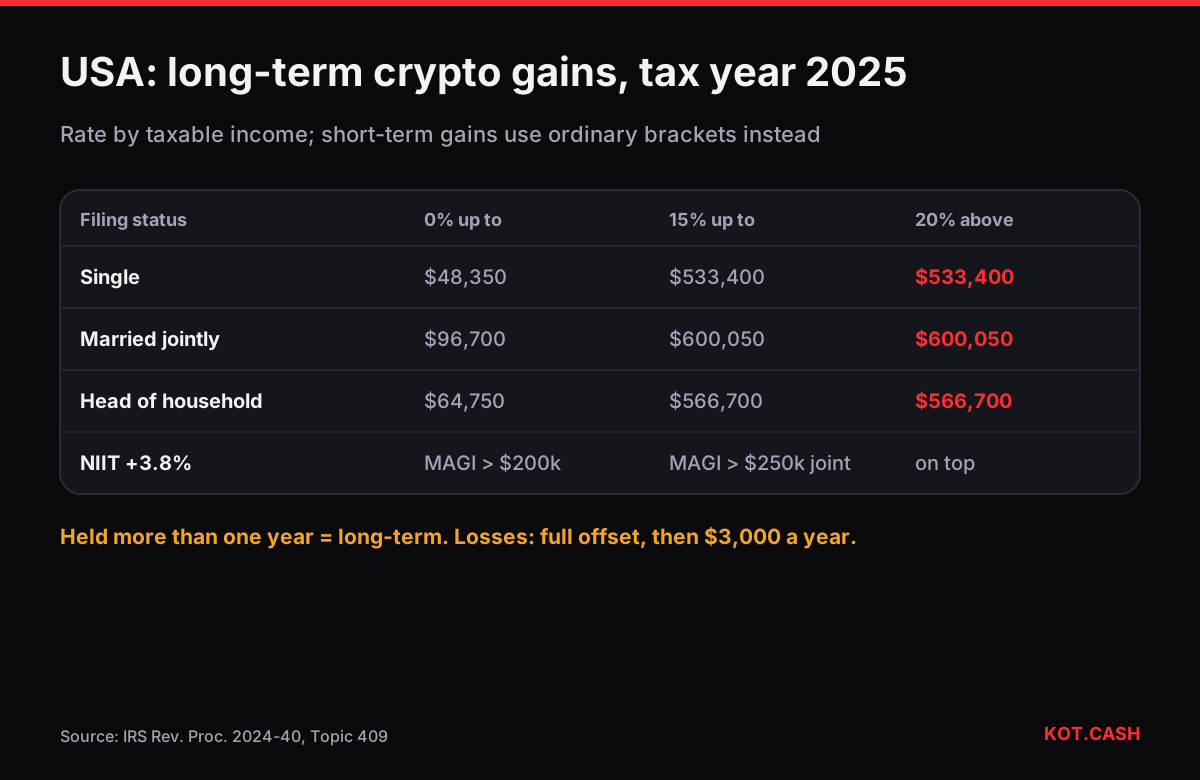
Long-term gains are taxed at preferential rates. For 2025 returns (filed in 2026), the IRS thresholds of taxable income are:
| Filing status | 0% up to | 15% up to | 20% above |
|---|---|---|---|
| Single | $48,350 | $533,400 | $533,400 |
| Married filing jointly | $96,700 | $600,050 | $600,050 |
| Head of household | $64,750 | $566,700 | $566,700 |
High earners also pay the 3.8% Net Investment Income Tax on gains when modified adjusted gross income is above $200,000 (single) or $250,000 (married filing jointly). Short-term gains simply add to ordinary income and follow the regular brackets, up to 37%. The US crypto tax calculator splits your lots into the two groups and applies the right rates.
Holding period and basis
The holding period starts the day after you acquire the coins and must exceed one year for long-term treatment. Basis is what you paid, including fees. If you bought the same coin several times, you must identify which units you sell; without specific identification, first in, first out applies. Since 2025 the IRS requires this identification wallet by wallet or account by account, rather than across all your holdings. The holding period calculator shows the date each lot turns long-term.
Losses
Capital losses offset capital gains without limit. If losses exceed gains, up to $3,000 a year ($1,500 if married filing separately) can reduce ordinary income, and the rest carries forward indefinitely. The wash sale rule in section 1091 applies to stocks and securities; as of October 2026 it does not cover crypto held as property, so selling at a loss and rebuying is not disallowed by that rule. Congress has repeatedly proposed extending it, so check before relying on it. The tax-loss harvesting calculator estimates what a harvested loss is worth at your rates.
Forms you will see
- Form 1040, digital asset question. Every filer answers yes or no on whether they received, sold, exchanged or disposed of digital assets.
- Form 8949 and Schedule D. Each disposal is listed with dates, proceeds, basis and gain, split into short-term and long-term.
- Form 1099-DA. Brokers report gross proceeds for sales from 1 January 2025; reporting of basis for covered assets starts with transactions from 2026. Your own records still matter for coins bought elsewhere.
- Schedule 1 or C for staking, mining and other crypto income.
Staking and other income
Revenue Ruling 2023-14 says staking rewards are income in the tax year you gain dominion and control over them, at their fair market value then. That value becomes the basis of the reward coins. Mining rewards, airdrops you can access and crypto received as pay are also income. Selling them later creates a separate capital gain or loss.
Hard forks follow Revenue Ruling 2019-24: new coins from a fork are income only when you actually receive them and can transfer them. If an exchange never credits the forked coins to you, there is no income.
Records for non-custodial swaps
A service like KOT.CASH does not issue tax forms. Keep the order link with the amounts, the deposit and payout transaction hashes and the timestamp, and note the dollar value of both sides at that time. That is the evidence you will need for Form 8949.
FAQ
Is crypto taxed as property in the US?
Yes. Since IRS Notice 2014-21, digital assets are property, so disposals create capital gains or losses.
How long do I need to hold crypto for long-term rates?
More than one year. Gains on coins held one year or less are short-term and taxed as ordinary income.
Does the wash sale rule apply to crypto?
As of October 2026 the section 1091 wash sale rule covers stocks and securities, not crypto held as property. Proposals to change this exist.
How much crypto loss can I deduct?
Losses offset gains fully, then up to $3,000 a year of ordinary income; the remainder carries forward.
What is Form 1099-DA?
A broker information return for digital assets. It reports gross proceeds from 2025 and basis for covered assets from 2026 transactions.