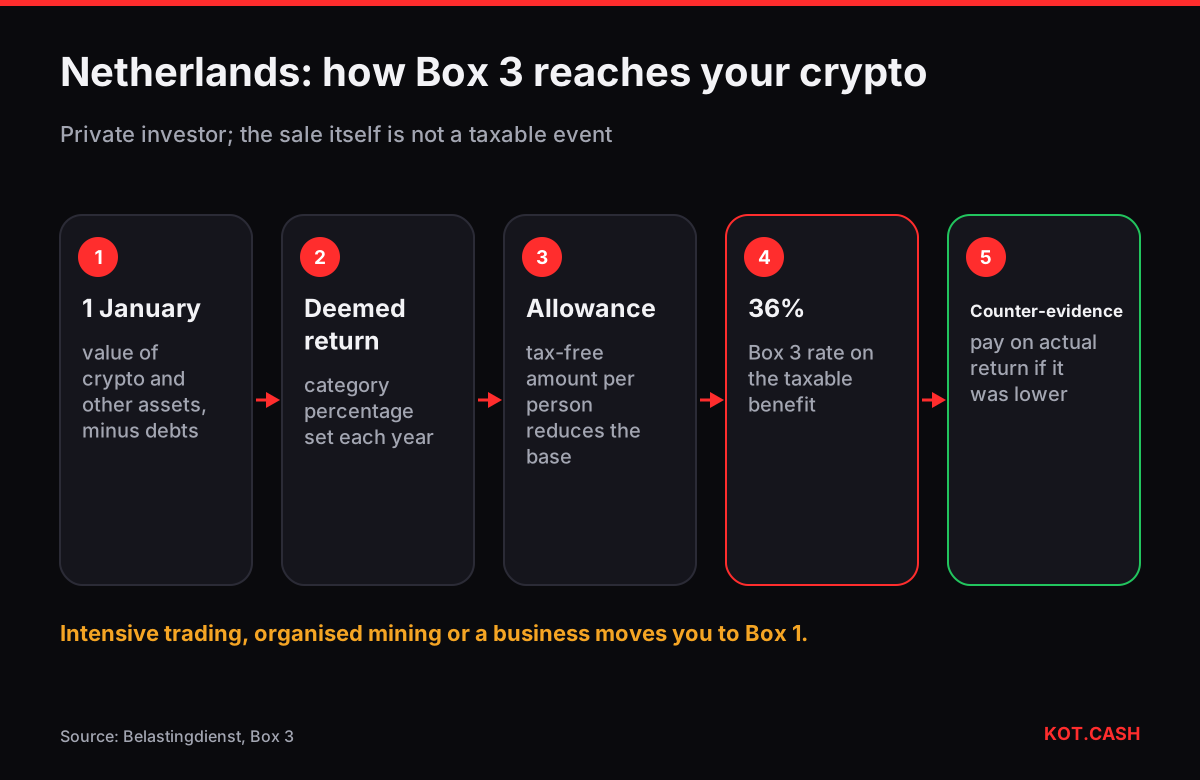
In the Netherlands, a private individual does not pay tax on the gain when selling or swapping crypto. Crypto is part of Box 3, the tax on savings and investments, which is based on the value of your assets on 1 January of the tax year and a deemed (assumed) return set by law, taxed at 36% for 2025 and 2026. A coin that tripled during the year and was sold in December adds nothing to that year's Box 3; what counts is what you held on the reference date. As of October 2026, that is the system, with a move to taxing actual returns planned for later years.
How Box 3 works, step by step
- Take the value of all your Box 3 assets on 1 January (peildatum): savings, investments, crypto and other assets, minus debts.
- Crypto falls in the category of other assets (overige bezittingen), together with shares and bonds, which has the highest deemed return percentage.
- The law applies a deemed return percentage to each category; the percentages are set for each year by the Tax Administration (Belastingdienst).
- The total deemed return is reduced in proportion to the tax-free allowance (heffingsvrij vermogen) per person.
- The resulting taxable benefit is taxed at the Box 3 rate, 36%.
Because the deemed return percentages and the allowance change every year, the Belastingdienst page on Box 3 is the place to check the exact figures for your return. The idea is simple though: a large crypto holding on 1 January increases Box 3 tax whether the market then rises or crashes.
Valuing crypto on 1 January
You declare each coin at its value in euros on 1 January. Use the price from the platform where you hold it or a reliable price source for that date, and use the same method every year. Coins in self-custody are declared just like coins on an exchange; there is no exemption for hardware wallets. Coins lost before 1 January are not assets; coins merely forgotten in a wallet still are. Staked or locked coins count at their value too, including rewards already credited.
Counter-evidence: when your actual return was lower
After the Supreme Court rulings that the deemed-return system can breach property rights, taxpayers whose actual return was lower than the deemed return can show that. The counter-evidence arrangement lets you report your actual return for the year, including unrealised changes in value, and pay tax on that if it is lower. For crypto, a bad year can mean the actual return is negative while the deemed return is positive. The calculation includes the change in value of all your Box 3 assets, not just crypto, so collect year-start and year-end values for everything.
When crypto is Box 1 instead
| Situation | Box | Taxed on |
|---|---|---|
| Holding and occasionally trading as an investor | Box 3 | deemed return on value at 1 January |
| Trading more actively than normal asset management | Box 1 (result from other activities) | actual profit at progressive rates |
| Mining or staking as an organised activity | Box 1 | actual income |
| Running a crypto business | Box 1 (business profit) | actual profit |
| Salary in crypto | Box 1 (wages) | value at payment |
The Belastingdienst looks at whether your activity goes beyond normal, active asset management: the scale, use of special knowledge, frequency and organisation. Box 1 means real profits and losses at progressive income tax rates, which can be much higher than Box 3 in a good year. Staking by delegating coins as an ordinary holder is generally treated in Box 3.
What is coming
The government has proposed replacing the deemed system with a tax on actual returns (werkelijk rendement), including unrealised gains on assets like crypto. As of October 2026 that law is planned to take effect from 2028 at the earliest. Until then, Box 3 with counter-evidence applies. If you plan large moves, keep an eye on the final form of the law.
Records that make filing easy
- A balance snapshot per wallet and exchange at 1 January, with the price source.
- Year-end balances and all transactions, needed if you use counter-evidence.
- For non-custodial swaps such as on KOT.CASH, the order links showing amounts and hashes.
- Evidence of losses: hacks, scams or lost keys with dates and transaction hashes.
The portfolio tracker helps produce the 1 January list. For staking, the real staking yield calculator shows how much of a nominal reward is offset by network inflation, which matters if you compare your actual return with the deemed return.
FAQ
Do I pay tax when I sell crypto in the Netherlands?
Not as a private investor in Box 3. Box 3 taxes a deemed return on the value of your assets on 1 January, not realised gains.
What is the Box 3 tax rate?
36% on the deemed taxable benefit for 2025 and 2026.
How do I value crypto for Box 3?
At its euro value on 1 January of the tax year, using a consistent and reliable price source.
What if my crypto lost value during the year?
You can use the counter-evidence arrangement and show your actual return, which may be lower or negative.
When is crypto taxed in Box 1?
When your activity goes beyond normal asset management, such as intensive trading, organised mining or a business.