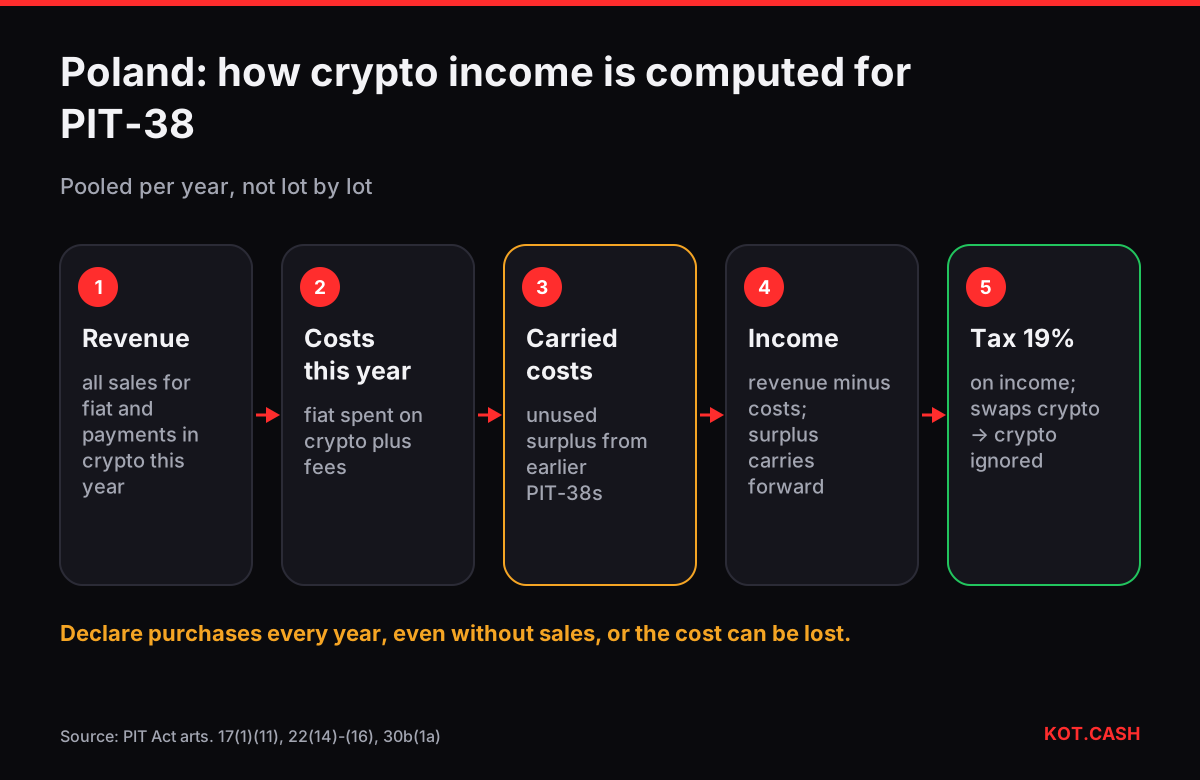
Poland taxes income from the paid disposal of virtual currencies at a flat 19%, declared on the PIT-38 return. The method is unusual: you do not match each sale with a lot. Instead you add up all your proceeds from the year, subtract all your costs of buying crypto in that year plus any unused costs carried from earlier years, and pay 19% on the difference. Swapping one crypto for another is not a disposal at all. These rules have applied since 2019, when articles 17 and 30b of the PIT Act were amended.
What is a taxable disposal
| Transaction | Revenue for PIT-38? | Cost? |
|---|---|---|
| Sell crypto for złoty, euro or other fiat | yes | — |
| Pay for goods or services with crypto | yes | — |
| Exchange crypto for another crypto | no | no |
| Buy crypto with fiat | — | yes, in the year paid |
| Exchange or intermediary fees | — | yes |
| Move coins between own wallets | no | no |
Stablecoins count as virtual currencies here, so a swap from BTC to USDT is neutral; tax arises when the USDT is sold for money or spent. This makes Poland one of the more convenient regimes for people who rotate between coins. The swap taxation comparison shows where it stands among other countries.
The cost pool and carry-forward
Costs are the documented expenses directly incurred to acquire virtual currency, plus fees paid to exchanges and intermediaries. They are recognised in the year you incur them, not when you sell the coins they bought. If your costs in a year exceed your revenue, the surplus does not become a loss; it is carried into the next year's costs, and so on with no time limit.
This has a practical consequence. Every purchase must be declared on PIT-38 in the year it happens, even when you sold nothing, otherwise you cannot carry the cost forward. People who bought in 2022, never filed, and sell in 2026 often lose the right to deduct their purchase.
Example across three years
- 2024: you buy crypto for 20,000 zł and sell nothing. Revenue 0, costs 20,000 zł. You file PIT-38; 20,000 zł carries forward.
- 2025: you sell part for 12,000 zł and buy more for 5,000 zł. Costs available: 25,000 zł. Revenue 12,000 zł is fully covered; 13,000 zł carries forward. Tax: 0.
- 2026: you sell for 30,000 zł. Costs available: 13,000 zł. Income 17,000 zł, tax 19% = 3,230 zł.
The Poland crypto tax calculator runs this carry-forward for several years so you can check your own numbers.
A separate basket
Income from virtual currencies is a separate source. You cannot offset it against losses on shares or other capital assets, and losses there cannot reduce crypto income. The cost surplus is the only way excess spending on crypto helps you later. The 19% rate does not depend on your other income; it is not added to salary.
Very high incomes face an extra 4% solidarity levy on total income above 1 million złoty a year, and income taxed under article 30b counts toward that threshold. For most people this never applies, but it matters for a large one-off sale.
Mining, staking and airdrops
The PIT Act describes revenue from virtual currencies in terms of their paid disposal, so coins you receive from mining, staking or an airdrop are generally not taxed at the moment you receive them; revenue arises when you later sell them for money or spend them. What you can count as a cost for such coins is narrower than for purchases, and the tax office has issued different answers to individual questions over the years. If you mine or stake at scale, this is the area where advice matters most.
Getting a binding answer
Poland lets taxpayers ask the National Tax Information service (KIS) for an individual tax interpretation (interpretacja indywidualna). It is binding on the tax office for the facts you describe. Many questions about DeFi, lending and staking have been answered this way, and published interpretations are searchable, which makes them a useful reference before you file.
Filing PIT-38
- Deadline: 30 April of the following year.
- Crypto revenue and costs go in their own section of the form, separate from shares.
- Amounts in foreign currencies are converted at the National Bank of Poland average rate from the last working day before the transaction.
- Polish platforms do not issue a PIT-8C for crypto; you collect your own figures.
Records
Keep bank statements and exchange confirmations of every purchase, and every fee. For swaps on a service without an account, like KOT.CASH, a coin-to-coin swap does not enter PIT-38, but keep the order link anyway: it proves the coins you later sell came from documented purchases.
FAQ
What is the crypto tax rate in Poland?
19% on income from the disposal of virtual currencies, declared on PIT-38.
Is exchanging crypto for crypto taxable in Poland?
No. Exchanging one virtual currency for another is neither revenue nor a cost.
What happens to crypto purchases in a year with no sales?
Declare them on PIT-38 as costs; the unused amount carries forward to the next year without a time limit.
Can crypto income be offset against stock losses?
No. Virtual currency income is a separate source and is not combined with securities.
When is PIT-38 due?
By 30 April of the year after the tax year.