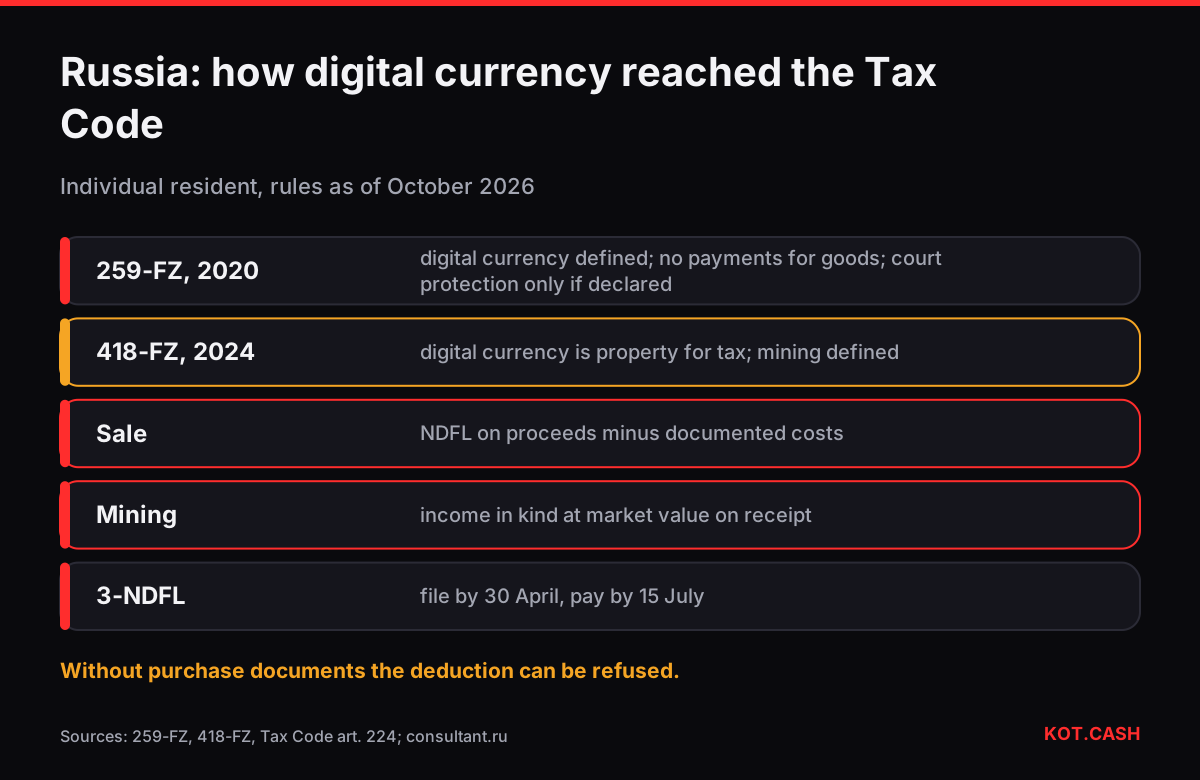
In Russia, digital currency is property for tax purposes. That follows from Federal Law 259-FZ of 2020, which defined digital currency, and from Federal Law 418-FZ of 29 November 2024, which wrote crypto into the Tax Code explicitly. For a resident individual, income from selling digital currency is subject to personal income tax (NDFL): the proceeds minus documented acquisition costs, declared on form 3-NDFL. Mining income is taxed when the coins are received. This article stays with what the law says as of October 2026 and points to the texts, because the area changed quickly and some details are still being clarified by the Federal Tax Service.
What the 2020 and 2024 laws established
- 259-FZ (2020) defined digital currency and prohibited Russian residents from accepting it as payment for goods, work or services. It also introduced a reporting condition: claims related to owning digital currency are protected in court only if the owner informed the tax authorities about it.
- 418-FZ (2024) amended the Tax Code: digital currency is recognised as property for tax purposes, mining is defined, and miners and mining infrastructure operators got their own reporting duties. The law took effect from 2025.
- Other rules restrict mining in certain regions and periods, and set up a register of miners. These are regulatory measures rather than tax rules, but they affect who may mine legally.
NDFL on selling digital currency
When you sell digital currency for roubles or foreign currency, the taxable income is the sale proceeds minus documented expenses of acquiring it. Without documents the deduction can be refused, which taxes the whole proceeds. The rates for this income are set in article 224 of the Tax Code; under the amendments in force from 2025 the rate for this kind of income is 13% on income up to 2.4 million roubles a year and 15% above that. Check the current wording of article 224 on the Consultant or Garant site before filing, as the Code was revised several times in 2024 and 2025.
How an exchange of one digital currency for another is treated is a narrower question. The general rules of the Tax Code treat exchange (mena) as a disposal that can produce income in kind. The Federal Tax Service and the Ministry of Finance have issued letters on specific situations, and the practice is not uniform. If you rotate between coins often, the conservative approach is to keep records of the rouble value of both sides of every swap.
Mining income
For an individual miner, digital currency received from mining is income in kind at its market value on the date it is received. When the mined coins are later sold, the value already taxed works as their acquisition cost. Individuals who mine above the threshold set by the government, and mining infrastructure operators, have specific registration and reporting duties under the 2024 changes. Mining as a business through a company or as an individual entrepreneur follows the rules for that tax regime.
Declaring: 3-NDFL
- Collect the year's sales: date, amount, rouble value, and the purchase cost of the coins sold.
- Convert foreign-currency amounts at the Central Bank rate on the date of the operation.
- File 3-NDFL by 30 April of the following year through the personal account on nalog.gov.ru.
- Pay the tax by 15 July of the following year.
The tax lot calculator helps match sales to purchases with a consistent method, which you will need to justify the expenses you deduct.
Why the reporting condition matters
The rule in 259-FZ about court protection is easy to miss. If a dispute arises, for example a counterparty does not deliver what was agreed, a claim related to digital currency is protected only if you declared owning it in the way the law sets. Declaring income also creates the documented history that makes a later deduction possible.
Records for every operation
| Document | Why |
|---|---|
| Exchange statements and wallet exports | proof of purchase cost and sale proceeds |
| Bank statements for fiat legs | link roubles to the operation |
| Order links for non-custodial swaps (e.g. KOT.CASH) | amounts sent and received and both hashes |
| Central Bank rate on each date | conversion of foreign currency to roubles |
| Mining pool reports | date and quantity of mined coins |
KOT.CASH does not issue tax documents. The order page is your record of what was sent and received and when; keep the link or a saved copy together with the transaction hashes.
FAQ
Is cryptocurrency property under Russian tax law?
Yes. Federal Law 418-FZ of 29 November 2024 recognised digital currency as property for tax purposes from 2025.
What tax do individuals pay on selling crypto in Russia?
NDFL on proceeds minus documented costs; for this income the Code sets 13% up to 2.4 million roubles and 15% above. Check article 224 for the current wording.
Is mined crypto taxable in Russia?
Yes. Coins received from mining are income in kind at market value when received.
When is 3-NDFL due?
By 30 April of the following year, with the tax paid by 15 July.
Why declare crypto I own?
Under 259-FZ, claims related to owning digital currency are protected in court only if the tax authority was informed.