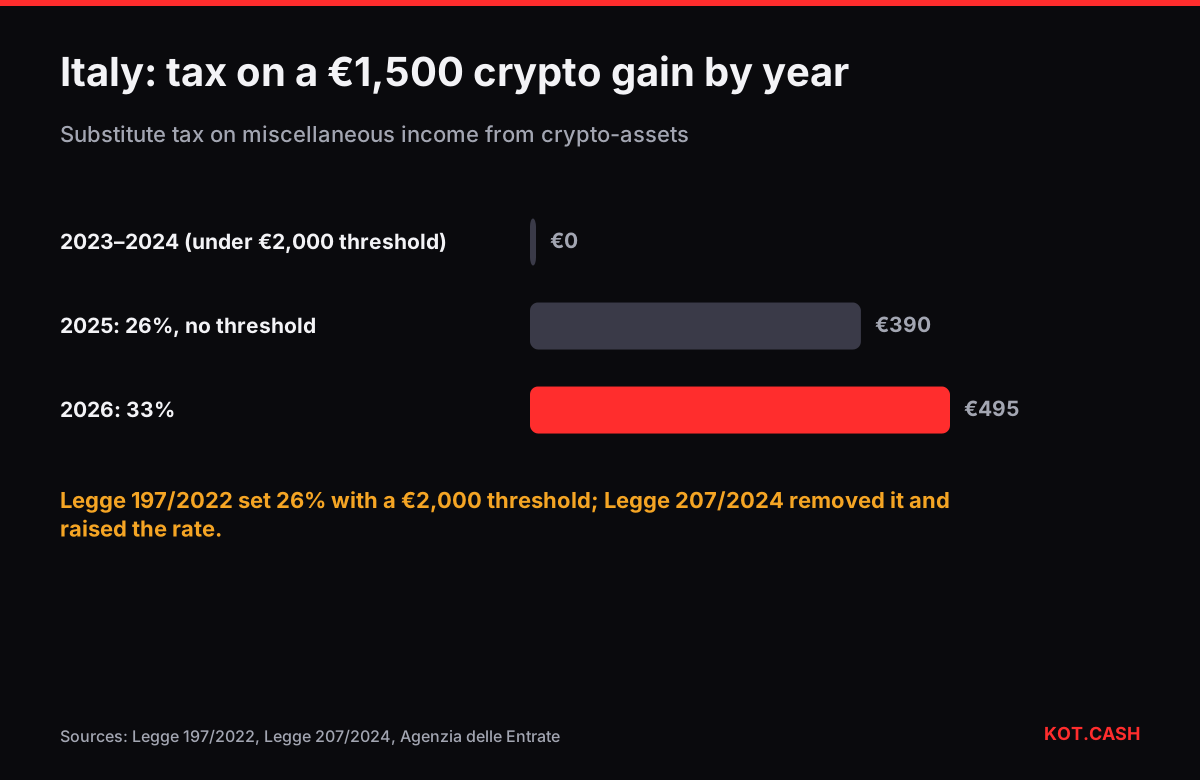
Italy taxes gains on crypto-assets as miscellaneous income (redditi diversi) with a substitute tax. For gains realised in 2025 the rate is 26% with no tax-free threshold; for gains realised from 1 January 2026 it is 33%. The rules come from the 2023 budget law (Legge 197/2022), which first set the regime, and the 2025 budget law (Legge 207/2024), which removed the €2,000 exemption and scheduled the increase. On top of the tax on gains, residents report crypto holdings in the RW section of the return and pay a small annual tax on their value.
How the rate changed
Before 2023 there was no specific regime and practice was inconsistent. Legge 197/2022 introduced letter c-sexies into article 67 of the TUIR: gains from the sale, exchange or holding of crypto-assets are miscellaneous income, taxed at 26%, but only if total gains in the tax year exceeded €2,000. Legge 207/2024 abolished the threshold from tax year 2025 and raised the rate to 33% for gains realised from 2026. A gain of €1,500 in 2024 was not taxed; the same gain in 2025 costs €390, and in 2026 €495.
Which transactions are taxed
- Sale for euros or other fiat: taxable.
- Using crypto to buy goods or services: taxable, as a disposal for consideration.
- Exchange between crypto-assets with the same characteristics and functions: not taxable. Swapping one cryptocurrency for another falls here according to the Revenue Agency's reading.
- Exchange into a crypto-asset with different functions, for example a utility token or certain other categories: can be taxable. The boundary is not always obvious; stablecoins pegged to fiat are a point to check with an adviser.
That middle rule makes Italy one of the countries where a BTC to ETH swap is usually neutral, while Germany or the UK tax it. A comparison across countries is in this guide.
Calculating the gain
The gain is the difference between the consideration received and the cost or purchase value, documented with certainty and specifically. If you cannot document the cost, the law allows the tax office to treat the cost as zero, which taxes the whole proceeds. Losses can be carried forward and offset against gains of the same category in the following four tax years, provided they were declared. The Italy crypto tax calculator lets you pick the tax year so the right rate applies.
Example for 2026
You bought 1 ETH in 2024 for €2,000 and an amount of SOL for €1,500. In March 2026 you sell the ETH for €3,000 (gain €1,000) and the SOL for €1,100 (loss €400). Net gain €600, tax at 33% = €198. If the SOL loss had come in 2025 and been declared, it could still be offset against 2026 gains, as losses carry forward for four years.
Step-up option on values at 1 January 2025
The 2025 budget law also allowed taxpayers to redetermine the cost of crypto-assets held on 1 January 2025 at their market value on that date by paying a substitute tax of 18% on that value, under conditions and deadlines set by the law. If you used that option, your new cost basis for later sales is the redetermined value. If you did not, your original documented cost applies.
Monitoring and the IVCA
| Obligation | What it covers | Where |
|---|---|---|
| Tax on gains | 26% (2025) / 33% (from 2026) | Redditi PF, quadro RT |
| Monitoring | crypto held anywhere at year end and during the year | quadro RW |
| IVCA | 2 per thousand of the value of crypto-assets | quadro RW |
| Records | cost, dates, counterparties | keep for audits |
The RW section is a reporting obligation, regardless of whether you sold anything, and it applies to wallets and exchanges abroad as well as self-custody. The imposta sul valore delle cripto-attività (IVCA) is charged at 2 per thousand on the value of holdings, as a wealth-style tax. Missing RW reporting carries penalties that are separate from the income tax.
Use one consistent source for euro values, such as the closing price of a major exchange or a recognised price index for the day, and apply it to every transaction of the year. Switching sources between sales makes the calculation hard to defend in an audit.
Swaps without an account
If you swap on a non-custodial service such as KOT.CASH and later sell the result on an Italian exchange, the exchange knows only the final sale. Your cost has to come from your own records: the order link with what you sent and received and both transaction hashes, plus the euro value at the time. Without that documentation the zero-cost rule can apply.
FAQ
What is the crypto tax rate in Italy in 2026?
33% on gains realised from 1 January 2026, under Legge 207/2024. Gains realised in 2025 are taxed at 26%.
Is there still a €2,000 tax-free threshold in Italy?
No. The threshold applied to 2023 and 2024 and was removed from tax year 2025.
Is swapping BTC to ETH taxable in Italy?
Exchanges between crypto-assets with the same characteristics and functions are not taxable, which normally covers coin-to-coin swaps.
Do I have to report crypto I did not sell?
Yes. Holdings go in the quadro RW of the return, with the IVCA at 2 per thousand of their value.
What if I cannot prove my purchase price?
The tax office can treat the cost as zero, so the full sale value becomes the gain. Keep purchase records.