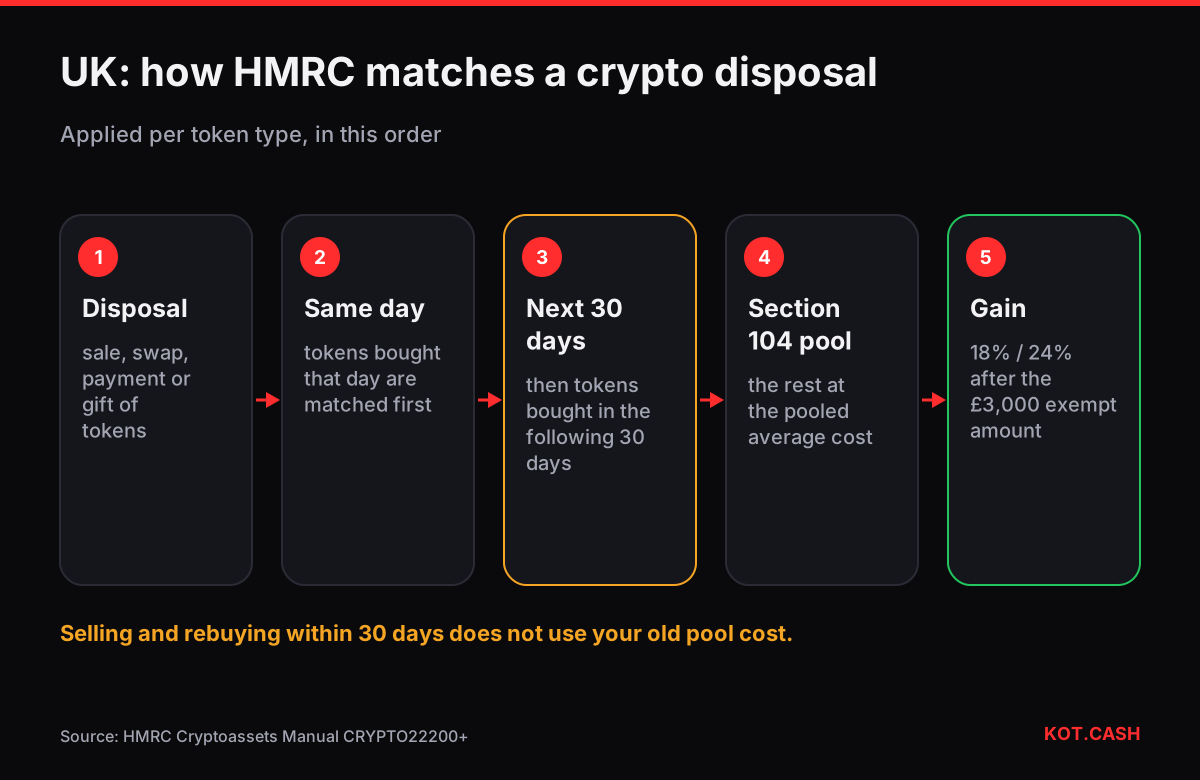
In the UK, HMRC treats crypto held as an investment as a chargeable asset: when you dispose of it, the gain is subject to Capital Gains Tax. As of October 2026 the rates are 18% for gains within your basic-rate band and 24% above it, after an annual exempt amount of £3,000. What makes UK crypto tax different from most countries is how your acquisition cost is worked out: not by lot, but through three matching rules and a pooled average cost.
What is a disposal
HMRC's Cryptoassets Manual lists the events that count as disposals:
- selling tokens for pounds or another fiat currency;
- exchanging one token for another, including swaps into stablecoins;
- using tokens to pay for goods or services;
- giving tokens away, except to a spouse or civil partner you live with.
Moving tokens between your own wallets is not a disposal. Neither is buying. Fees you paid to acquire or dispose of a token, including network fees, are allowable costs.
The three matching rules
When you dispose of tokens of one kind, HMRC matches the disposal with acquisitions in a fixed order (CRYPTO22200 onwards):
- Same day. Tokens bought on the same day as the disposal are matched first.
- Next 30 days. Then tokens bought in the 30 days after the disposal. This is the bed-and-breakfast rule: selling at a loss and buying back the next week does not crystallise the loss against your old cost.
- Section 104 pool. Everything else comes from the pool: all your remaining tokens of that kind, with one average cost. Each acquisition adds its amount and cost to the pool; each disposal takes out a proportional share of the cost.
A worked example. You hold 2 ETH in the pool with a total cost of £4,000 (£2,000 each). On 1 May you sell 1 ETH for £2,600. On 20 May you buy 0.5 ETH for £1,100. Under the 30-day rule, 0.5 of the ETH sold is matched with the 20 May purchase: proceeds £1,300, cost £1,100, gain £200. The other 0.5 comes from the pool at £2,000 per ETH: proceeds £1,300, cost £1,000, gain £300. Total gain £500, not the £600 a simple pool calculation would show. The UK crypto tax calculator applies all three rules to your transaction list.
Rates and the annual exempt amount
| Item | Value | Note |
|---|---|---|
| Annual exempt amount | £3,000 | per person; unused part is lost |
| Rate within basic-rate band | 18% | since 30 October 2024 |
| Rate above it | 24% | since 30 October 2024 |
| Spouse transfer | no gain, no loss | if living together |
Your taxable gains are added on top of your taxable income to decide which rate applies. If your salary already uses the whole basic-rate band, every pound of gain above £3,000 is taxed at 24%. The exempt amount was £12,300 until April 2023 and was cut in two steps; many older guides still quote the higher figures.
When you must report
You report through Self Assessment, or through HMRC's real-time Capital Gains Tax service if you do not otherwise file a return. You need to report when your gains exceed the annual exempt amount, and also when your total disposal proceeds are over £50,000 in the year even if the gain is below the allowance. Losses must be reported within four years of the end of the tax year to be carried forward.
Income rather than capital gains
Some crypto receipts are income first. Staking and mining rewards are usually taxed as miscellaneous or trading income at their value when received, and crypto paid by an employer is employment income. Those tokens then enter the pool at that value, so a later sale only taxes the growth since receipt. If you trade so often and so systematically that it looks like a business, HMRC can treat profits as trading income, though it says this will be rare for individuals.
Moving abroad does not automatically end the liability. Under the temporary non-residence rules, if you leave the UK and return within five years, gains on tokens you owned before leaving and sold while abroad can be taxed in the year you come back.
Keeping records
HMRC expects a record of every transaction: the type of token, date, number of units, value in pounds, cumulative pool totals and fees. For swaps on a service without an account, such as KOT.CASH, keep the order link: it shows what you sent, what you received and both transaction hashes. Add the pound value at that moment from a consistent price source.
FAQ
What is the crypto tax-free allowance in the UK?
The Capital Gains Tax annual exempt amount is £3,000 per person for 2024/25 and later years.
What rate of tax do I pay on crypto gains in the UK?
18% on gains that fall within your remaining basic-rate band and 24% above it, for disposals since 30 October 2024.
Is swapping BTC for ETH taxable in the UK?
Yes. Exchanging one cryptoasset for another is a disposal for Capital Gains Tax.
What is the 30-day rule for crypto?
Tokens bought within 30 days after a disposal are matched with that disposal before the Section 104 pool, so you cannot sell and quickly rebuy to lock in a loss.
Do I have to report if my gain is under £3,000?
Yes, if your total disposal proceeds for the year are over £50,000, even when the gain itself is below the allowance.