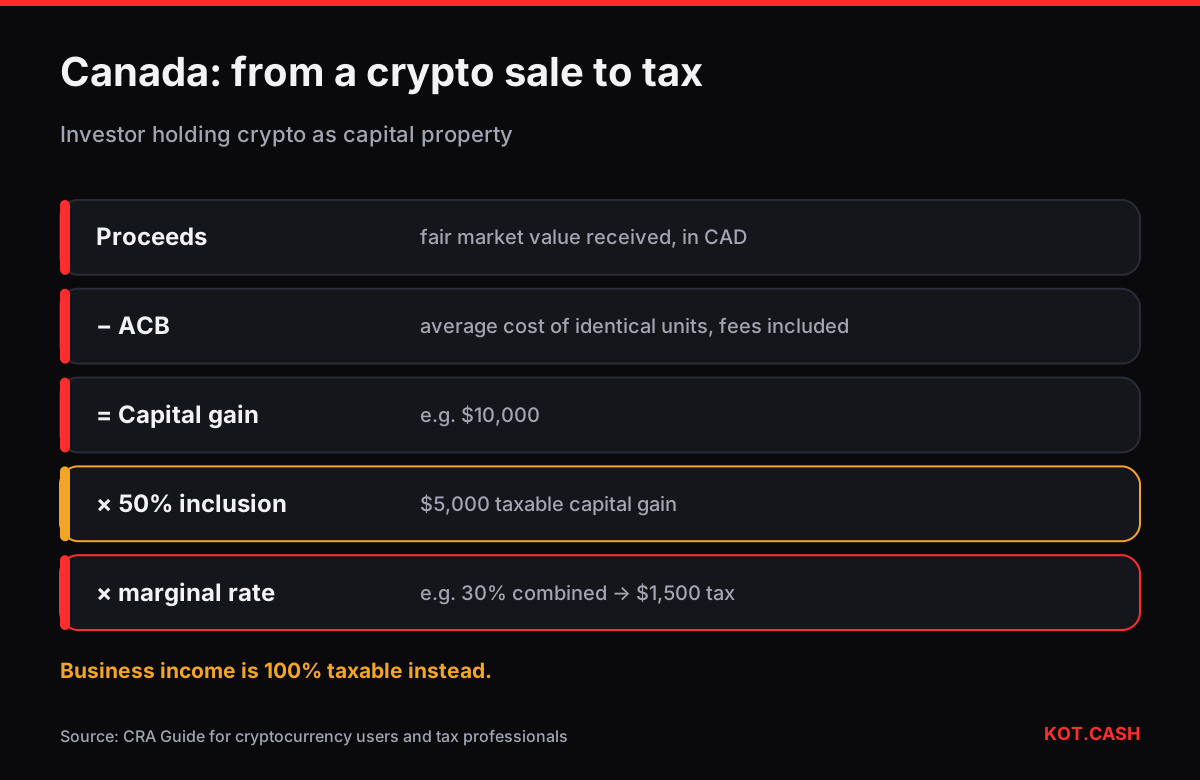
The Canada Revenue Agency (CRA) treats cryptocurrency as a commodity. When you dispose of it as an investor, half of the capital gain is included in your income and taxed at your marginal rate; half of a capital loss is an allowable loss. If your activity amounts to a business, the whole profit is business income instead. Both cases start from the same rule: selling, trading crypto for crypto, gifting or spending is a disposition. As of October 2026, the inclusion rate is still one half; the planned increase to two thirds was cancelled in 2025.
What counts as a disposition
- Selling crypto for Canadian dollars or another government currency.
- Trading one crypto for another. The CRA calls it a barter transaction and values it at the fair market value of what you receive.
- Using crypto to pay for goods or services.
- Giving crypto as a gift, which is a disposition at fair market value.
- Converting crypto into a stablecoin, which is also a trade of one crypto for another.
Moving coins between wallets you own is not a disposition. Buying with fiat is not either, but it sets your cost.
Adjusted cost base: Canada uses an average
Unlike countries that match sales to individual lots, Canada uses the adjusted cost base (ACB) of identical properties. All units of the same coin you hold are averaged: total cost including fees divided by the number of units. Each disposal uses that average; each purchase updates it. Example: you buy 1 ETH for $3,000 and later 1 ETH for $4,000. The ACB is $3,500 per ETH. Selling 1 ETH for $5,000 gives a capital gain of $1,500, of which $750 is taxable. The average price calculator keeps the running average for you.
From gain to tax
The taxable half is added to your other income for the year and taxed at your combined federal and provincial marginal rate. With a combined marginal rate of 30%, a $10,000 capital gain costs $1,500: $5,000 taxable times 30%. Allowable capital losses reduce taxable capital gains of the same year; any remaining net capital loss can be carried back three years or forward indefinitely, but only against capital gains. The Canada crypto tax calculator applies the inclusion rate and your marginal rate.
Investor or business?
The CRA looks at the facts: how often you trade, how long you hold, whether you promote yourself as a trader, the time you spend, whether you use borrowed money and whether your activity looks like a commercial operation. Frequent short-term trading, organised mining or running crypto-related services can make the profit business income. Then 100% is taxable, losses can offset other income, and the superficial loss rule below does not apply to inventory in the same way. The classification is decided case by case, and it matters more than any rate.
The superficial loss rule
If you sell crypto at a loss and you, or a person affiliated with you such as a spouse, acquire identical property within 30 days before or after the sale and still hold it 30 days after, the loss is a superficial loss. It is denied for now and added to the ACB of the replacement units, so you recover it when you finally sell them. The CRA applies this to crypto held as capital property. Selling BTC on 1 December and buying it back on 10 December to book a loss does not work.
Staking, mining and other income
Crypto received from staking, mining or as payment for work is income at its fair market value when received, either business income or other income depending on the facts. That value becomes the cost of those units in your ACB. Airdrops and hard forks depend on circumstances; the CRA guide discusses them separately.
Crypto lost through a hack or a scam may give rise to a capital loss if you can show the disposition; lost keys with no realistic way to recover are discussed in the CRA guide as well.
Reporting
| Item | Form | Note |
|---|---|---|
| Capital gains and losses | Schedule 3 | proceeds, ACB, outlays |
| Business income from crypto | T2125 | if you carry on a business |
| Foreign property over $100,000 cost | T1135 | crypto held outside Canada may be specified foreign property |
| Filing deadline | 30 April | 15 June if self-employed, balance still due 30 April |
Keep records of every transaction for at least six years: dates, amounts, fair market value in Canadian dollars, wallet addresses and the exchange or service used. For a swap on a non-custodial service like KOT.CASH, the order link shows what you sent and received and both hashes. Add the CAD value from a consistent source.
FAQ
How much of a crypto gain is taxable in Canada?
Half. The capital gains inclusion rate is 50%; the proposed increase to two thirds was cancelled in 2025.
Is trading crypto for crypto taxable in Canada?
Yes. The CRA treats it as a barter transaction and a disposition at fair market value.
How is the cost of crypto calculated in Canada?
With the adjusted cost base: an average cost of all identical units you hold, including fees.
Does the superficial loss rule apply to crypto?
Yes, for crypto held as capital property. Rebuying within 30 days before or after a loss sale denies the loss for now.
When is crypto profit business income?
When the facts show a business: frequent trading, short holding periods, commercial organisation. Then 100% is taxable.