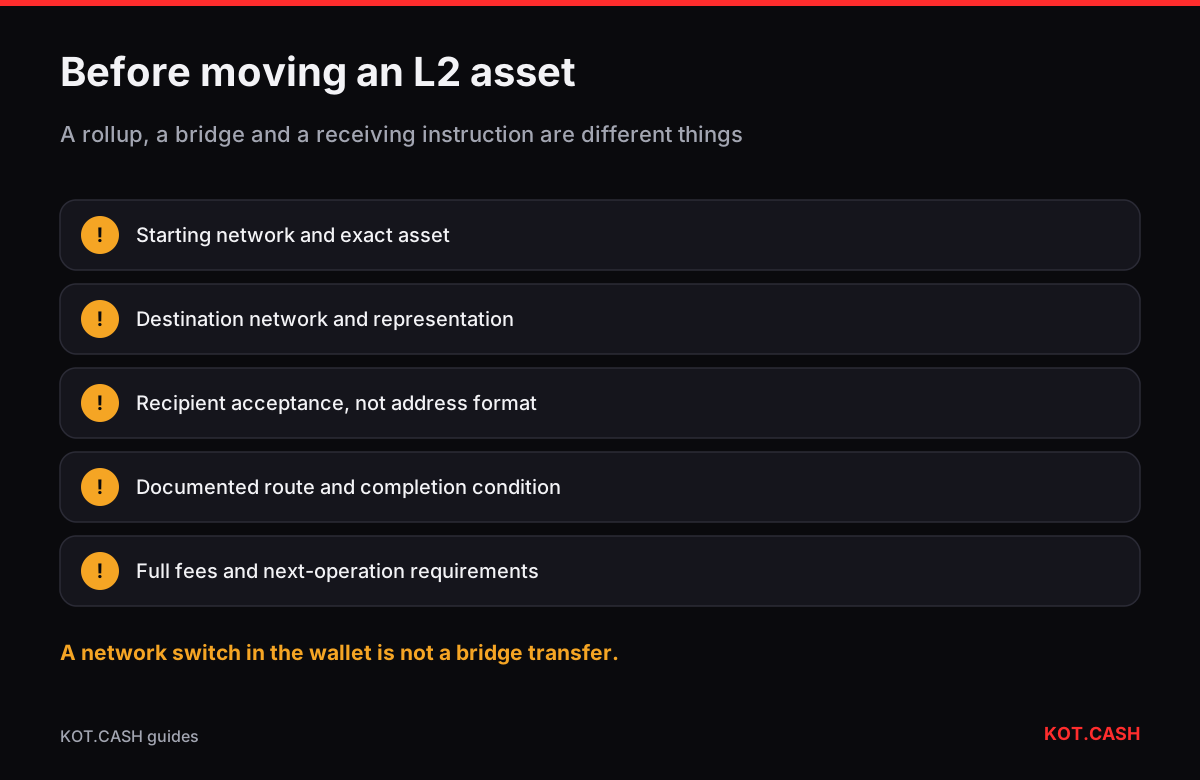
You open a withdrawal form and see several networks beside the same asset name. One is described as a layer 2, another as Ethereum Mainnet. Choosing the cheaper line is not enough: the receiving application must support the selected network and asset representation. A rollup explains one way an L2 can operate, but the word does not turn different networks into interchangeable destinations. Start by identifying where your funds are now and where the recipient expects them. Then decide whether you need a same-network transfer, a bridge or a provider-supported cross-network route.
The short technical definition
In the Ethereum context, a rollup processes transactions outside the base-layer execution environment and uses Ethereum for settlement and publication of the data needed for its rollup security model. Transactions are grouped rather than each user executing the whole operation directly on L1. Ethereum’s optimistic-rollup documentation and validity-rollup documentation explain distinct ways of checking those results. This is an architecture description, not a guarantee that every product advertised as an L2 has the same implementation, operational assumptions or maturity.
Two verification approaches, not two payment buttons
An optimistic design provides a process for challenging incorrect state claims during a specified window. A validity-rollup design verifies proofs of correct state transitions. These distinctions matter for settlement and withdrawal procedures, but they do not tell you which network a merchant accepts. Nor does the label “ZK” automatically make payments confidential: Ethereum explicitly separates validity proofs from transaction confidentiality. If privacy is your concern, investigate the actual published data and application behaviour rather than drawing a conclusion from a proof-system name.
Follow one payment through three separate places
Consider an illustrative user with funds on network A who needs to pay a recipient on network B. First, the source wallet must authorise the relevant source operation. Second, the selected route must establish whatever cross-network result it promises. Third, the recipient must recognise the correct asset on B. A successful source transaction answers only the first part. This example deliberately does not name a live bridge or quote a completion time. Actual mechanisms differ, so trace the official route before authorising funds rather than assuming every movement follows one universal lock-and-mint script.
| Your situation | Question to answer | Evidence needed |
|---|---|---|
| Sender and recipient use the same network | Is a direct transfer supported? | Receiving asset and address instructions |
| Funds are on a different network | Which route explicitly reaches the destination? | Source/destination route specification |
| Same ticker appears on both networks | Is the intended token representation supported? | Official contract or asset identifier |
| A wallet shows the same address text | Does the recipient accept this chain? | Network acceptance, not address format |
| Source operation succeeded | Which destination event completes the route? | Destination record or official tracking |
An address is not a network selection
In compatible account environments you may encounter the same-looking address on multiple networks. Treat the receiving instruction as a combination of network, asset and destination, not as an address string alone. In particular, do not assume that a hosted service monitors every chain on which a syntactically valid address can exist. A local address-format check cannot establish that a business will credit a deposit. If the recipient lists only one network, ask before using another. A visually identical destination does not change the network in which the sender’s transaction executes.
Switching the wallet view does not move the balance
Selecting another network in a wallet changes the context you are inspecting and using. It is not, by itself, evidence that an asset has crossed between networks. Before troubleshooting a missing balance, record the network of the completed transaction and inspect the intended account in that context. Then establish the asset identifier and whether the wallet needs an appropriate display entry. Do not import a recovery phrase into an unfamiliar website to “activate L2 funds”. If there is a genuine cross-network step, identify its official procedure and associated authorisations separately from changing the wallet’s visible network.
Why a fast screen update does not settle every withdrawal
An L2 application can report progress at a stage different from base-layer settlement or completion of an exit procedure. Read the actual network’s definitions. In particular, do not apply a single optimistic challenge duration to every withdrawal route, or promise immediate withdrawal for every validity rollup. A liquidity-assisted route can introduce different counterparties and charges from a protocol’s native exit. Compare what you are using, not just the category name. The finality guide explains why source inclusion, consensus state and service crediting are separate questions.
Price the whole journey
A low displayed fee for one operation does not establish the total cost of reaching a usable destination balance. List source execution costs, any route or provider charge, destination requirements and the amount you expect to receive. Check whether the destination account will also need a fee-paying asset for its next operation. Do not assume every rollup uses the same gas policy or that a token received can immediately pay its own sending costs. Use the chosen network’s current documentation and route preview. If a component is unclear, record it as unknown rather than treating it as zero.
A receiving instruction worth saving
- The destination network’s full name and official reference, not merely an L2 marketing label.
- The exact asset identifier or contract where applicable, with the recipient’s supported representation.
- The receiving address and any extra instruction supplied by the recipient.
- The route, deadlines, expected output, fees and official way to track each step.
- The next action required after arrival, including any documented fee asset requirement.
Where an exchange can fit
A provider may offer a route between specified assets and networks without the user operating a bridge directly. That does not establish support for every L2. For KOT.CASH, inspect the current supported assets, terms and selected route before creating a deposit. Confirm both sides of the operation with the receiving requirements you saved. This guide makes no claim that a particular rollup route is available today. The practical test remains simple: can you document the starting network, destination network, exact asset and official completion condition before you send?
FAQ
Is a rollup the same as a bridge?
No. A rollup is a network architecture; a bridge is a mechanism for communication or movement across networks.
Does switching wallet networks move funds?
Changing the displayed network does not by itself demonstrate a cross-network transfer. Identify the actual transaction and route.
Does ZK mean transactions are private?
Validity proofs do not by themselves establish confidentiality. Inspect the actual network and application.
Is the same address enough for an exchange deposit?
No. The recipient must support the selected network and asset representation, alongside the receiving address.