You approve a swap after seeing an expected output of 1,000 units, but the completed operation returns 994. Was the missing amount a fee, a price change or something else? The answer depends on what the original number included and which execution rules applied. Slippage is a comparison between an expected outcome and execution, not a convenient label for every difference on a receipt. Before changing any setting, reconstruct the quote, its timestamp, the input amount and the final output. This article uses invented unit amounts to explain the calculation; they are not live prices or a recommended trade.
Pick one baseline before calculating
In an exact-input example, hold the input amount constant and compare output units of the same asset on the same network. Write down whether the quoted output already includes trading fees. Keep separately charged network costs in a separate column. If one quote is for a different input size, or one total includes a withdrawal charge and another does not, the percentage will mix different questions. A number labelled “estimated” also needs a time: an earlier preview and the final confirmation screen may not be the same baseline. Preserve the actual quote that applied to the submitted operation.
Three numbers that are often confused
Uniswap distinguishes price impact from slippage: the former concerns the effect of your own trade, while the latter compares expectation and execution. A tolerance setting is a permitted bound, not a statement that this percentage will be charged. Separately, network fees pay for execution resources; Ethereum documents gas independently of a swap’s output. This terminology does not mean every exchange implements the same controls or presents its quote in the same way. Read the relevant interface before applying the calculation.
Worked example with an explicit sign convention
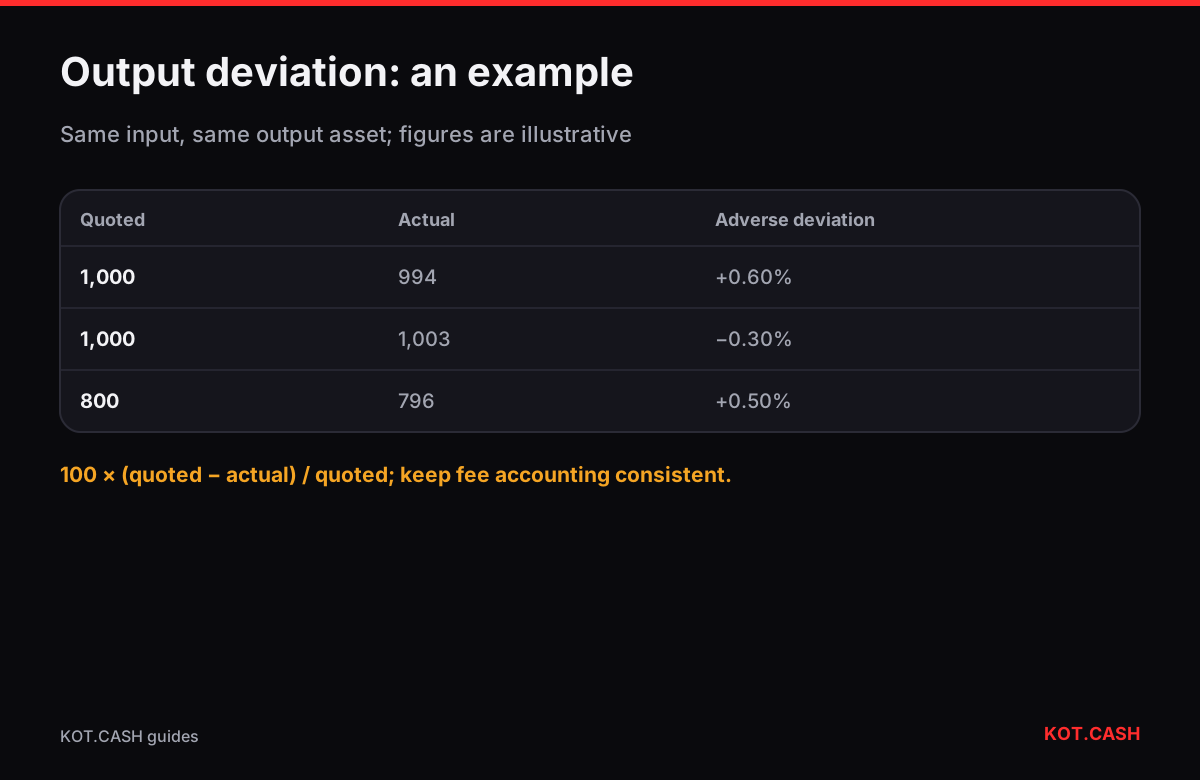
Let Q be the quoted output and A the actual output for the same input. Define adverse output deviation as 100 × (Q − A) / Q. A positive result means fewer output units than quoted; a negative result means more. With Q = 1,000 and A = 994, the result is 0.6%. This is an output-based comparison, not a universal execution-price formula. If you instead compare unit prices, state the pair orientation and denominator. Do not switch between price change and output deviation mid-calculation and expect identical percentages.
| Quoted Q | Actual A | Adverse deviation | Interpretation |
|---|---|---|---|
| 1,000 | 994 | 0.60% | 6 fewer output units |
| 1,000 | 1,003 | −0.30% | 3 more output units |
| 800 | 796 | 0.50% | 4 fewer output units |
| 0 | Any value | Undefined | A positive baseline is required |
Suppose the 994-unit receipt also shows a separate network cost. Do not subtract that cost from 994 unless you are deliberately calculating an all-in result and have converted it into the same unit using a stated valuation. Conversely, if a provider deducts a service charge from the payout, identify that deduction before deciding how much of the difference represents market execution. The table isolates arithmetic; a real receipt needs a fee breakdown. Without that breakdown, record the unexplained difference rather than inventing a cause.
A tolerance protects a boundary, not a forecast
For a simplified exact-input example, a 0.5% adverse-output bound on Q = 1,000 corresponds to 995 units. That arithmetic does not establish what a particular application submits. Uniswap’s developer documentation describes minimum-output guards and, for exact-output operations, maximum-input guards. Check which operation you are authorising. Rounding, asset precision and route rules matter. A displayed estimate of 1,000 does not automatically make 995 the enforceable minimum unless the actual transaction or service agreement establishes that boundary.
Why “increase tolerance until it works” is a poor diagnosis
A failed attempt does not prove that a narrow tolerance caused the failure. The reason might concern account funds, transaction permissions, network execution or a route that is no longer available. Identify the recorded error before changing a parameter. Widening an acceptable bound changes what you agree to receive or spend; it does not repair an unrelated issue. There is no percentage in this guide that is appropriate for every asset and transaction. If a preview is materially worse than the outcome you are willing to accept, declining the operation is a valid result of the review.
A short review before authorisation
- Confirm the asset identifiers, network and input amount. Token names alone are not a sufficient comparison.
- Record quoted output, quote time, separately listed fees and the displayed minimum received or maximum spent, if applicable.
- Calculate your own acceptable outcome in asset units. Compare it with the actual confirmation details rather than relying on a percentage label.
- If the quote expires or changes before authorisation, review the refreshed terms. Do not assume a saved preview still governs execution.
- After completion, reconcile the receipt with the applicable quote. Keep the calculation and any unresolved charge separate from a market-price claim.
Do not copy a DEX setting into an instant-exchange order
A wallet swap and a provider-mediated exchange can use different execution arrangements. For KOT.CASH, read the current fees information, terms and selected order instructions. Establish which quoted amount is indicative, whether a rate is fixed under specified conditions, what deadlines apply and how any revised outcome is handled. This guide does not assert that KOT.CASH offers a user-adjustable on-chain slippage parameter or implements the Uniswap guards. The useful question is what outcome the actual route commits to, not where another application places its settings button.
When the completed amount still looks wrong
Prepare a compact reconciliation: quote reference and time, input, expected output, final output, network identifiers and listed deductions. Ask the official support channel which part of the difference each item explains. Keep order identifiers private and do not share wallet recovery material. If the data does not establish the reason, say so. A clear unanswered question is more useful than a confident but unsupported accusation that the provider charged “slippage”. The objective is to account for the receipt and understand the agreed boundary before another operation, not to make a transaction execute at any cost.
FAQ
Is slippage tolerance a fee?
No. It describes an acceptable execution boundary where implemented, not an automatic charge of that percentage.
How is output deviation calculated?
For the same input, use 100 × (quoted output − actual output) / quoted output. State the sign convention and keep fees consistent.
Does raising tolerance fix a failed transaction?
Not necessarily. Identify the actual failure before agreeing to a wider range of outcomes.
Does every exchange use the same setting?
No. Check the current route and service conditions instead of assuming a DEX control applies elsewhere.