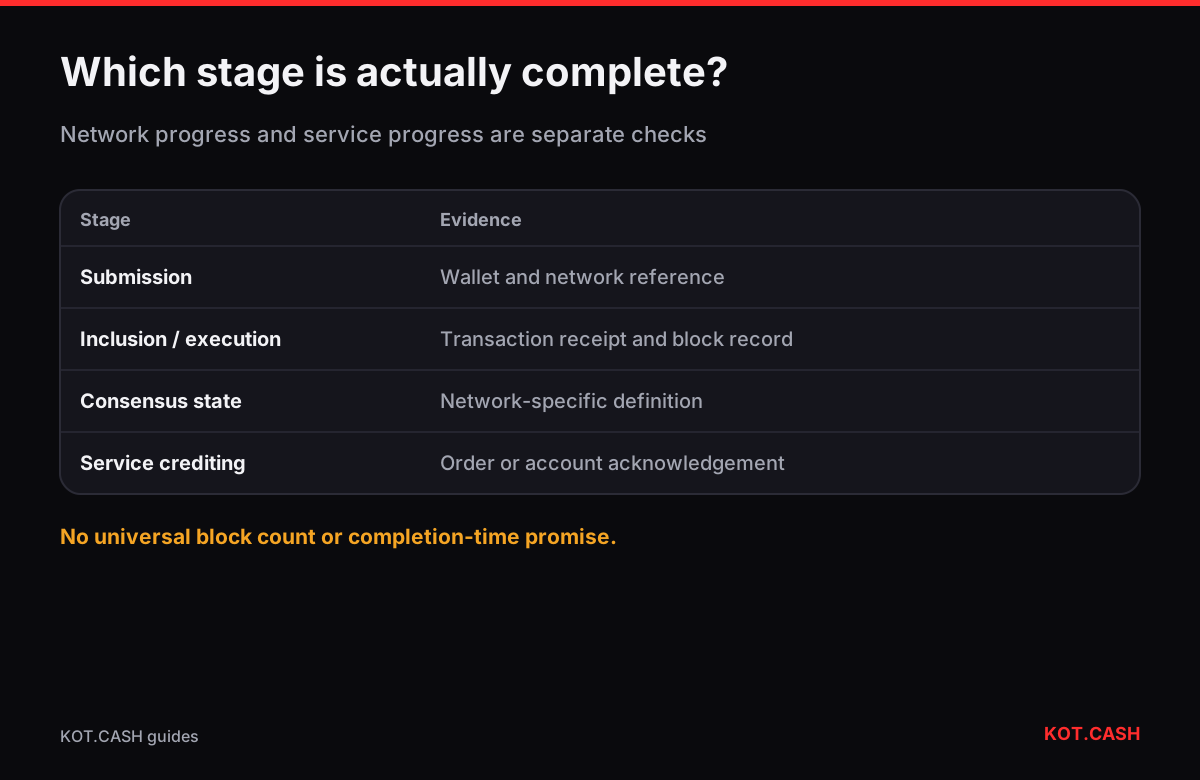
A wallet says “sent”, an explorer displays a successful transaction, and a receiving service still says “waiting”. These messages can describe different stages rather than a contradiction. Finality concerns the stability of a blockchain record under that network’s consensus rules. It does not, by itself, say that a service has credited an account, a bridge has completed its destination operation, or an invoice has been matched. To understand a delay, identify the stage and the party reporting it. This guide separates those questions without promising that a particular number of seconds or blocks settles every payment.
Four questions behind one status label
Ask whether the transaction was broadcast, whether it was included, whether the intended operation succeeded, and whether the receiving application has recognised it under its own requirements. A transaction identifier is a reference for investigation, not a substitute for these answers. Preserve the network name alongside it. The same word, such as “confirmed”, can refer to a protocol state, an explorer’s presentation or a service’s internal label. Read the definition in the context where the label appears before treating two screens as equivalent. A screenshot without the network and observation time may be difficult to interpret.
Bitcoin and Ethereum reach confidence differently
Bitcoin’s blockchain documentation describes competing valid branches and selection by accumulated work. Additional confirmations should not be presented as an absolute mathematical promise against every possible reorganisation. Ethereum’s proof-of-stake documentation describes explicit checkpoint finalisation through validator voting and economic penalties for conflicting finalised history. These are different models. Do not copy one network’s terminology or a provider’s required block count into another network and assume the security interpretation is unchanged. A useful explanation names the consensus context rather than calling every included block final.
A concrete naming example: Solana commitments
The Solana RPC documentation distinguishes processed, confirmed and finalized commitment levels. A processed view can still be rolled back; confirmed and finalized describe stronger states under that network’s rules. If an application and an RPC query use different commitment settings, first establish which state each is reporting. This example is not a recommendation to change a production setting, nor does it make a Solana label interchangeable with a Bitcoin confirmation count. For an actual integration, use the network’s current documentation and the receiving service’s stated acceptance requirement.
| Observation | Question still open | Next evidence to obtain |
|---|---|---|
| Wallet submitted a transfer | Was it included on the intended network? | Network-specific transaction record |
| Explorer shows inclusion | What execution result and consensus state apply? | Receipt, status definition and block details |
| Network state meets expectations | Does the provider require another condition? | Current deposit instructions |
| Source-chain step completed | Is another chain or bridge step pending? | Official route tracking |
| Service still waiting | Is there an account or order matching issue? | Official support response with reference |
Worked example: the record looks complete, the order does not
Consider an illustrative deposit, not an actual customer incident. The sender sees an included transaction and asks why the receiving account is unchanged. First compare the asset, network and destination with the original deposit instructions. Then inspect the actual execution result and the state the service requires. If those agree, preserve the relevant identifiers and ask whether the service has detected and matched the deposit. The sequence matters: “the chain has a record” does not answer whether it is the expected asset on the expected network for the expected order.
Do not send another payment merely to make a waiting screen refresh. A second transfer can create a second unresolved case. Instead, record what you checked and when, including any stated minimum or memo requirement. If support asks for evidence, provide the transaction reference and order details through the official channel. Never provide a private signing key or recovery phrase. The purpose of the record is to identify the operation and the unmet condition, not to give another person signing control over the wallet.
When the confirmation count changes
A changing display requires investigation, not an immediate conclusion that funds were stolen or the service cancelled a payment. Compare the transaction’s current block reference and status on the correct network with the earlier observation. Check whether you are viewing an up-to-date source and whether the transaction is still included. Bitcoin’s branch-selection discussion explains why competing histories matter; the actual diagnosis needs current evidence for the particular transaction. Keep earlier screenshots as a record of the observation, but do not treat them as stronger evidence than the current validated network state.
Cross-chain operations add another boundary
A completed source-chain transaction does not automatically answer what happened on a destination chain. A bridge or multi-step route may have its own verification and execution stages. Inspect the official tracking information for the actual route and identify the next expected event. Avoid inventing a universal waiting period from the word “finality”. If the source transaction has reached the required state but the destination step is absent, ask the route operator which condition remains unmet. Keep source and destination transaction references distinct instead of using one hash as proof of the entire process.
A useful support request
- Name the network, asset and operation: direct payment, exchange deposit or a documented bridge step.
- Provide the transaction identifier and observation time privately, with the applicable order reference where relevant.
- State the current execution result and consensus label exactly as reported; do not rename an included transaction finalized without evidence.
- List the receiving requirements you checked and the specific mismatch that remains.
- Ask for the next required action or condition. Do not repeat the transfer or change wallet secrets solely because a status remains pending.
What to check for a KOT.CASH order
Read the current how-it-works information, terms and the instructions for the selected route. Separate deposit detection, any required confirmations, processing and payout tracking. This article does not set KOT.CASH confirmation thresholds, promise a completion time or diagnose a real order. Those depend on the actual route and current service evidence. The practical outcome is a clear statement such as “this source transaction is included, but the provider has not confirmed matching it”, which is more actionable than saying every delay must mean the blockchain lacks finality.
FAQ
Does an included transaction mean a credited deposit?
No. Establish execution result, network state and the receiving service’s requirements separately.
Is every confirmation count equivalent?
No. Interpret the network’s consensus model and the provider’s stated requirements in their own context.
Can a finalized source transaction prove a bridge finished?
It does not by itself establish destination execution. Check the actual route and destination evidence.
Should I send again while waiting?
Investigate the existing transaction and receiving requirements before deciding on another payment. A duplicate can create another unresolved transfer.