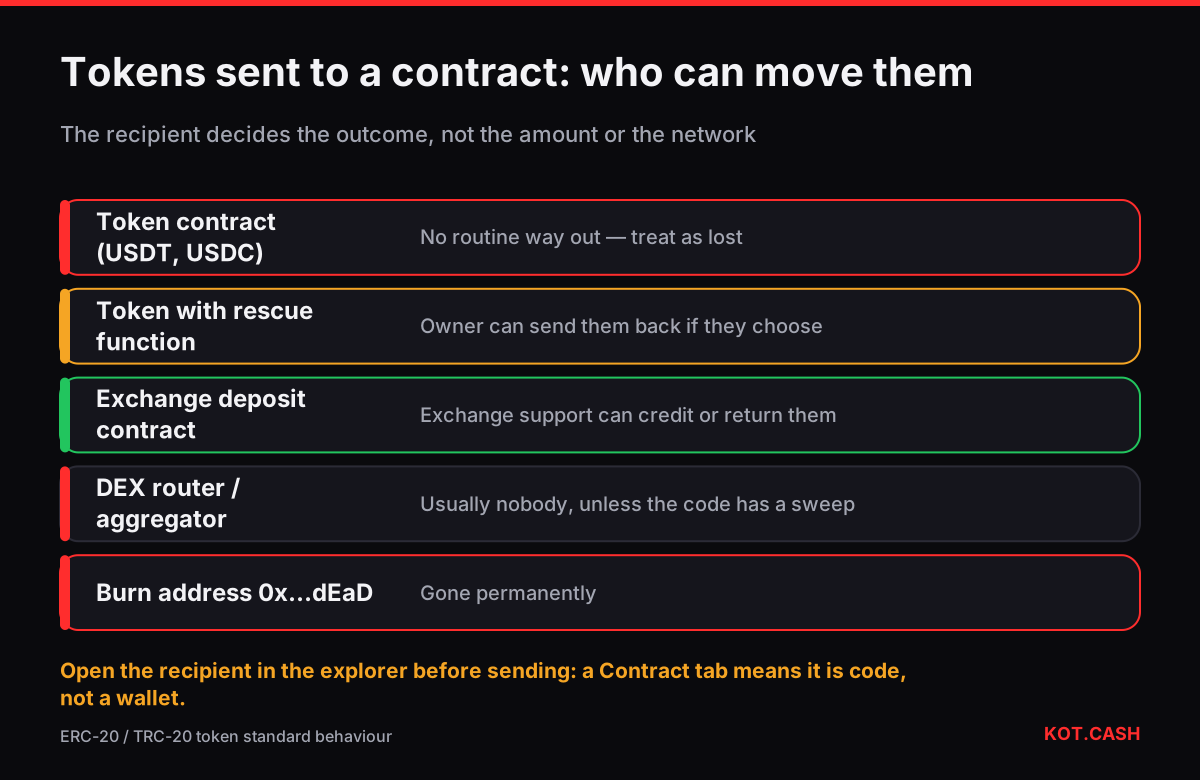
If you pasted a token's contract address into the recipient field and pressed Send, the tokens now sit in the balance of that contract. Whether you get them back depends on one question: does the contract have a function that lets someone move tokens out of its own balance? For the big stablecoins the honest answer is usually no — USDT and USDC sent to their own contract addresses are almost never returned. For smaller tokens and for project contracts with a rescue function, recovery is sometimes possible, but only the contract owner can do it.
How this mistake happens
Block explorers and coin listing sites show the token contract right next to the token name, with a copy button. People copy it while looking for the right network, then paste it into the wallet instead of the recipient's address. Wallets accept it because a contract address has exactly the same format as a personal one: 0x plus 40 hex characters on Ethereum and BNB Smart Chain, a T… address on TRON. Nothing in the address itself says it belongs to code rather than a person.
The well-known contract addresses are worth recognising on sight. USDT on Ethereum is 0xdAC17F958D2ee523a2206206994597C13D831ec7; USDT on TRON is TR7NHqjeKQxGTCi8q8ZY4pL8otSzgjLj6t. If the address you are about to send to matches the token you are sending, stop.
Confirm what happened in the explorer
- Open the transaction by its hash in the network's explorer (Etherscan, BscScan, Tronscan). The transaction hash identifier tells you which explorer to use if you are not sure.
- Check the status. Success means the transfer went through; the tokens are no longer in your wallet.
- Look at the token transfer line: from your address, to an address labelled with the token name or marked as a contract. On Etherscan a contract shows a document icon and a Contract tab.
- Open the recipient address. If it is the token itself (the page title says Token Tracker or the same ticker you sent), the tokens are stuck in the token contract. If it is some other contract — a router, a bridge, a project's vault — note its name; that changes who can help.
- If the token page is unclear, paste the raw input data into the transaction input decoder: a
transfer(to, amount)call withtoequal to the token contract confirms the case.
When tokens can come back
| Recipient | Who controls the balance | Chance of recovery |
|---|---|---|
| USDT / USDC token contract | Nobody can move it out by design | Very low |
| Small token with a rescue or withdraw function | The contract owner (project team) | Possible, at their discretion |
| Exchange deposit contract or smart wallet | The exchange or wallet provider | Often, via support, sometimes for a fee |
| DEX router or aggregator contract | Usually nobody; some have sweep functions | Low, depends on the code |
| Burn or zero address (0x000…dEaD) | Nobody | None |
Some token contracts include a function, often called recoverERC20, rescueTokens or withdrawToken, that lets the owner send foreign tokens out of the contract. You can check by opening the contract's Read/Write tabs on the explorer if the source is verified. If such a function exists, the owner can return your tokens, but nothing obliges them to. Tether and Circle have publicly said they do not process recovery of tokens sent to their contracts as a routine service.
Who to contact and what to send
- The project behind the contract — through the official website or GitHub listed on the explorer's token page, never through someone who messages you first.
- The exchange, if the tokens went to an exchange's deposit contract by mistake. Give them the hash, amount, time and your account ID.
- The swap service, if the address came from an order page. On KOT.CASH, write to support with the order link and the hash; if the deposit landed somewhere other than the order address, support can tell you what is visible on their side but cannot reverse a transfer to a third-party contract.
How to avoid sending to a contract again
- Copy the recipient address only from the recipient: the order page, the exchange's deposit screen, your own wallet's Receive screen.
- Before sending, open the address in the explorer. A contract has a Contract tab and code; a normal wallet does not.
- Compare the first six and last six characters with the source, not just the ends; the address validator checks the format and checksum.
- Send a small test amount first when the address is new to you; on TRON and BSC that costs cents.
On KOT.CASH every order shows a fresh deposit address generated for that order; it is never the token contract. If you are moving USDT between networks, the guide on moving USDT between TRC20, ERC20 and BEP20 explains which address belongs where, and sending to the wrong network covers the related mistake of choosing the wrong chain.
FAQ
I sent USDT to the USDT contract address. Can Tether return it?
In practice almost never. The USDT contract has no routine function to send out tokens stuck in its own balance, and Tether does not offer recovery as a service.
Why did my wallet allow sending to a contract?
Contract and personal addresses have the same format. The wallet cannot tell from the address that the recipient is code, and an ERC-20 transfer to a contract succeeds unless the token blocks it.
How do I see if an address is a contract?
Open it in the explorer. Etherscan, BscScan and similar show a Contract tab with bytecode or verified source; on Tronscan the address page is marked as a contract.
Is there any tool that can pull tokens out of a contract?
No outside tool can. Only a function in the contract itself, called by whoever the contract authorises, can move its balance.
I sent to a swap order but the explorer shows a contract. Is that a problem?
Some services use smart-contract deposit addresses. Contact the service with the hash; if the address came from the order page, they can trace it.