If tokens or NFTs you never bought appear in your wallet, often with a name like “$5000 USDT reward — claim at xyz-site”, leave them alone. They are an advertisement for a phishing site. Sending a token to millions of addresses costs the attacker little, and anyone who visits the site and connects a wallet risks signing an approval or a drainer transaction. Receiving the token does not harm you; interacting with it can.
What happens, step by step
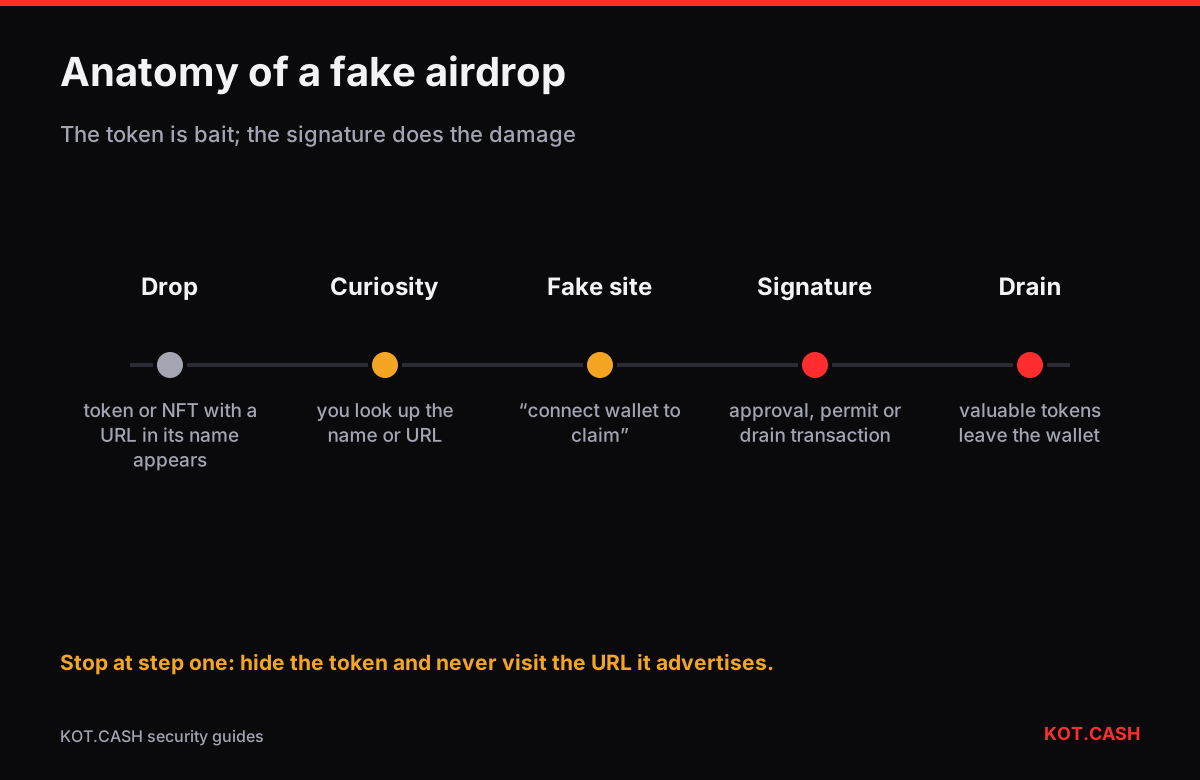
The scam follows the same path almost every time. The timeline below shows where the damage is done — and where you can stop it.
- Drop. A token or NFT appears in your wallet. Its name, symbol or image contains a URL or a promise: “Visit … to claim”, “Voucher 2,500 USDC”.
- Curiosity. The wallet shows it as an asset, sometimes with a fake price. You search the name or type the URL.
- Site. A polished page imitating a known project asks you to connect your wallet to “claim” or “convert” the reward.
- Signature. You are asked to sign — an approval, a Permit2 message, an NFT
setApprovalForAll, or on Solana a transaction that transfers your assets. - Drain. Within minutes the valuable tokens leave your wallet. The “reward” was never real.
Some variants skip the website: the token’s own contract makes selling it impossible or triggers a fee, or the token is used to plant a look-alike address in your history — see address poisoning.
Where these tokens show up
| Network | Typical form | What wallets do |
|---|---|---|
| Ethereum, L2s, BNB Chain, Polygon | ERC-20 token or NFT with a URL in the name | Many wallets hide unverified tokens |
| Solana | Compressed NFTs or SPL tokens with a link in metadata | Phantom and others flag spam and allow burning/hiding |
| TRON | TRC-20 tokens named like USDT or “Airdrop” | Tronscan marks scam tokens; wallets may not |
| Cosmos, Sui, others | Tokens with promotional names | Varies by wallet |
What to do with a spam token
- Ignore or hide it. Most wallets let you hide a token from the list. That is enough.
- Do not try to sell or swap it. The swap page it points to is the trap, and some tokens are designed to fail or charge you on sale.
- Do not send it anywhere. Transferring it may require an approval, and moving scam tokens to an exchange can cause support questions.
- Burning is offered by some Solana wallets and recovers the rent deposit of the token account. It is safe when done through the wallet’s own feature, not a website.
Why wallets still show these tokens
A blockchain does not ask permission to credit an address, so the token really is in your wallet. Wallets decide what to display: some hide tokens without a known price or verified contract, others show everything they find. Fake liquidity pools can give a spam token a quoted price, so it may even appear in your portfolio total. Turning on “hide unknown tokens” or a spam filter in the wallet settings removes most of the noise without affecting real assets.
How real airdrops work
Genuine airdrops exist: projects distribute tokens to early users, often based on a snapshot of past activity. Their pattern differs from the scam in clear ways.
- They are announced on the project’s official site and verified accounts, usually with documentation of eligibility.
- Claiming happens on the project’s official domain, which you reach yourself, not through a link inside a token name.
- Some airdrops arrive without any claim; then there is nothing to sign at all.
- No real airdrop asks for a seed phrase, a payment “to unlock” or an unlimited approval of your other tokens.
When a claim really requires a signature, read it: the EIP-712 signature decoder shows whether it is a harmless claim message or a permit giving someone your tokens. Check the domain first with the phishing link checker.
A quick way to verify a claim: search the project’s name together with “airdrop” on its official website or documentation, not in a search engine’s ads. If the official site says nothing about a distribution, there is none.
If you already connected and signed
- Revoke approvals on that network immediately — how to revoke token approvals.
- Move remaining assets to a new address if you signed a transaction you do not understand, especially on Solana where the transaction itself may have moved ownership.
- Report the site to your wallet provider and to phishing lists; report losses to the police with the transaction hashes.
FAQ
Is it dangerous to receive an unknown token?
No. Anyone can send tokens to any address. The danger begins when you visit its site or interact with it.
Can I sell a spam token I received?
Do not try. The suggested swap site is the trap, and many such tokens cannot be sold.
Why does my wallet show a high value for the spam token?
Fake liquidity pools can give the token a price. It is not real money you can withdraw.
Should I burn spam NFTs on Solana?
Using the wallet’s built-in burn or hide feature is fine and returns the small rent deposit. Do not use a website for it.
How do I verify a real airdrop?
Check the project’s official site and verified accounts, reach the claim page yourself and read every signature.