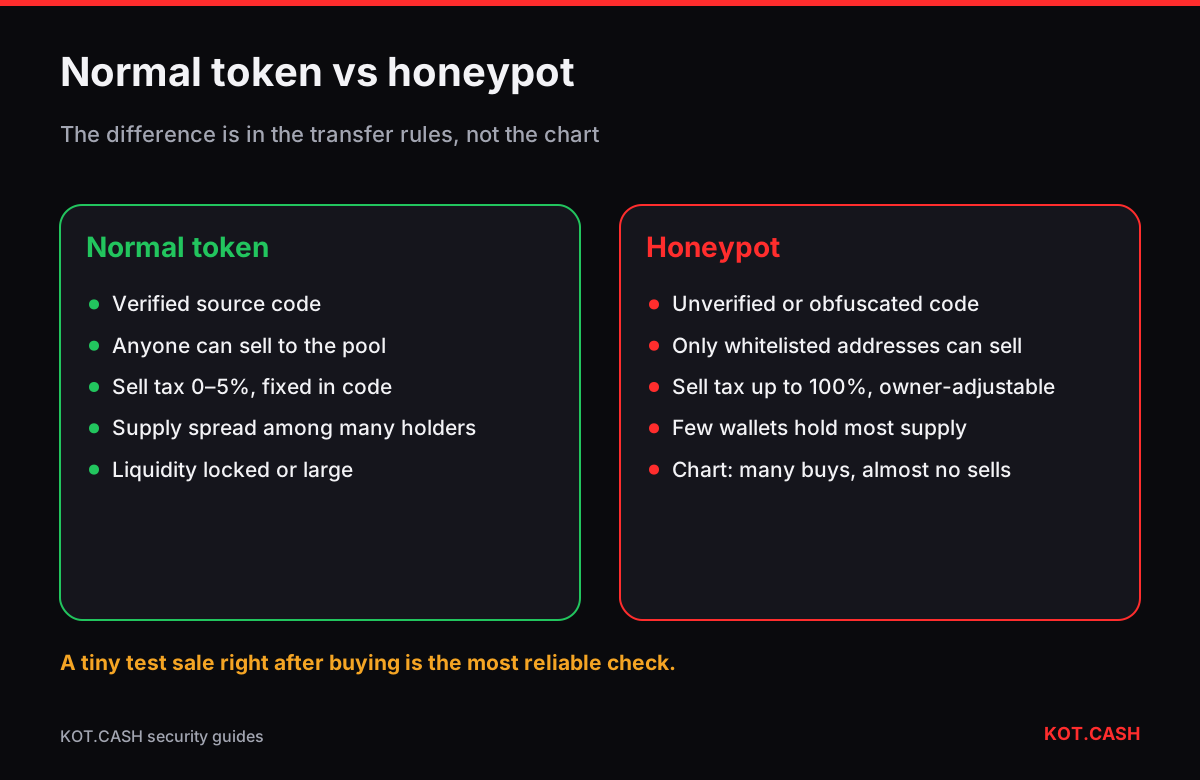
A honeypot token is a token whose smart contract lets anyone buy it but prevents ordinary holders from selling. The chart only goes up because nobody but the creator can sell, which attracts more buyers. When enough money is in, the creator sells into the pool and leaves everyone else holding a token with no exit. If you bought a token and every sell fails or returns almost nothing, you are probably in one.
How the trap is built
On EVM networks such as Ethereum, BNB Smart Chain or Base, a token is a contract with its own transfer logic. Selling on a decentralised exchange means transferring the token to the liquidity pool. A honeypot adds a condition to that path. Common variants:
- Blacklist or whitelist: only addresses approved by the owner can transfer to the pool; buyers are added to a blocklist automatically.
- Sell tax of 90–100%: the sale technically goes through, but almost everything is taken as a “fee”.
- Max transaction or cooldown set so low or long that selling is impossible in practice.
- Owner-only switches such as “trading enabled” that the owner turns off after you buy.
- Hidden mint: the owner can create unlimited tokens and dump them, crashing the price.
On Solana the mechanism differs: SPL tokens can keep a freeze authority, and Token-2022 tokens can have a transfer hook or transfer fee. A token with an active freeze authority can freeze your token account so you cannot move it.
Honeypot vs ordinary bad trade
Not every token you cannot sell profitably is a honeypot. A real honeypot blocks the sale technically. A rug pull removes the liquidity so there is nothing to sell into. A pump-and-dump simply collapses in price. The checks below catch the first and help with the second.
Checks before buying a new token
- Make sure you have the right contract address from the project’s official site; scam copies use the same ticker. Explorers mark verified contracts.
- Check whether the source code is verified on the explorer. Unverified code on a new token is a strong reason to stay away.
- Run the address through public scanners (for example honeypot.is, Token Sniffer or GoPlus Security). They simulate a buy and a sell and list risky functions. A clean result is not a guarantee.
- Look at holders: if one or two addresses besides the pool hold most of the supply, they can dump it.
- Look at the trades: many buys and almost no sells from addresses other than one or two is the classic honeypot chart.
- Check who owns the contract and whether ownership was renounced, and whether the liquidity is locked and for how long.
Reading the contract without being a developer
On Etherscan or BscScan open the token, then the Contract tab. A green check means the source is published. Under “Read contract” and “Write contract” look at the function names: words like blacklist, setFee, setMaxTx, enableTrading, mint or excludeFromFee callable by the owner mean the owner can change the rules after you buy. A sell fee that can be set above 10–20% by one address is a warning on its own. On Solana explorers check whether the token’s mint authority and freeze authority are “null” (revoked).
Why price impact matters too
Thin pools make even honest tokens hard to exit. If the pool holds $20,000 of liquidity and you buy $5,000 worth, selling back loses a large share to price impact even before any fee or tax. The DEX price impact calculator shows how much you would receive for a given pool size and trade, using the constant-product formula that Uniswap-style pools follow.
If you are stuck in a honeypot
- Do not pay anyone who promises to “unlock” the token — it is a follow-up scam.
- Revoke approvals you gave to the token or to unknown routers — see revoking token approvals.
- Report the contract on the explorer (most have a “report/flag” option) and to the scanners, so others see the warning.
- Keep the transaction hashes. Losses from fraud may be reportable to the police and, depending on the country, recognised for tax purposes.
Where honeypots are found
Honeypots almost always live on decentralised exchanges with permissionless listings, promoted through Telegram “signal” groups, paid influencers and airdropped tokens that appear in wallets uninvited — see fake airdrop token scams. Coins listed by an instant exchange such as KOT.CASH are established assets supported by the liquidity providers, not new DEX tokens. Swapping BTC, ETH or USDT through a swap order does not touch token contracts you have not chosen.
FAQ
Why can I buy a token but not sell it?
Its contract probably blocks transfers to the liquidity pool for ordinary holders, or applies a near-100% sell tax. That is a honeypot.
Can a honeypot drain my other tokens?
The token itself cannot, but if you approved an unknown router or signed something on its site, revoke those approvals.
Are honeypot checkers reliable?
They catch many known patterns, but new tricks appear. Combine them with a tiny test sale and a look at the holders and trades.
Is a honeypot the same as a rug pull?
No. A honeypot blocks selling; a rug pull removes the liquidity so selling returns nothing.
Do honeypots exist on Solana?
Yes, via freeze authority, transfer hooks or fees in Token-2022 tokens. Check the token’s authorities in the explorer.