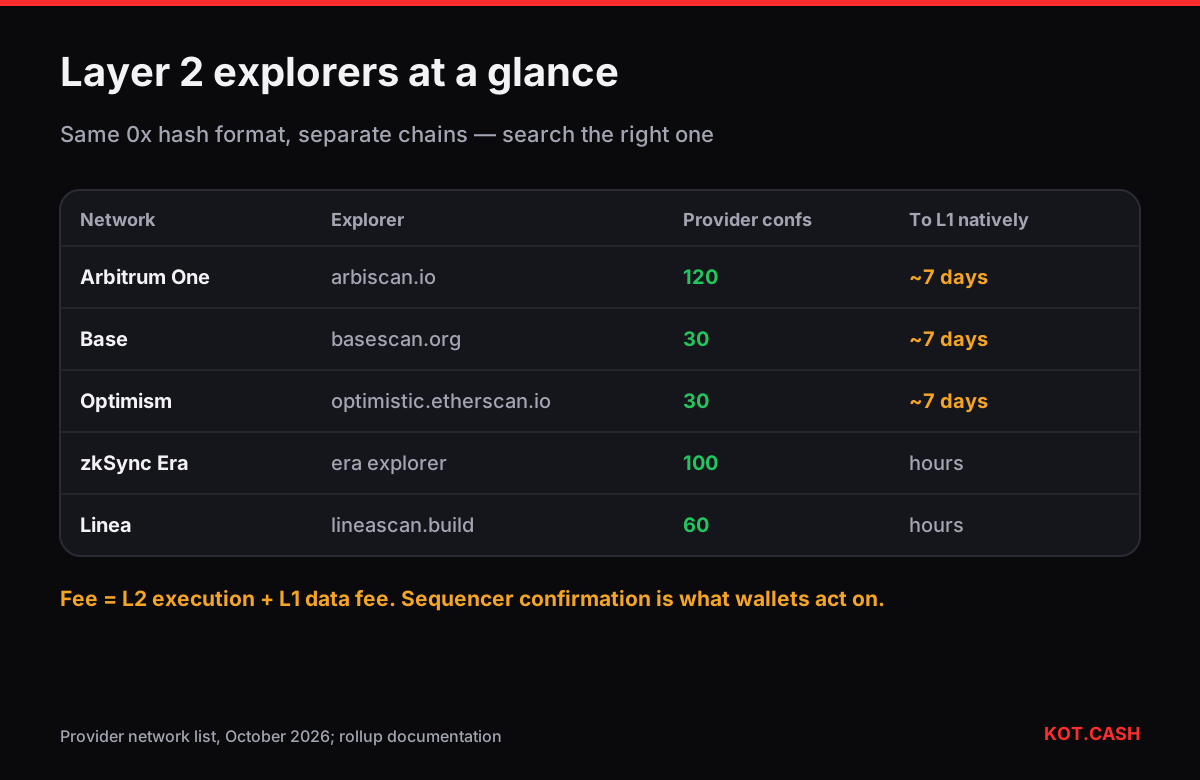
Layer 2 networks like Arbitrum One, Base and Optimism have their own block explorers — Arbiscan, Basescan and Optimistic Etherscan — built on the Etherscan design. A transaction made on an L2 exists only there; searching its hash on Etherscan returns nothing. The pages look familiar, but two fields are new: the transaction's L1 status (has the batch containing it been posted to Ethereum, and is it final there) and the L1 fee, the part of the cost that pays for publishing data on Ethereum.
Which explorer for which network
| Network | Explorer | Provider confirmations | Native withdrawal to L1 |
|---|---|---|---|
| Arbitrum One | arbiscan.io | 120 | ~7 days (challenge period) |
| Base | basescan.org | 30 | ~7 days (fault proofs) |
| Optimism | optimistic.etherscan.io | 30 | ~7 days |
| zkSync Era | explorer.zksync.io / era.zksync.network | 100 | hours, after proof |
| Linea | lineascan.build | 60 | hours, after proof |
Block intervals are short on rollups — Arbitrum produces blocks every quarter of a second, Base and Optimism every two seconds — which is why providers count many more confirmations than on Ethereum yet still credit within minutes.
Sequencer confirmation vs L1 finality
On a rollup, a single operator called the sequencer orders transactions and returns a result within a second. At that point the transaction is confirmed by the sequencer: practically safe, and what wallets and most services act on. Later, the sequencer posts the batch to Ethereum; once that Ethereum block is finalised, the L2 transaction inherits Ethereum's finality. Arbiscan shows this as a status such as 'Confirmed by Sequencer' or a link to the L1 batch; Basescan and Optimistic Etherscan show the L1 state batch or a 'Finalized' status. For a swap deposit you do not need to wait for L1 finality; the confirmation count is what matters.
Where the fee comes from
- L2 execution fee — gas used on the L2 × L2 gas price. This is usually a tiny fraction of a cent.
- L1 data fee — the cost of posting the transaction's compressed data to Ethereum, shown on OP Stack explorers as 'L1 Fees Paid' with the L1 gas price and fee scalar, and on Arbitrum folded into the gas used ('Gas Used for L1').
- Since Ethereum's Dencun upgrade in March 2024, rollups post data as blobs, which made the L1 data fee much cheaper. A plain transfer on Base or Arbitrum typically costs well under 5 cents.
The gas fee calculator estimates transfer costs on these networks next to Ethereum mainnet.
When a hash is not found
- Check which network the wallet used. MetaMask and Rabby show the network on the activity entry.
- Try the explorer of that L2. All of them accept the same 0x hash format, so the transaction hash identifier lists them all as candidates.
- If the hash is on an L2 you did not intend, the funds are at your address on that L2; recover tokens sent on the wrong EVM chain explains how to move them.
Tokens on L2: check the contract
USDC on Base, Arbitrum and Optimism exists in a native version issued by Circle and, on older deployments, a bridged version often labelled USDC.e. They are different contracts with different liquidity. On the token transfer line, open the contract and compare it with the issuer's official list before sending to an exchange that accepts only one of them. The same applies to USDT on Arbitrum, which uses its own contract.
Paying a swap order from an L2
When you pay a KOT.CASH order with ETH on Arbitrum or Base, the order page names the network next to the deposit address. After sending, open the hash on the matching explorer, check Status: Success and the recipient, then wait for the provider's confirmation count from the table above — about half a minute on Arbitrum at 120 blocks, about a minute on Base at 30. The deposit confirmations table has the current numbers for every network.
FAQ
Why can't Etherscan find my Arbitrum transaction?
Transactions on Arbitrum exist only on Arbitrum. Search the hash on arbiscan.io.
What is the L1 fee on Basescan?
The part of the fee that pays for publishing the transaction's data on Ethereum. Since March 2024 it is much cheaper thanks to blobs.
Is a sequencer-confirmed transaction safe?
For everyday payments, yes; wallets and services act on it. Full Ethereum finality follows once the batch is posted and finalised.
Why does withdrawing to Ethereum take 7 days?
Optimistic rollups allow a challenge period during which invalid state can be disputed. The native bridge waits for it to end.
How many confirmations does the provider need on Arbitrum?
120 confirmations, which pass in well under a minute because Arbitrum blocks are very frequent.