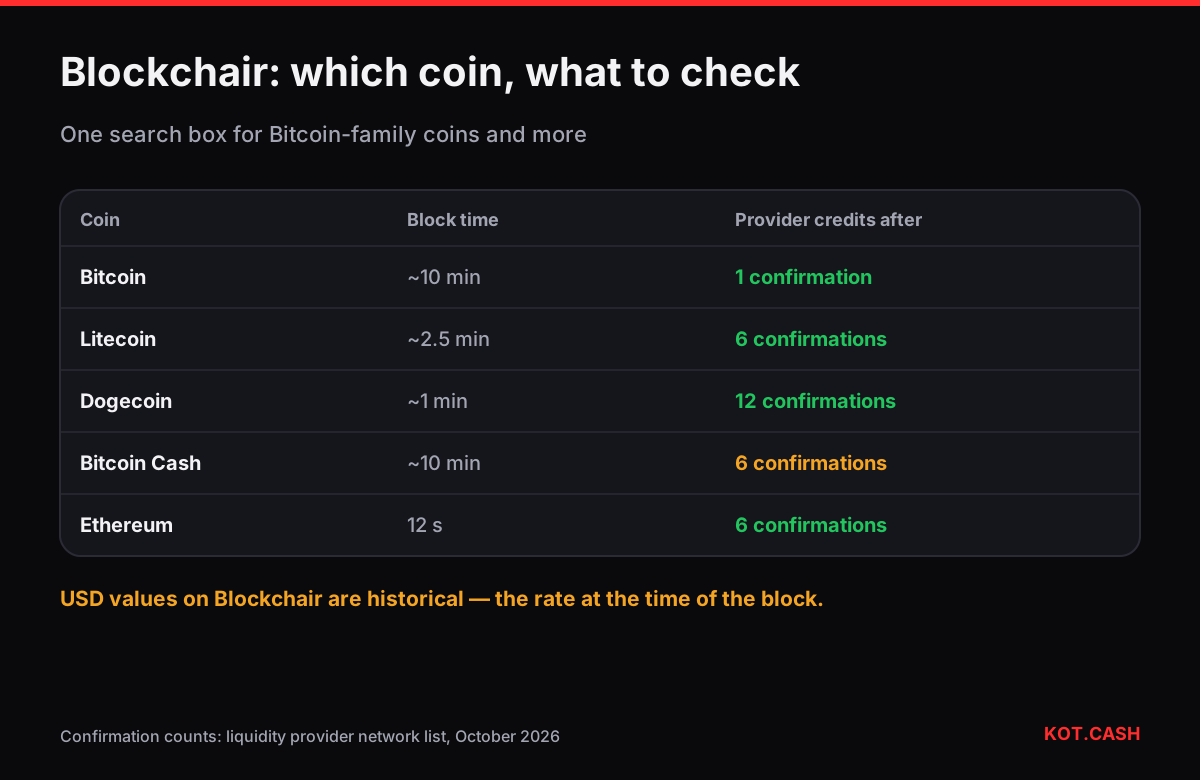
Blockchair is a multi-chain block explorer: one search box covers Bitcoin, Bitcoin Cash, Litecoin, Dogecoin, Dash, Zcash, Ethereum and a number of other networks. Paste a transaction hash or an address and it finds which chain it belongs to, which is handy when a 64-character hex txid could be Bitcoin, Litecoin or Dogecoin. Use it when you are not sure of the network or when you want USD values at the time of the transaction; for chain-specific detail, the native explorers often go deeper.
Search across chains
Bitcoin-family coins share the same txid format, so a hash alone does not tell you the coin. Blockchair searches all supported chains at once and shows matches. If you get two results — rare, but possible for addresses that are valid on both Bitcoin and Bitcoin Cash, like legacy 1… addresses — pick the chain from the label. The transaction hash identifier narrows the candidates if you want to check a hash before opening any explorer.
What each chain's page offers
| Coin | What to look at | Native alternative |
|---|---|---|
| Bitcoin | Fee rate, RBF flag, privacy-o-meter | mempool.space |
| Litecoin | Confirmations, MWEB pegs on the block page | litecoinspace.org |
| Dogecoin | Confirmations; fee per kB | dogechain-style explorers |
| Bitcoin Cash | CashAddr and legacy forms of addresses | bch.loping.net |
| Ethereum | Calls and token transfers, basic view | Etherscan |
| Zcash, Dash | Transparent transactions only | project explorers |
Reading a Bitcoin-family transaction page
- Status and confirmations. Unconfirmed transactions show with a mempool badge; confirmed ones show the block height and confirmation count.
- Fee and fee per vbyte (or per kB on Dogecoin). Compare with the network's current rates to judge a delay.
- Inputs and outputs, each with the amount and its USD value at the time of the transaction — useful for record-keeping.
- Flags such as SegWit, RBF and, for Bitcoin, Taproot spends.
- Privacy-o-meter (Bitcoin and some forks): a score with notes such as address reuse, round-number outputs or a likely change output. It is a heuristic and educational, not a verdict on anyone.
Litecoin and Dogecoin specifics
Litecoin blocks come every 2.5 minutes and Dogecoin blocks every minute, so confirmation counts climb faster than on Bitcoin. The KOT.CASH liquidity provider credits Litecoin deposits after 6 confirmations (about 15 minutes) and Dogecoin after 12 (about 12 minutes). Litecoin's MWEB extension blocks hide amounts for transactions inside MWEB; Blockchair shows the peg-in and peg-out transactions on the main chain but not the private transfers inside. Dogecoin fees are quoted per kilobyte; the commonly used default is 0.01 DOGE per kB.
Exports and the API
Blocks and the network dashboard
Each chain has a dashboard with the latest blocks, the mempool size, average fees and the current price. Open a block to see its size, the number of transactions, the miner (where identifiable) and the reward. On Litecoin the block page also shows MWEB-related data. This is useful when a confirmation seems slow: if no block has been mined for 25 minutes on Bitcoin, nothing is wrong with your transaction — it is just variance in block times, and the confirmation time estimator shows how long such gaps can last.
Blockchair offers CSV exports of address histories and a public API with a free tier and paid plans for heavier use. For a handful of lookups the website is enough. If you do accounting for several addresses, the export saves copying rows by hand. Be aware that pasting your addresses into any third-party site tells that site which addresses you are interested in; for privacy, use your own node or an explorer you run.
Finding a payment without a hash
- Search your receiving address and set the right chain.
- Sort or scroll by date and find the incoming amount.
- Open it and copy the txid for the sender, the recipient or support.
Limits of a multi-chain explorer
Breadth comes at a cost. For EVM chains Blockchair shows the basics, but token approvals, decoded contract calls and internal transactions are easier to read on Etherscan-family explorers. For Bitcoin fee bumping, mempool.space shows RBF history and projected blocks in more detail. And data on less common chains can lag behind the network during busy periods. A good routine is to use Blockchair to identify the chain and get the overview, then switch to the native explorer for anything that needs a decision.
For deposits to a KOT.CASH order in LTC, DOGE or BCH, Blockchair is a quick way to confirm that the deposit address from the order page received the full amount and how many confirmations it has. The deposit confirmations table lists how many each coin needs before it is credited.
FAQ
Which blockchains does Blockchair support?
Bitcoin, Bitcoin Cash, Litecoin, Dogecoin, Dash, Zcash, Ethereum and several others. The selector on the site shows the current list.
Why does a txid show up on more than one chain?
Transaction IDs only collide in extremely rare cases; addresses, however, can be valid on both Bitcoin and Bitcoin Cash. Check the chain label.
What is the privacy-o-meter?
A heuristic score for Bitcoin transactions that flags patterns like address reuse or obvious change outputs. It is educational, not proof of ownership.
Are the USD values current prices?
No. They are the rates at the time the block was mined.
Can Blockchair speed up my transaction?
No. Explorers only read data. Use RBF or CPFP in your wallet.