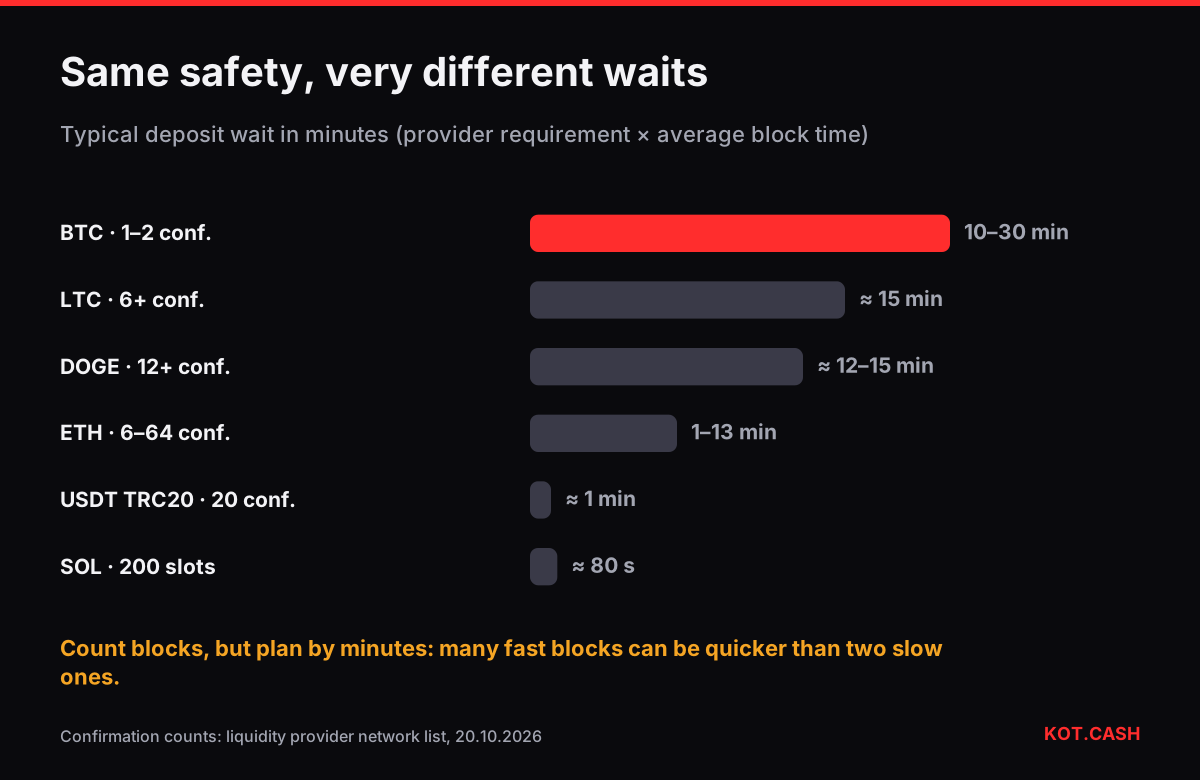
A crypto deposit is credited after a set number of blocks has been added on top of your transaction. For the liquidity provider behind KOT.CASH that is 1–2 confirmations for Bitcoin, 6–60 for Litecoin, 12–36 for Dogecoin, 6–64 for Ethereum, 20 for TRON, 60 for BNB Smart Chain and 200 slots for Solana. In time, that ranges from seconds to about half an hour. The deposit confirmations lookup has the numbers for 190 coins on every network; this article explains why they differ and what to do when a deposit seems to take forever.
What a confirmation protects against
When your transaction enters a block it has one confirmation. Each later block on top adds one more. Until a transaction is buried deep enough, a chain reorganisation could in principle replace the block it is in, and a double-spend attempt could make the payment disappear. A swap pays out irreversibly in another coin, so it waits until reversal is impractical. How many blocks that takes depends on how much work or stake each block represents and how often reorganisations happen on that chain.
Why the counts are so different
Fast chains need many blocks but little time; slow chains need few blocks and a lot of time. Comparing the counts alone is misleading — compare the wait.
| Coin / network | Confirmations | Block time | Typical wait |
|---|---|---|---|
| BTC | 1–2 | ~10 min | 10–30 min |
| LTC | 6–60 | ~2.5 min | 15 min, more for large deposits |
| DOGE | 12–36 | ~1 min | 12–15 min |
| ETH / USDT ERC20 | 6–64 | 12 s | 1–13 min |
| USDT TRC20 / TRX | 20 | 3 s | about 1 min |
| BNB / USDT BEP20 | 60 | under 1 s | under 1 min |
| SOL / USDT on Solana | 200 slots | ~0.4 s | about 80 s |
| ADA | 15–70 | ~20 s | 5–25 min |
| XRP | 1 | 3–5 s | seconds |
A range such as 6–60 means the provider can ask for more confirmations on some deposits — typically larger ones. The exact number for your order is on the order page, next to a live counter.
Why your wallet and the order page disagree
Your wallet, the block explorer and the provider count confirmations from their own view of the chain, which can lag by a block or two. If the explorer shows 13 confirmations and the order page 12, wait a minute. If the explorer shows a confirmed transaction and the order page shows nothing at all after ten minutes or so, check that you sent to the right address and on the right network.
When a deposit has zero confirmations
- Bitcoin and Litecoin: the fee rate was probably too low for the current mempool. If your wallet supports Replace-By-Fee, raise it. Otherwise wait; low-fee transactions often confirm when demand drops.
- Ethereum and EVM chains: a transaction can be stuck behind an earlier one with the same sender if that one is pending. Speed it up or cancel it in the wallet.
- Exchange withdrawals: the exchange may not have broadcast it yet. Check the withdrawal status on the exchange and ask for the hash.
- Any chain: never send a second payment to the same order to "push" it. It will not merge with the first.
Why large deposits can need more confirmations
The cost of attacking a chain is roughly fixed, while the reward grows with the amount at stake. A double-spend on a $50 deposit is never worth it; on a deposit of several hundred thousand dollars on a smaller chain it might be. That is why providers express requirements as ranges — 6–60 for Litecoin, 12–36 for Dogecoin, 15–70 for Cardano — and apply the upper end to large deposits. For the biggest coins the range is narrow: Bitcoin is 1–2.
Proof-of-stake chains add finality: after a certain point a block cannot be reverted without validators losing their stake. On Ethereum a block is finalised after two epochs, about 13 minutes, which matches the upper end of the provider's 6–64 range. Fast chains such as TRON, BNB Smart Chain or Solana reach practical finality within seconds to a minute, so their counts look high but take little time.
Exchange deposits follow the same logic, and their numbers can differ from a swap provider's. When you send to an exchange, check its deposit page for the confirmation count it uses.
Confirmations do not change the fee
The number of confirmations affects only how long you wait. It does not affect the rate, the service fee (1% float, 1.5% fixed) or the network fee. On the float rate the final amount follows the market until the deposit is confirmed; if you want the amount locked while you wait, use the fixed rate.
Choosing a faster coin to send
If speed matters more than which coin you start from, send something that confirms quickly: USDT on TRON, BNB Smart Chain or Solana, XRP or LTC on small amounts. The confirmation time estimator shows expected and 90th-percentile waits per network, and the Bitcoin fee calculator helps you pick a fee rate that confirms in the next block or two.
FAQ
How many confirmations does Bitcoin need on KOT.CASH?
1–2 confirmations, usually 10–30 minutes.
How many confirmations does USDT TRC20 need?
20 TRON blocks, about one minute.
Why does Litecoin need 6 confirmations or more?
Litecoin blocks come every 2.5 minutes, so six of them take about as long as one or two Bitcoin blocks and offer comparable protection.
My transaction is confirmed on the explorer but the order did not move.
Give it a minute — counts can lag by a block. If it stays, check the address and network, then contact support with the hash.
Can I speed up confirmations?
Only by paying a higher network fee when you send, or raising it later with Replace-By-Fee where supported.