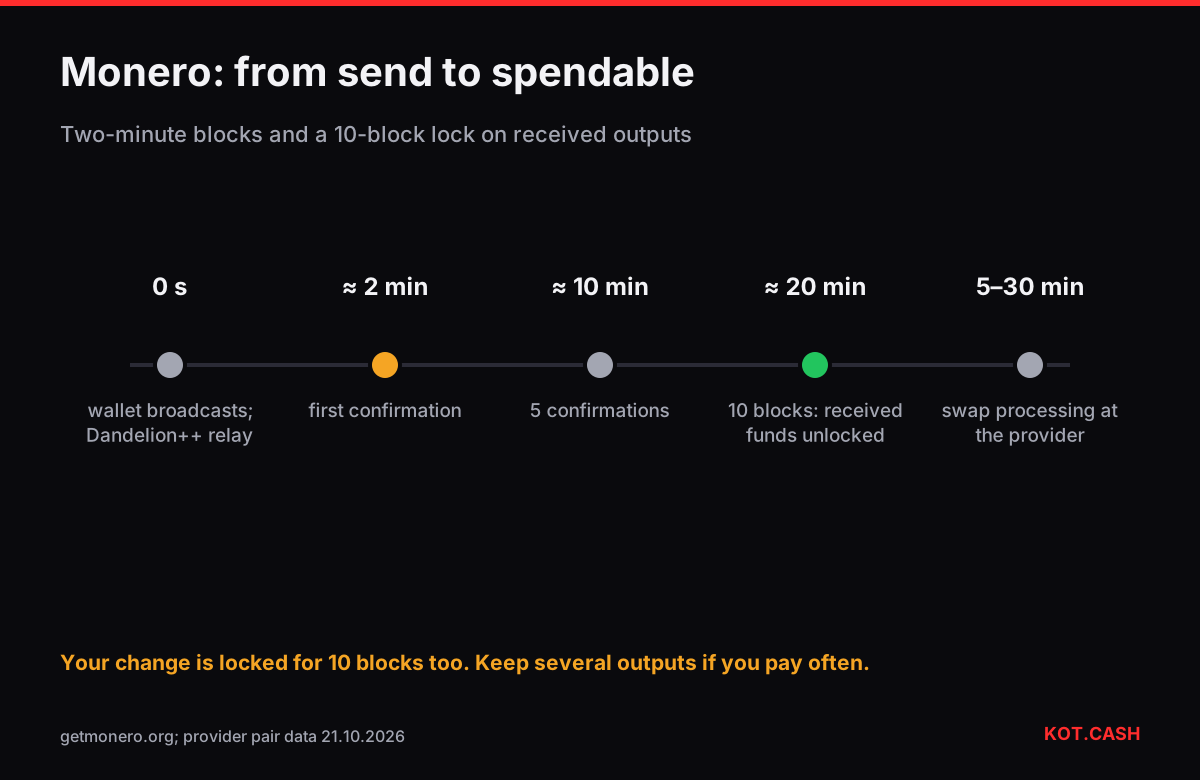
A Monero transaction usually appears in a block within about two minutes, because the network targets one block every 120 seconds. The coins you receive cannot be spent again until 10 blocks have passed, which takes roughly 20 minutes. Exchanges and swap services often wait for 10 or more confirmations before crediting a deposit. A typical transfer costs a fraction of a cent to a few cents in fees, depending on the priority your wallet uses and how busy the network is.
From send to spendable
| Moment | Time from sending | What happens |
|---|---|---|
| Broadcast | seconds | Wallet relays the transaction; Dandelion++ spreads it |
| In the mempool | seconds | Recipient's wallet may show it as pending |
| 1 confirmation | ≈ 2 minutes on average | Included in a block |
| 10 confirmations | ≈ 20 minutes | Received outputs become spendable (unlocked) |
| Service-specific | 10–20+ blocks | Exchange or swap credits the deposit |
Block times are random around the 2-minute target, so one confirmation can take 30 seconds or six minutes. The confirmation time estimator shows the spread for any number of confirmations: for ten blocks at two minutes, the median is close to 20 minutes and the 90th percentile closer to 26.
The 10-block lock
Every output you receive is locked for 10 blocks. During that time your wallet shows it as part of the balance but not the unlocked (spendable) balance. The rule exists to protect against chain reorganisations: if a recently received output were spent and the block containing it were replaced, ring signatures referencing it could become invalid. The practical effect is that you cannot receive XMR and pass it on within a minute.
A side effect catches people out: when you send part of a balance, the change returns to you as a new output, which is also locked for 10 blocks. If your wallet holds a single large output, a second payment right after the first must wait for the change to unlock. Keeping several outputs avoids that.
Fees and priority levels
Monero fees are calculated per byte (more precisely, per transaction weight) with a dynamic base fee that adjusts to block sizes. Wallets offer priority levels — for example low, normal, elevated and highest in the official CLI — that multiply the base fee. A common transaction with two inputs and two outputs weighs around 1.5 kB. At normal priority its fee has typically been a few hundred-thousandths of an XMR, which at about $620 per XMR is a few cents or less. Higher priority matters only when blocks are full; most of the time normal priority confirms in the next block.
- More inputs make a transaction larger and more expensive; consolidating many tiny outputs costs more than one payment.
- Monero blocks can grow when demand rises, with a penalty that keeps growth gradual; fees rise mainly in those periods.
- Miners are paid the block reward (a tail emission of 0.6 XMR per block since 2022) plus fees, so security does not depend on fees alone.
Why a transfer can be slow
- Wallet sync. A wallet that has not synced the latest blocks shows payments late. Restoring with a wrong or too-early restore height makes syncing long.
- Remote node issues. A slow or overloaded remote node delays broadcasting and seeing transactions.
- Locked change. Your own previous payment's change is still within its 10 blocks.
- Low priority during congestion. Rare, but possible during spikes in usage.
- Service confirmations. The receiving service waits for its own number of blocks and may process deposits in batches.
Monero on KOT.CASH: what to expect
XMR swaps go through the second liquidity provider, Heleket, at a float rate. The provider quotes 5–30 minutes of processing for XMR routes; on 21.10.2026 the minimum for XMR to USDT TRC20 was about 0.011 XMR and for USDT TRC20 to XMR about 7 USDT, with a payout network fee of about 0.005 XMR on XMR payouts. Send exactly the amount shown, keep your transaction ID, and remember that your wallet must have enough unlocked balance — not just total balance — to make the payment.
Comparison with other networks
Two-minute blocks put Monero between Bitcoin (ten minutes) and fast networks such as Litecoin (2.5 minutes) or Solana (sub-second slots) in raw speed. In fees, Monero is cheaper than Bitcoin in busy periods and close to Litecoin. The network fee comparison and the deposit confirmations lookup show how other coins compare at the provider.
FAQ
How long does a Monero transaction take?
About two minutes for the first confirmation on average; received funds become spendable after 10 blocks, about 20 minutes.
What is the 10-block lock?
A rule that makes newly received outputs, including your own change, unspendable for 10 blocks to protect against reorganisations.
How much is a Monero fee?
Typically a few hundred-thousandths of an XMR at normal priority — a few cents or less — depending on transaction size and network load.
Why does my wallet show less unlocked balance?
Recent incoming outputs or change from your last payment are still within the 10-block lock.
How long does an XMR swap take on KOT.CASH?
The provider quotes 5–30 minutes of processing on top of the Monero confirmations.