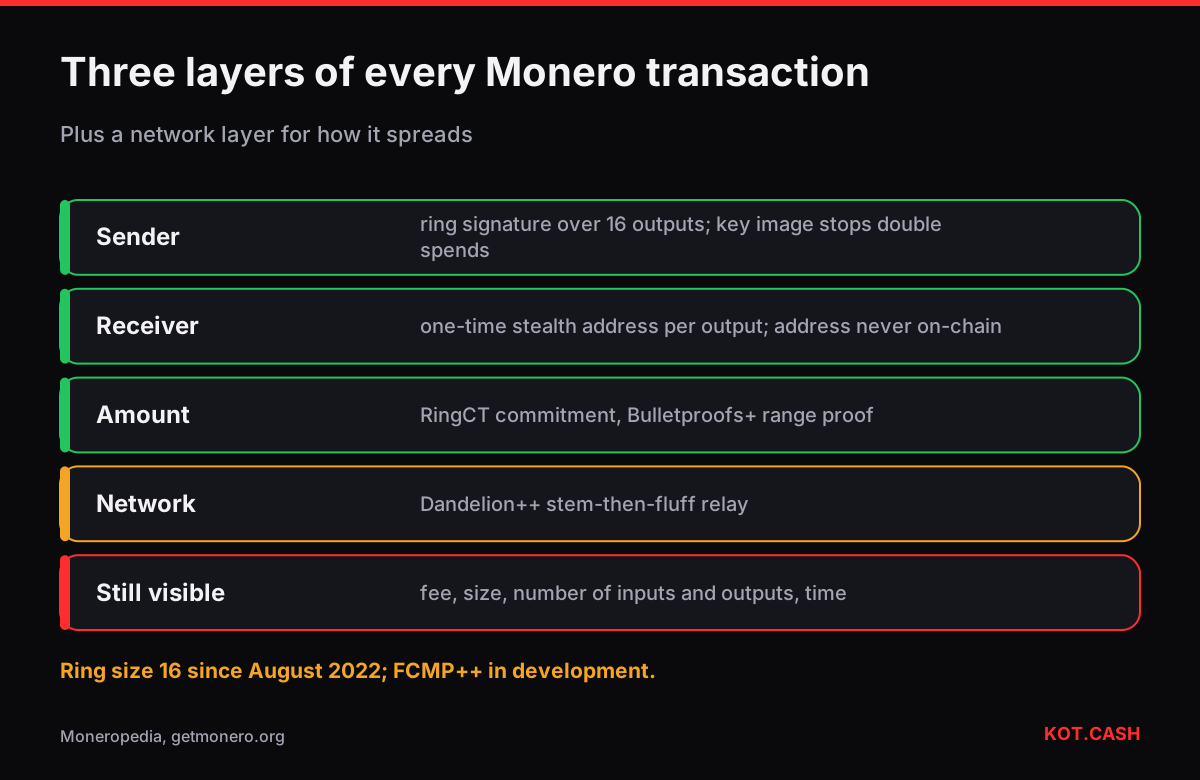
Monero hides three things that Bitcoin's blockchain shows openly: who sent a payment, who received it and how much moved. It does this with three separate mechanisms that every transaction uses by default — ring signatures for the sender, one-time stealth addresses for the receiver and RingCT commitments for the amount. Privacy is not an option you switch on; a Monero transaction without it is not valid. This article explains each part, what an observer of the chain can still see and where the known limits are.
Sender: ring signatures
When you spend an output, your wallet picks 15 other outputs from the blockchain as decoys and signs with a ring signature over all 16. Anyone can verify that one of the 16 is being spent and that the signer owns it, but not which one. The ring size has been fixed at 16 since the network upgrade of August 2022; earlier versions used smaller rings, and very early transactions could have rings of one, which is one reason old history is weaker than new.
To prevent double spending without revealing the real output, each spend publishes a key image: a value derived from the output's private key. The same output always produces the same key image, so the network rejects a second spend, yet the key image cannot be linked to the output it came from.
Receiver: stealth addresses and subaddresses
A Monero address (95 characters, starting with 4 for a primary address or 8 for a subaddress) is never written to the blockchain. The sender's wallet combines the recipient's public view key and public spend key with a random per-transaction key to derive a one-time public key for each output. Only the recipient, scanning the chain with their private view key, can recognise which outputs belong to them. Two payments to the same address therefore look unrelated on-chain.
Subaddresses let one wallet hand out a different address to each payer while keeping a single seed. Integrated addresses (106 characters) embed a short payment ID and were used by services before subaddresses became standard.
Amount: RingCT and range proofs
Since 2017 every Monero output's amount is hidden in a Pedersen commitment. The network checks that the sum of input commitments equals the sum of output commitments plus the fee, so no coins are created, without learning any amount. Range proofs show that each hidden amount is positive and within limits; Monero moved to Bulletproofs in 2018 and Bulletproofs+ in 2022, which made transactions much smaller and cheaper than the first RingCT design.
| Data | Bitcoin | Monero | Mechanism |
|---|---|---|---|
| Sender's output | visible | hidden among 16 | ring signature + key image |
| Recipient address | visible | hidden | one-time stealth address |
| Amount | visible | hidden | RingCT commitment + Bulletproofs+ |
| Fee | visible | visible | — |
| Number of inputs and outputs | visible | visible | — |
| Originating IP of broadcast | visible to peers | obscured | Dandelion++ |
Network layer: Dandelion++
On-chain privacy does not help if the first node that hears your transaction learns your IP address. Monero nodes relay new transactions with Dandelion++: a transaction first travels along a random chain of single nodes (the stem) and only then spreads to everyone (the fluff), which makes it hard to tell which node originated it. Wallets connected to a third-party remote node still reveal their IP and which transactions they request to that node operator.
What remains visible and known limits
- Transaction shape. The number of inputs and outputs, size, fee and time are public. Unusual shapes stand out.
- Decoy selection. Rings are only as good as the decoys; research has shown that poor selection or timing patterns can make the real input more likely. The algorithm has been improved several times.
- Information outside the chain. Exchange records, IP addresses, reused view keys and published transaction proofs can link activity regardless of on-chain cryptography.
- Older history. Transactions before RingCT or with small rings are weaker.
Researchers and the Monero project are working on full-chain membership proofs (FCMP++), which would replace 16-member rings with proofs over the whole set of outputs. At the time of writing it is in development and testing, not live on mainnet.
Where Monero is available on KOT.CASH
Monero swaps are routed through a second liquidity provider, Heleket, at a float rate only (no fixed rate). On 21.10.2026 the minimum for XMR to USDT TRC20 was about 0.011 XMR and for BTC to XMR about 0.000085 BTC; processing takes 5–30 minutes. XMR prices at the time of writing were around $620. Addresses can be checked with the address validator, which verifies Monero's checksum, and the Monero QR code generator creates payment QR codes offline.
FAQ
Is every Monero transaction private?
Yes. Ring signatures, stealth addresses and RingCT are mandatory; a transaction without them is invalid.
What is the ring size in Monero?
16: the real input plus 15 decoys, fixed since the August 2022 network upgrade.
Can anyone see my Monero balance?
Not from the blockchain alone. Someone with your private view key can see incoming payments.
What is a key image?
A value published with each spend that prevents double spending without revealing which output was spent.
Can Monero be traced at all?
On-chain links are much harder than in Bitcoin, but metadata such as IP addresses, exchange records or shared keys can still link activity.