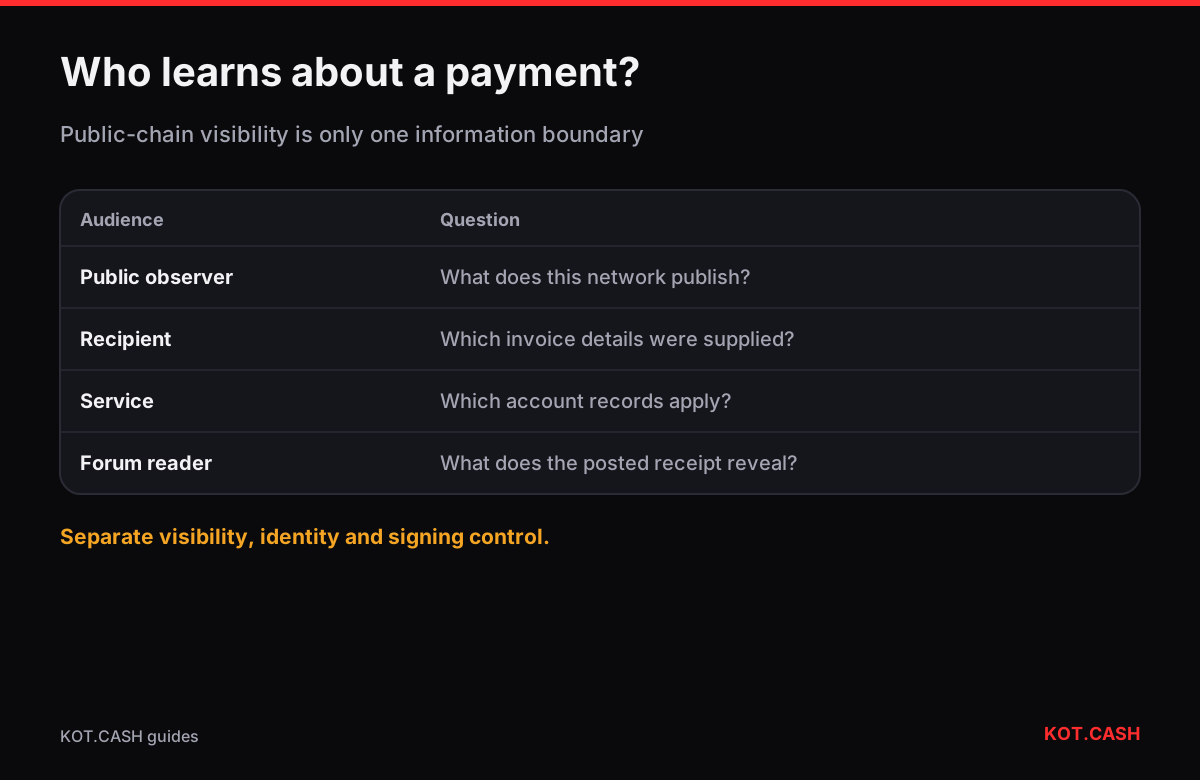
Imagine paying an invoice and then sending the receipt to a public discussion board to ask for help. There are now several audiences: the recipient, the service processing the payment, readers of the post and people inspecting a blockchain. They do not necessarily know the same things. Comparing Bitcoin and Monero starts with separating these audiences, not assigning a single privacy score. This guide concerns ordinary on-chain transactions and the information around a payment. It does not claim that a private transaction format hides your identity from a merchant you have already told your name.
First distinguish a ledger record from a customer record
A blockchain entry and an invoice answer different questions. A ledger records the network operation; an invoice can connect a payer, an order and delivery information. Consider an illustrative shop that assigns an order number before displaying a payment address. Even if an outside observer cannot read all payment details from the chain, the shop may still know what its own order represents. When assessing a real payment, list the organisations and people involved and ask what you supplied to each. Do not assume a protocol feature changes information already present in a receipt, an email or an account.
Bitcoin: public transaction structure is not a list of names
Bitcoin’s transaction guide explains how inputs reference earlier outputs and how outputs specify amounts and spending conditions. For ordinary on-chain payments this creates public transaction data. But a transaction record is not, by itself, a verified identity directory. The Bitcoin privacy guide warns that publishing addresses or purchase details can connect that data to people. Keep these two statements together: public financial structure can expose information, while an observer’s claim about a real-world owner still requires evidence.
Monero: a different default, with boundaries
The Monero FAQ describes default protections for sender, recipient and amount, while explicitly rejecting an absolute anonymity guarantee. These protections change what a passive public-chain observer can read; they do not erase the knowledge of a payment participant. Avoid turning that comparison into a claim that no information can ever be inferred. A recipient may recognise their own payment, and data deliberately supplied outside the chain remains a separate source of information. For a deeper mechanism discussion, use the technical privacy guide.
| Observer | Question to ask | What not to assume |
|---|---|---|
| Public-chain observer | Which fields are available from this network? | That every field is a verified personal identity |
| Payment recipient | What invoice and delivery details did I provide? | That ledger privacy erases the order record |
| Custodial service | What account and transaction records apply? | That using XMR removes service rules |
| Public forum reader | What did my post disclose? | That a cropped balance hides all identifying details |
| Support agent | What minimum evidence resolves the issue? | That recovery secrets are needed for a receipt check |
A worked example: proving that an invoice was paid
Suppose a business asks for evidence of a payment against invoice A. This is an example, not a claim about any particular merchant. Start by identifying the disputed fact: was a transfer sent, did the intended recipient receive it, or did the business allocate it to the right invoice? Those are not interchangeable. A public transaction link may help answer one question while failing to establish who placed an order. A screenshot of a wallet balance may fail to answer all three. Ask the recipient which official payment-evidence procedure they support, then provide only the material necessary for that specific dispute.
Keep your own copy of the invoice, time, selected network, wallet record and support correspondence. Do not post the whole folder publicly in the hope that more data makes the answer faster. A payment dispute is not a reason to reveal a seed phrase or private signing key. If a procedure calls for another kind of sensitive proof, understand its scope before sharing it and use the intended recipient’s official channel. For Monero-specific evidence, consult the wallet’s documented payment-proof procedure rather than assuming a Bitcoin-style explorer link can serve the same purpose.
Read an explorer without overstating the result
- Write the question before opening the explorer: transaction inclusion, confirmation state or a particular published output. Use the correct network.
- Separate fields displayed by the explorer from labels supplied by its operator. A label needs its own justification; it is not automatically part of consensus data.
- Compare the record with your wallet and invoice. If they disagree, investigate the transaction and account context instead of repeating the transfer.
- When sharing evidence, remove unrelated order and personal details. Explain what the record establishes and what it does not establish.
Privacy, self-custody and acceptance are different decisions
A wallet can give you signing control without making its network’s public record confidential. Conversely, a transaction format with privacy protections does not guarantee that a service accepts the asset or your account. Treat these as three separate checks: what the chain reveals, who authorises spending, and which provider rules apply. The custody comparison covers the second question; the delisting guide covers how to interpret a provider’s announcement. Neither guide establishes current availability for a specific reader.
Before using a swap route
For KOT.CASH, inspect the current terms, privacy policy, AML policy and the selected route instructions before depositing. Record the order reference privately and verify the receiving asset and network. Do not interpret this Bitcoin–Monero comparison as a promise about service record retention, route availability, compliance checks or exchange completion time. Those questions require the current service documents and actual route details. A sensible privacy review ends with a concrete list of information disclosed and unresolved questions, rather than a slogan that one coin makes every participant anonymous.
FAQ
Does a Bitcoin record show a person’s name?
The transaction structure is not an identity directory. A claim about an owner needs evidence beyond merely displaying a transaction.
Does Monero guarantee total anonymity?
No. The project itself describes limits; payment participants and information shared outside the chain remain separate considerations.
Is a screenshot proof of invoice payment?
Establish the disputed fact and the recipient’s supported evidence procedure. A balance screenshot may not prove the intended invoice was paid.
Does self-custody determine privacy?
Signing control and public data exposure are separate questions. Evaluate each for the actual account and network.