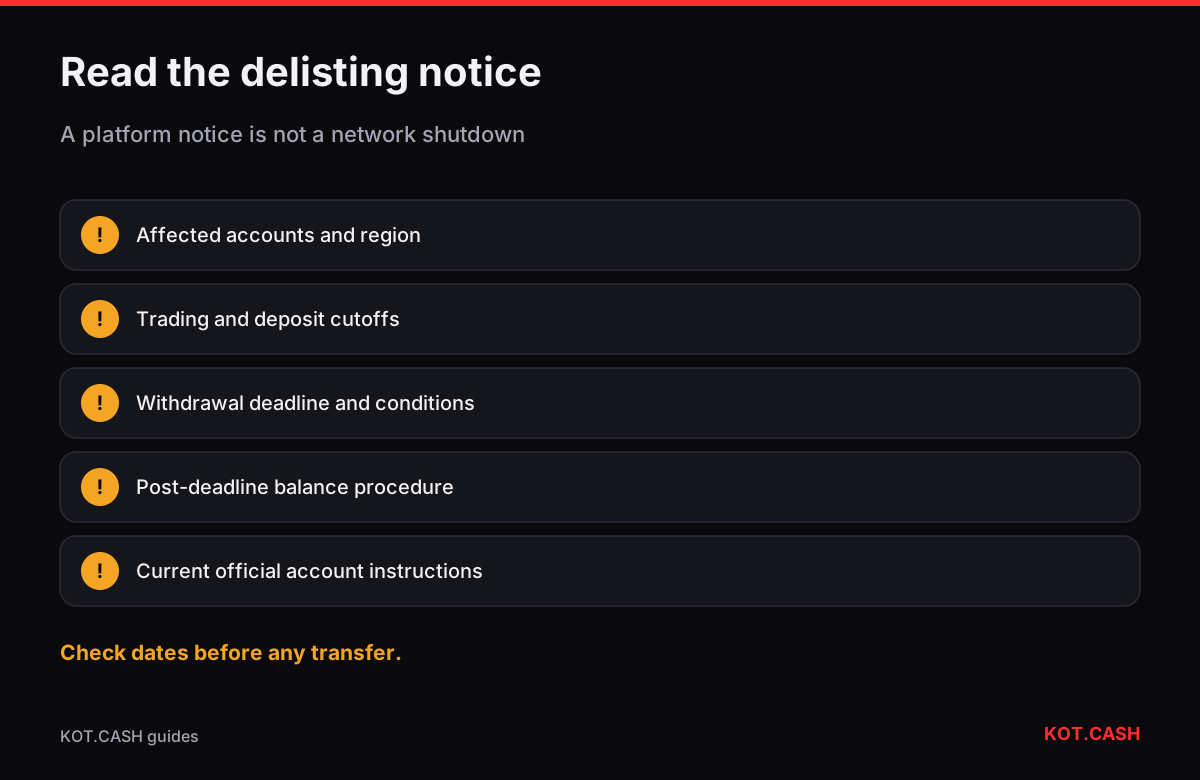
An exchange removing Monero does not, by itself, tell you whether your wallet has stopped working, whether you can withdraw, or whether a different service accepts you. Those are separate questions. Start with the notice published by the service that holds your balance. Identify the affected customers, the operations being stopped and the deadlines. Then inspect your own account. A search-result headline saying “XMR delisted” is not a withdrawal instruction and is not evidence about every jurisdiction. This guide explains how to read such a notice without confusing a platform decision with a change to the Monero network.
Why a platform might remove an asset
Use the explanation supplied by the platform, rather than inventing a cause from the coin’s reputation. A notice may discuss regulatory requirements, an operational review or a commercial decision. These categories lead to different follow-up questions: which customers are affected, which products are changing, and what arrangements apply to existing balances? If the announcement gives no explanation, record the reason as undisclosed. Privacy technology can be relevant background, but it does not establish what a particular company was instructed to do. Nor does a delisting announcement alone settle the legal position of an individual reader.
A dated example, not a current availability list
Kraken’s European XMR notice, updated on 31 March 2025, attributed its EEA delisting to regulatory changes. For EEA-registered clients, trading and deposits stopped on 31 October 2024; the withdrawal deadline was 31 December 2024. The notice also describes conversion of remaining XMR balances to BTC. This is a historical, geographically scoped example. Those dates have passed. Do not treat them as a new withdrawal window, infer that the same procedure applies to another exchange, or use the notice as proof of present availability outside its stated scope.
Read the operational verbs separately
| Notice wording | Question to resolve | Evidence to keep |
|---|---|---|
| Trading stopped | Can existing orders execute or are they cancelled? | Order history and official notice |
| Deposits stopped | Has the service disabled crediting new transfers? | Deposit-page warning and cutoff |
| Withdrawals available | What deadline, fee and account checks apply? | Withdrawal instructions at that time |
| Balance conversion | Which asset and procedure does the notice specify? | Conversion record and account statement |
| Regional restriction | Does the notice cover this registered account? | Applicable account region and notice scope |
Do not substitute one verb for another. A missing trading pair does not prove withdrawals are open, while a visible deposit address does not prove the service will credit a new payment. Check the relevant authenticated account page and current official notice together. If the two disagree, stop before sending funds and ask the platform through its official support channel. Preserve the answer and the time you checked it. A screenshot is useful evidence of what you saw, but it cannot extend a deadline or override the provider’s terms.
Build a record before changing anything
- Open the notice through the service’s official website. Check its publication or update date, affected product and geographic scope. Avoid relying on a forwarded image alone.
- Export the available account statement and relevant order or withdrawal history. Record the balance and any pending operation without publishing account identifiers.
- Check whether there is an active withdrawal instruction, a completed conversion or a pending support case. A zero XMR balance may require inspecting conversion history rather than attempting a fresh deposit.
- If clarification is necessary, ask a narrow question: which procedure applies to this account and this existing balance? Never include recovery words, a private key or a password in the request.
A receiving wallet is only one part of withdrawal preparation
For a withdrawal that the provider still permits, establish that the destination supports native XMR and that you control the intended account. Follow that wallet’s official receiving and recovery instructions. The Monero FAQ distinguishes wallet issues and synchronisation questions from loss of funds; a display problem needs diagnosis rather than an assumption that another transfer will repair it. Before confirming anything, compare the destination, amount, fee and any provider-specific requirements. Do not turn a general recommendation to make a test transfer into a promise: minimums, fees and deadlines can make repeated withdrawals impractical.
Privacy does not cancel service requirements
The Monero project describes privacy protections in its official FAQ, including limits rather than an unconditional anonymity guarantee. That technical design does not mean a custodial provider has no customer records or no account rules. Do not read a privacy label as permission to bypass geographic eligibility, identity checks or a service restriction. If a route is not available to you, seek clarification or use a lawful eligible option. A different interface, an old address or a third-party intermediary does not establish that the underlying service will accept the operation.
Compare eligible alternatives without chasing a logo
If you need another service, compare the operation you actually require: receiving XMR, withdrawing it, exchanging it, or keeping it under your own signing control. Check eligibility, current route availability, fees, minimums, receiving-network support and the published dispute process. Record the check time because a route can change after an article is written. For KOT.CASH, consult the current supported assets, terms and AML policy, then inspect the selected route before a deposit. This article does not assert that any XMR route is currently available or suitable for every reader.
After the deadline: investigate, do not improvise
When a deadline has already passed, inspect the announced post-deadline procedure and your account records. The correct next step may be locating a conversion statement or asking about an existing balance, rather than attempting a withdrawal that is no longer offered. Use the original case reference in follow-up messages. Treat unsolicited offers to “unlock delisted coins” as unverified: a stranger cannot establish authority merely by quoting the announcement. Keep recovery secrets private and do not pay an unknown contact for a supposed deadline extension. Separate what the provider has confirmed from what remains unresolved in your own notes.
FAQ
Does a delisting stop the Monero network?
The notice describes a service decision. Establish the affected operation and account scope rather than inferring a network change.
Can I still withdraw?
Check your provider’s current account-specific instructions and deadline. A historical article does not establish present withdrawal access.
What if the deadline passed?
Inspect the official post-deadline procedure and account history, then contact official support about the existing balance.
Does another service have to accept me?
No. Verify eligibility, asset and network support, route requirements and current availability before depositing.