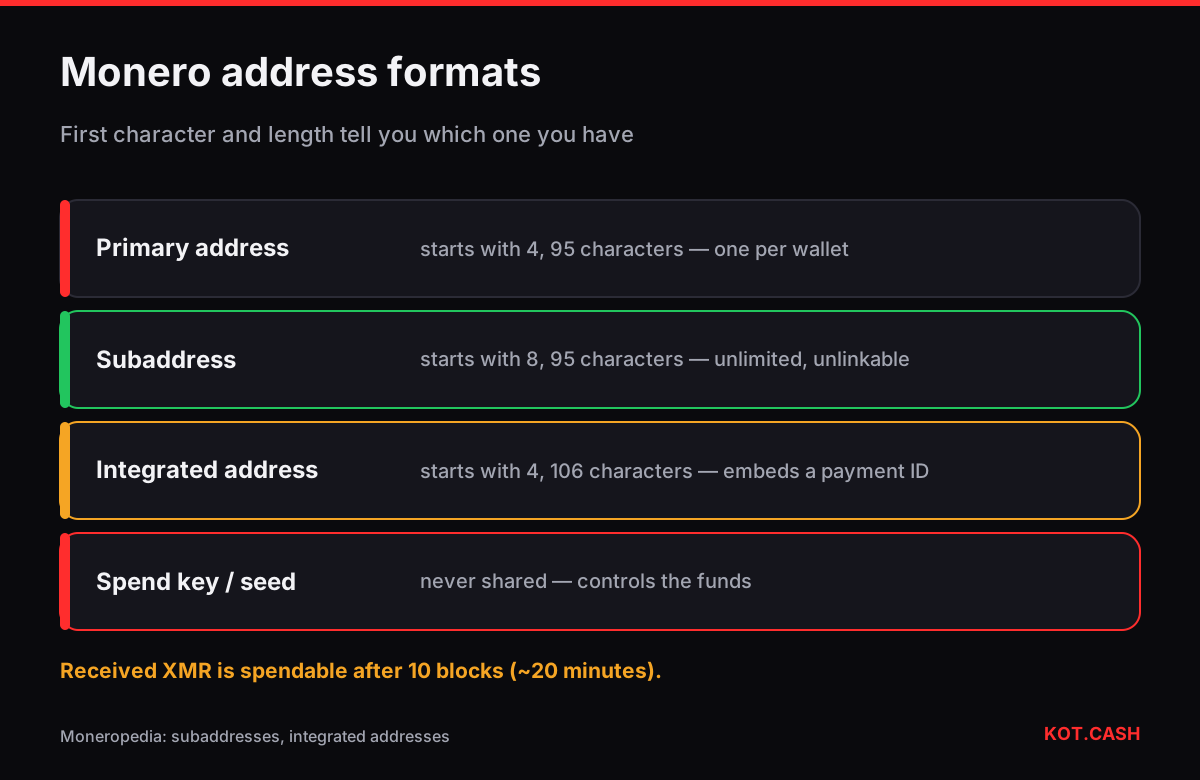
A Monero wallet has one primary address starting with 4 and can generate any number of subaddresses starting with 8; both are 95 characters long. Cake Wallet and Feather show a subaddress on their Receive screens and create a new one on request. All subaddresses belong to the same wallet and seed, and the wallet finds payments to any of them with its view key. A third format, the integrated address, also starts with 4 but is 106 characters long because it embeds a payment ID.
Why subaddresses exist
On a transparent blockchain, anyone who knows one of your addresses can follow it. Monero hides amounts and recipients on-chain by design, but if you give the same address to many people, they all know it is the same recipient. Subaddresses solve that at the address level: each payer gets a different string, and nobody outside the wallet can tell that two subaddresses belong to the same owner. They also replace the older practice of payment IDs: a merchant can give each customer a subaddress and see which one was paid.
Subaddresses are organised into accounts (a major index) and addresses within an account (a minor index). Cake Wallet and Feather show them as a list you can label — useful to keep track of what each was for.
Receiving in Cake Wallet
- Open the Monero wallet and tap Receive.
- Cake Wallet shows the current subaddress with a QR code. Tap the address area to see the list and add a new subaddress or a label.
- Copy the address or show the QR. Optionally set an amount; the QR then encodes a
monero:URI. - Incoming payments appear after the wallet has scanned the block. Received funds become spendable after 10 confirmations, about 20 minutes with 2-minute blocks.
Receiving in Feather
- Open the Receive tab. Feather lists subaddresses with their labels and whether each has been used.
- Select an unused subaddress or press Create new address, and add a label.
- Right-click to copy the address or show the QR code.
- Feather can also show the primary address; prefer a fresh subaddress for each payer.
Seeds and restore height
Monero uses its own seed formats, not BIP39. The classic format is 25 words. Feather and newer Cake Wallet versions also use Polyseed, a 16-word format that stores the wallet creation date, so a restore knows where to start scanning. With a 25-word seed, note the restore height (the block height when the wallet was created) next to the backup; without it, a restore scans from the beginning of the chain, which is slow. Restoring the same seed in another Monero wallet gives the same primary address and subaddresses.
Compatibility with services
Most current services accept subaddresses, but some older systems accept only the primary address or integrated addresses. If a withdrawal form rejects an address starting with 8, check the service's documentation rather than assuming the address is wrong. When a service gives you an integrated address (106 characters), send to it exactly — the embedded payment ID is how it identifies your deposit, and modern wallets will not let you add a separate payment ID. The address validator checks the length and checksum of Monero addresses.
XMR on KOT.CASH
XMR pairs on KOT.CASH are routed through a separate liquidity provider and use the floating rate only; the widget shows the minimum and the network fee for the pair. For an XMR payout paste a subaddress or the primary address from your wallet. The order page shows the payout transaction ID; Monero explorers show only that a transaction exists, not its amount or recipient, so the confirmation that counts is your own wallet showing the incoming payment.
Common mistakes
- Retyping a 95-character address by hand — copy and paste, then compare the first and last six characters.
- Trying to spend a payment that just arrived — it stays locked for 10 blocks.
- Restoring without the restore height and thinking the balance is gone — the wallet is still scanning.
- Confusing a Monero integrated address with a primary address because both start with 4 — the length tells them apart.
FAQ
Why does my Monero address start with 8?
It is a subaddress. Subaddresses start with 8, the primary address with 4. Both belong to the same wallet.
Do I need a new subaddress for every payment?
It is good practice for each payer, so they cannot link their payments to others. Reusing one is technically fine.
Can someone see my balance from my address?
No. Monero addresses do not reveal balances on-chain. Only the view key reveals incoming payments.
Why can't I spend XMR I just received?
Received outputs are locked for 10 confirmations, about 20 minutes.
Is a Monero seed compatible with BIP39 wallets?
No. Monero uses 25-word seeds or 16-word Polyseed, restored in Monero wallets.