A Monero wallet shows enough XMR, yet sending reports insufficient available funds. The total balance alone does not explain what can be spent now, how much the fee requires or which whole outputs will be used as transaction inputs. Separate those three questions before repeating the attempt.
Check the selected account and its unlocked funds
The official Moneropedia distinguishes locked and unlocked funds. An incoming transfer's unlock conditions and waiting for change after your own transfer can temporarily restrict availability. This does not necessarily mean funds disappeared or a previous recipient withheld anything.
Monero's sending guide separately requires a synchronized wallet and node and an available balance in the selected account. First check whether the displayed information is current and the intended account is selected. This article does not establish a waiting period for your operation: check its status in the wallet you use.
| Amount | Meaning | What it does not establish |
|---|---|---|
| Total balance | The overall recorded amount | That all of it is available for another send |
| Unlocked funds | Funds the wallet considers spendable now | That the full amount can reach a recipient without a fee |
| Selected output total | The whole input amounts in a hypothetical transaction | That the recipient must receive the entire total |
| Change | The remainder after the send and fee | That it can immediately be spent again |
Why the sending amount differs from a selected input
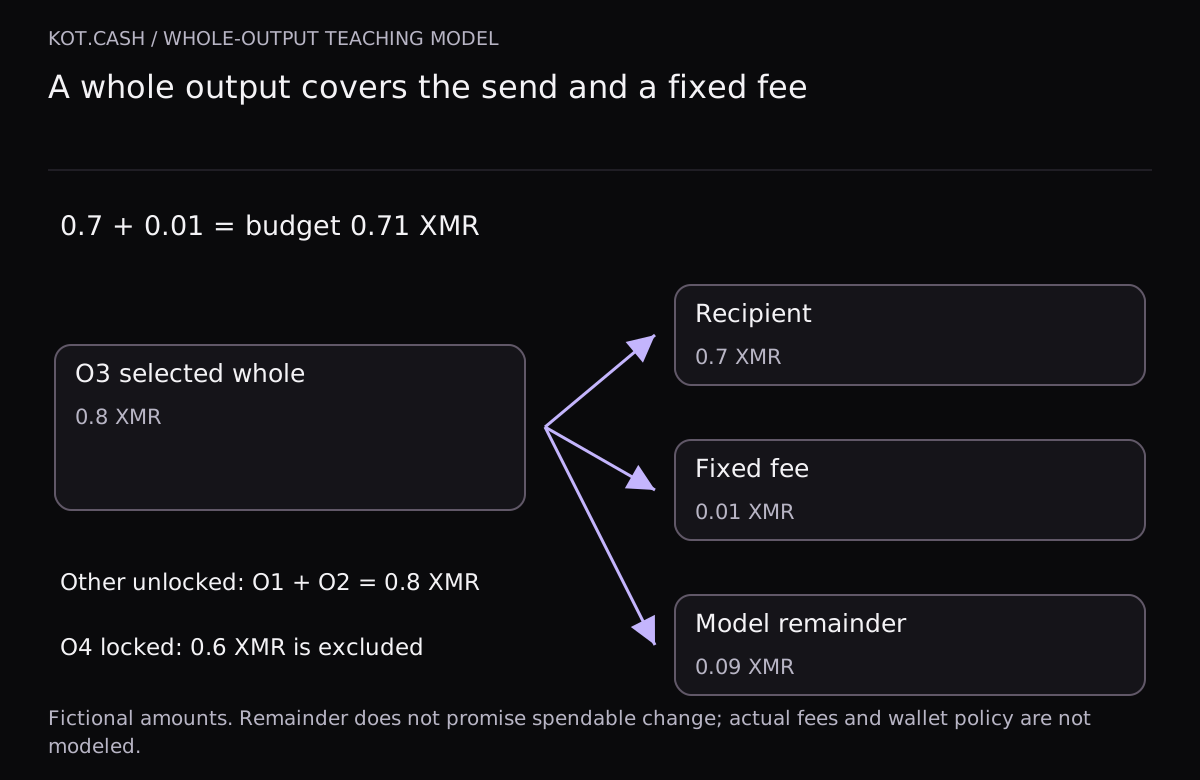
The demonstration contains unlocked outputs O1 with 0.3 XMR, O2 with 0.5 and O3 with 0.8. Another 0.6 XMR in O4 is marked locked. All listed outputs total 2.2 XMR, but those marked available total only 1.6. These are fictional entries, not information about anyone's wallet.
Sending 0.7 XMR with a hypothetical fixed fee of 0.01 requires covering 0.71. Output O3 with 0.8 covers the entire budget. The difference is 0.09 XMR. O1 and O2 provide the same input total, but use two inputs rather than one.
When the excess is equal, this tool prefers fewer outputs, then identifier order. That is an explicitly chosen teaching rule. It neither reproduces a real wallet's policy nor optimizes privacy, and it does not recommend consolidating or spending particular funds.
A fixed fee is a significant simplification
The official Monero guide relates network fees, among other factors, to transaction size and the number of spent outputs. Changing the inputs while assuming the real fee stays constant is therefore unsuitable without checking the wallet. Here the fee is fixed only to study the selection arithmetic.
For a real send, use your wallet's final details and the current terms of the particular swap. Neither the example fee of 0.01 XMR nor the selection result estimates the current network fee or constitutes a KOT.CASH offer. The tool signs and sends nothing.
Change differs from other available outputs
After the hypothetical selection of O3, O1 and O2 remain in the list with a total of 0.8 XMR. Separately, the arithmetic difference between the selected input and budget is 0.09. Their sum must not simply be called an immediately spendable balance after sending: actual change can be locked temporarily.
Nor does the number of previous deposits establish the exact input count of the next transaction. Outputs are spent whole and the available set changes. You enter an already prepared list here; the tool neither reads the blockchain nor reconstructs wallet history.
What happens when the available total is insufficient
Change the sending amount to 1.7 XMR with the same hypothetical fee. The required amount becomes 1.71, while only 1.6 is marked unlocked. The shortfall is 0.11 XMR even though the overall listed total of 2.2 exceeds the budget. Locked O4 is not used to make the difference disappear.
An unknown status also excludes an output from selection. This indicates missing input information, not lost funds. The tool cannot unlock anything or establish which entries are actually spendable on the network. An incorrect user-supplied status produces an incorrect model.
Explore the example without sharing wallet data
- Enter fictional identifiers, positive amounts and unlocked, locked or unknown statuses.
- Enter the recipient amount and a fixed hypothetical fee separately.
- Compare the overall listed total with the amount marked available.
- Inspect the whole subset, arithmetic remainder and other available outputs.
- Return to current wallet and order details for an actual operation.
Selection is limited to eighteen outputs marked unlocked. It searches their whole subsets for the smallest excess above the budget instead of taking an arbitrary fraction from each entry. Amounts are processed to twelve decimal places without binary floating point rounding.
If the balance and sending status are unclear, a useful support question is which amount is available in the selected account and what final fee the wallet shows. That is more specific than treating the total balance as a promise that the entire amount can immediately be sent.
Whole subset for a hypothetical budget
Up to 18 outputs marked unlocked. Positive amounts, up to 12 decimal places; the fee may be zero. Selection minimizes arithmetic excess, then input count and IDs. Not wallet policy, a privacy assessment, a fee estimate or an unlock check. The calculation runs on your device; nothing you enter is sent anywhere.